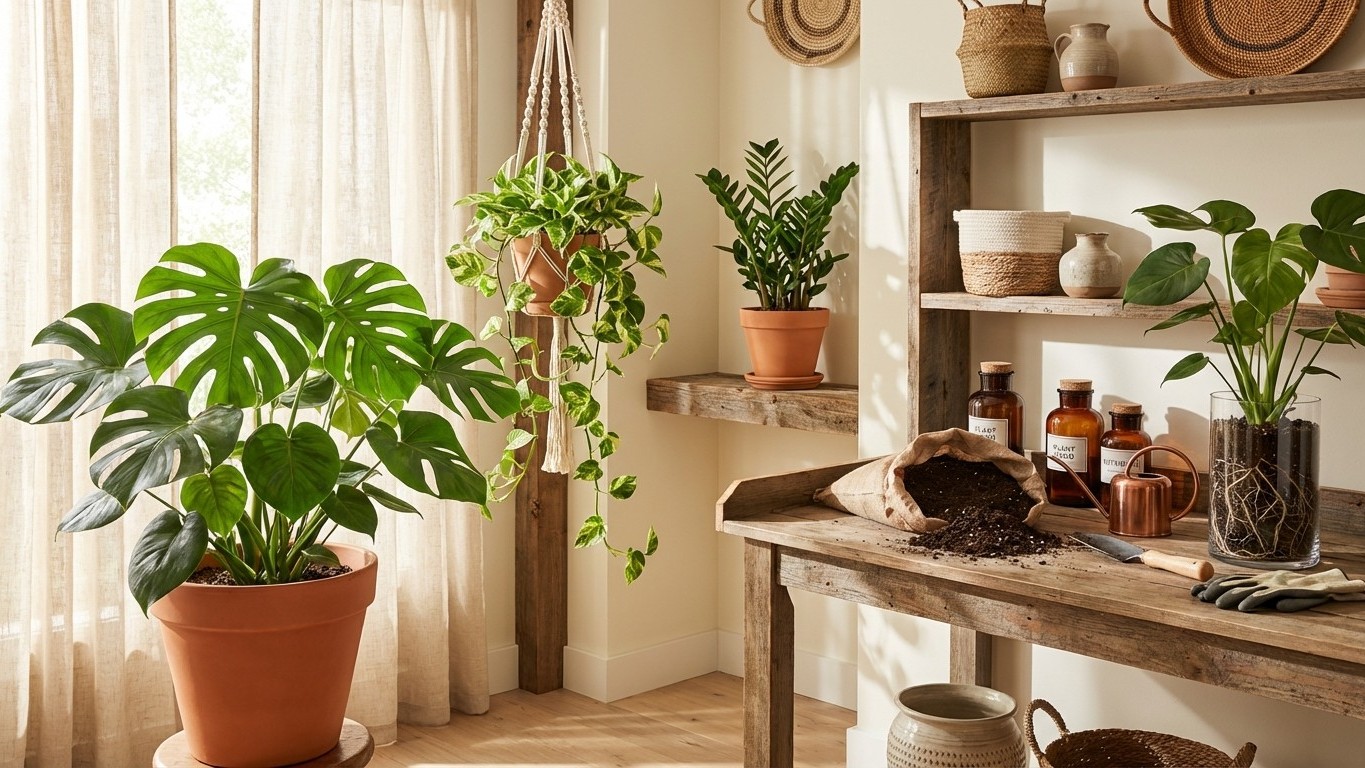
Your monstera hasn’t pushed out a new leaf in two months. Your pothos looks fine but hasn’t grown an inch. You’ve watered on schedule, you’ve done everything “right”, and yet, nothing. Sound familiar? The frustrating reality is that slow growth is rarely caused by a single missing element. It’s almost always a combination of three interacting factors: light, nutrition, and root space. Get all three working together, and your plants respond. Ignore even one of them, and the others can’t compensate.
This guide breaks down each factor precisely, not to give you a generic checklist, but to help you identify which lever is actually limiting your specific plants, and what to do about it today.
Why Some Indoor Plants Grow Slowly
Physiological Factors Built Into the Plant
First, a reality check worth absorbing:
not all slow growth is a sign of poor care. Many species, succulents, ZZ plants, and certain palms, naturally have slower growth cycles.
A ZZ plant that gains three inches over six months is doing exactly what a ZZ plant does. Expecting it to grow like a pothos is a losing battle. Before adjusting anything, confirm that your plant’s actual growth rate matches its biological baseline. That said, even naturally slow growers can be severely hampered by environmental conditions, and that’s where things get interesting.
The core process driving all growth is photosynthesis.
Plants require light to convert carbon dioxide and water into carbohydrates (energy), with oxygen released as a byproduct. Plants need this energy to grow, bloom, and produce seed — and without adequate light, carbohydrates cannot be manufactured, the energy reserves are depleted, and plants die.
This isn’t abstract biology; it’s the direct reason a plant placed six feet from a north-facing window struggles to grow even a single new leaf in spring.
Environmental Factors Inside Your Home
Plant growth is affected by light, temperature, humidity, water, nutrition, and soil.
The problem is that most homes fail on several of these simultaneously.
In greenhouses, plants are accustomed to high light, nutrition, water supply, temperatures, and relative humidity — conditions ideal for fast growth. Residential homes, with low-light interiors and low relative humidity, will most likely produce a stressful experience for plants.
the moment a plant leaves the nursery and enters your living room, it’s already downshifting.
Many houseplants don’t get the right amount of light, and homeowners often underestimate the light levels in their home, placing houseplants far from light sources where conditions are less than optimal.
Add compacted soil, a root-bound container, and a fertilizer applied at the wrong time, and you have a plant that’s essentially surviving, not growing. The goal of everything that follows is to close that gap.
Optimizing Light to Stimulate Growth
Understanding Light Requirements by Species
Of all the factors affecting plant growth indoors, adequate light is by far the most important. Light is needed for plants to produce food and survive — generally, the more light available, the more food produced for growth.
But “more light” doesn’t mean the same thing for every species.
Each variety has its own preferences. Some plants, like strelitzia reginae, cacti, and succulents, prefer a bright spot; others, like aglaonema or goeppertia picturata, prefer part shade.
Spotting a light-starved plant isn’t difficult once you know what to look for.
When plants lack light, they don’t produce chlorophyll and can turn pale green to yellow. A lack of sufficient light causes the plant to grow long spaces on stems between the leaf nodes — and plants without sufficient light may also drop their leaves, especially older leaves.
That leggy, sparse look isn’t an aesthetic choice by the plant; it’s desperation.
Making the Most of Natural Light
Window orientation matters more than most people realize.
Our homes tend to have one or two windows in each room, often facing in just one direction. When plants grow outdoors, they get light from multiple directions at a much higher intensity than what makes it indoors.
The practical consequence?
Even spots that might seem to fulfill the “bright indirect light” goal most houseplants want are still likely to be darker than what they really need.
A few simple adjustments can dramatically improve natural light delivery. Rotating your plants a quarter turn each week ensures all sides receive even exposure. Placing a large mirror on the wall opposite a window can effectively bounce light deeper into the room. Cleaning dusty leaves helps too, dust dulls normal leaf coloration and shades plant surfaces, reflecting light that could be used in photosynthesis; dust on lower leaf surfaces may also clog stomata, inhibiting gas exchange within the leaf.
When and How to Use Grow Lights
Grow lights aren’t just for dedicated plant rooms or elaborate setups. They’re the most reliable way to override the limitations of your home’s architecture.
In many growers’ experience, artificial lights are the best way to make indoor plants grow faster. Full-spectrum LED exposure for 8 to 10 hours a day will have plants growing bigger, stronger, and healthier.
The spectrum matters.
Blue light or mixed light bulbs are suitable for starting seeds, leafy greens, and non-flowering houseplants. Red light or mixed light bulbs are suitable for promoting bud formation in flowering plants. White or balanced light bulbs are suitable for most plants at any stage of growth.
For a practical household solution,
LED grow lights offer the energy efficiency and long lifespan of an LED bulb while providing full-spectrum light. They can be more expensive initially, but over time they offer cost savings because they consume so little power and can last five to ten years.
They’re most valuable during winter, on low-light shelves, and for tropical species that crave intensity, see our guide on how to care for houseplants in winter (less light) for a deeper dive into cold-season light management.
Improving Nutrition: Soil and Fertilizer
Why Your Potting Mix Is the Foundation
Soil isn’t just a medium that holds a plant upright.
Soil is more than just a medium — it’s the foundation for root health and nutrient delivery.
And over time, even a good mix degrades.
The soil in containers often degrades quicker than the plant actually outgrows the pot. Inadequate soil lacks nutrients, no longer holds enough moisture to satisfy the roots, and often becomes compacted, limiting airflow. Refreshing this soil brings the roots back to good health, boosting growth.
The composition of your mix depends on the species.
Most houseplants thrive in soil with a balance of organic matter for nutrition and drainage materials like perlite or sand. Succulents and cacti need sandy, fast-draining soil. Tropical plants prefer rich, moisture-retentive soil. Orchids do best in bark-based mixes that allow airflow around roots.
Using the wrong mix, say, dense garden soil in a pot, is a problem because garden soil is too heavy for houseplants
and will compact over time, strangling roots.
The growing medium provides anchorage, water, and minerals; when repotting, make sure the new mix is well drained and aerated, holds water and nutrients well, and is within the right pH range (5.0–6.5).
Choosing a Fertilizer and Getting the Frequency Right
The single biggest fertilizer mistake most plant owners make isn’t applying too little — it’s applying at the wrong time.
Indoor plants are typically fertilized during their active growing season, which is spring and summer, when longer days and stronger light support new growth. During fall and winter, most houseplants slow down due to reduced light and shorter days, so fertilizing is usually reduced or paused altogether.
As a general rule, fertilize indoor plants during the growing season once a month, using fertilizer at half strength. Indoor houseplants should be fertilized when they are actively growing during spring and summer.
For tropical species like monsteras, pothos, or philodendrons,
fertilizing once every 2 to 4 weeks during the active growth season is appropriate, as most indoor plants grow actively during warmer months and require additional nutrients.
Succulents and cacti need fertilizing sparingly, about once every 2 to 3 months during the growing season.
Start spring feeding cautiously.
As days begin to lengthen noticeably and houseplants shift from a semi-dormant state into a period of active growth, the first three fertilizer applications should be made at half the recommended strength.
Liquid fertilizers offer the most control for this ramp-up period. Explore the full spectrum of care variations per species in our comprehensive indoor plants care varieties houseplants guide.
Avoiding Overdosing and Underdosing
Over-fertilizing is a real risk that most enthusiastic plant owners underestimate.
Many fertilizers are full of soluble salts, which can build up in the soil over time. Applying fertilizer too often or too heavily can harm plants, when there is too much salt in the soil, plants have a difficult time taking up the water they need, and excessive salts can burn sensitive root tips and leaf margins, leaving a sad, stunted plant.
Underdosing has its own symptoms.
Signs of nutrient deficiency include slow or stunted growth during the growing season, yellowing leaves (excluding natural leaf shedding), and pale or weak foliage.
The key diagnostic question: is the slow growth happening in spring and summer (when light is sufficient) or in winter? If it’s the latter,
fertilizer doesn’t fix stress — it fuels growth. When plants aren’t getting enough light, they can’t use extra nutrients properly.
One final note:
if you have just repotted your plant with good quality soil, you can refrain from applying fertilizer during the first one or two months.
Repotting: Unlocking Growth Through Root Space
Signs Your Plant Needs a New Home
Plants are patient. They’ll squeeze themselves into increasingly cramped containers without obvious complaint — until they can’t.
Confinement can often improve growth, encouraging the plant to push out new leaves and even flowers. But once the roots have nowhere else to grow and begin to wrap around each other, houseplant growth becomes stunted.
The tipping point arrives faster than you’d expect.
Watch for these concrete signals that it’s time to act:
- Roots growing out of the drainage holes in the bottom.
- Roots pushing the plant upward, out of the container, so it appears to be popping out of the pot.
- Growth slower than normal (or stopped completely in spring and summer), the plant frequently falling over due to being top-heavy, or the plant chronically thirsty even when watered regularly.
Repotting has a double effect: you give the plant more room and renew its substrate — two elements that will make it grow faster.
That’s why repotting isn’t just about accommodating size; it’s an active growth strategy.
How to Repot Without Stressing the Plant
Timing is the first decision.
According to Pennsylvania State University Extension, spring is the best time to repot a plant. Most houseplants prefer a spring refresh as they wake up from winter dormancy and kickstart growth — their roots recover faster in warmer temperatures and longer daylight hours.
Avoid repotting during the dormant period, which is generally from October to January for most species. During this time, the plant is resting and repotting could cause unnecessary stress.
For pot sizing, resist the temptation to go big.
You don’t want to overdo it — putting a plant into an overly large pot makes it hard to get the right amount of water to the plant. The best method is to increase the pot size by 1 to 2 inches in diameter more than the current pot, and ensure the new pot has drainage holes so the soil doesn’t stay overly moist.
A pot that is too big is also problematic, it may retain too much moisture, and plants cannot absorb all of it. Soil may not dry out properly, easily leading to root rot.
Before repotting,
water your houseplant the day before. This keeps the roots hydrated and flexible, reducing the chances of damage and disturbance during the transplant.
After the move,
do not fertilize for the first two weeks — roots are healing, not absorbing nutrients efficiently.
Expect a brief adjustment period;
wilting for 2 to 5 days post-repot is normal transplant shock, keep soil lightly moist, not soggy, and provide moderate light and warmth. Most plants recover fully.
Complementary Practices to Accelerate Growth
Humidity, Temperature, and Air Circulation
Tropical houseplants, calatheas, ferns, monsteras, are accustomed to humidity levels that most American homes simply don’t provide, especially in winter when heating systems dry the air aggressively.
Some plants grow faster with steadier humidity, including calatheas, ferns, and some tropicals.
A pebble tray filled with water placed under the pot, or grouping plants together to create a shared microclimate, costs nothing and makes a measurable difference. Just avoid misting directly onto leaves during cold months, as water sitting on foliage in low-light, low-airflow conditions invites fungal issues.
Pruning, Leaf Cleaning, and Plant Stimulation
Pruning gets overlooked as a growth tool.
Pruning helps redirect energy into healthy branches, encouraging bushier growth and more flowers or fruits — trimming dead or weak stems every few weeks produces the best results.
The logic is simple: a plant channeling resources into a dying branch has less energy for new growth. Cut the dead weight, and that energy gets redirected.
Leaf cleanliness isn’t cosmetic either.
Dusty leaves block light absorption, slowing photosynthesis — wiping leaves gently with a damp cloth every few weeks makes a practical difference.
For plants with glossy leaves like ficus, peace lily, or croton, this habit alone can noticeably improve growth rates over a season.
The Seasonal Calendar and Its Impact on Growth
Growth isn’t a steady line; it follows a rhythm tied to day length and temperature.
During the summer when light levels increase and the plant is actively growing, its need for fertilizer increases.
Conversely,
in late summer to early fall, gradually taper off the frequency and strength of fertilizing as plant growth slows down, and cease fertilizing during late fall and winter months when plants are semi-dormant.
Align every action, repotting, fertilizing, pruning, even moving to a brighter window — with this growth calendar. Spring is the accelerator pedal. Winter is the time to consolidate. Trying to force growth in December with extra fertilizer isn’t ambition; it’s working against your plant’s biology. For a full seasonal framework that covers the cold months, dormancy management, and pruning schedules, the resource on winter care for indoor plants provides a comprehensive roadmap. And if you plan to travel during peak growth season, check our guide on how to keep houseplants alive while on vacation so momentum doesn’t get lost while you’re away.
FAQ: Accelerating Growth : 7 Quick Answers
How do I stimulate rapid growth in indoor plants? Start with light, it’s the single highest-leverage change. Move plants closer to windows, rotate them regularly, and add a grow light for darker corners. Then match fertilizer timing to the active growing season and check whether roots are cramped.
What type of artificial light works best for indoor plants?
LED grow lights offer the energy efficiency and long lifespan of an LED bulb while providing full-spectrum light like a typical fluorescent light.
Full-spectrum white LED lights that balance blue and red wavelengths are the most versatile option for foliage houseplants.
Can repotting really speed up growth? Yes — but only when the plant is genuinely root-bound.
Repotting can speed growth, but only if roots are packed and the plant is drying too quickly, or growth has stalled despite good light.
How often should I fertilize to maximize growth?
Indoor plants need fertilizer every 2 to 4 weeks in the growing season (early spring to late summer).
Start at half strength in early spring and build frequency through summer.
What are the signs of a nutrient deficiency slowing growth?
Signs include slow or stunted growth during the growing season, yellowing leaves (excluding natural shedding), pale or weak foliage, and lack of flowering in flowering plants.
Should I fertilize after repotting?
Hold off on fertilizing newly repotted plants until they show signs of active growth — excess nutrients can cause unwanted stress.
Wait at least two weeks, ideally until you see a new leaf emerging.
Does the potting mix type really matter that much? Profoundly. A dense, compacted mix suffocates roots, limits water absorption, and prevents oxygen from reaching the root zone.
Houseplants need light and well-draining soil with plenty of space between particles to promote airflow and prevent waterlogging.
A Step-by-Step Action Plan for Vigorous Indoor Plants
Pull all of this together into a practical sequence and the approach becomes clear. Start by auditing your light situation, identify the actual brightness level at each plant’s location (a free light meter app on your phone gives a reasonable estimate). If any plant is getting below what its species requires, move it or add supplemental lighting. That one change, applied this week, will do more for growth than months of fertilizing in the wrong conditions.
Next, check your soil. If it’s been more than a year since you repotted or refreshed the mix, the substrate is likely depleted and compacted. Spring is the perfect window for both repotting and soil refresh —
spring is the most suitable time to repot houseplants, when the growing period starts and photosynthesis is at its peak, allowing the plant to recover from transplanting the fastest.
Go up just one pot size, use a fresh, species-appropriate mix, and resist the urge to fertilize for the first two weeks.
Then, build a seasonal fertilizer schedule: half-strength liquid fertilizer in March, increasing to full-strength every 2 to 4 weeks through summer, tapering off in September, and pausing through winter. Match that calendar to leaf cleaning, occasional pruning of dead growth, and humidity management, and you’ve built a system, not just a routine. For a complete reference on species-specific requirements within this framework, the indoor plants care varieties houseplants guide covers the full range of common houseplants.
The plants that grow fastest aren’t the ones that receive the most products or the most attention, they’re the ones whose owners understand where the actual bottleneck is. Identify the limiting factor first. Then remove it. Everything else follows.