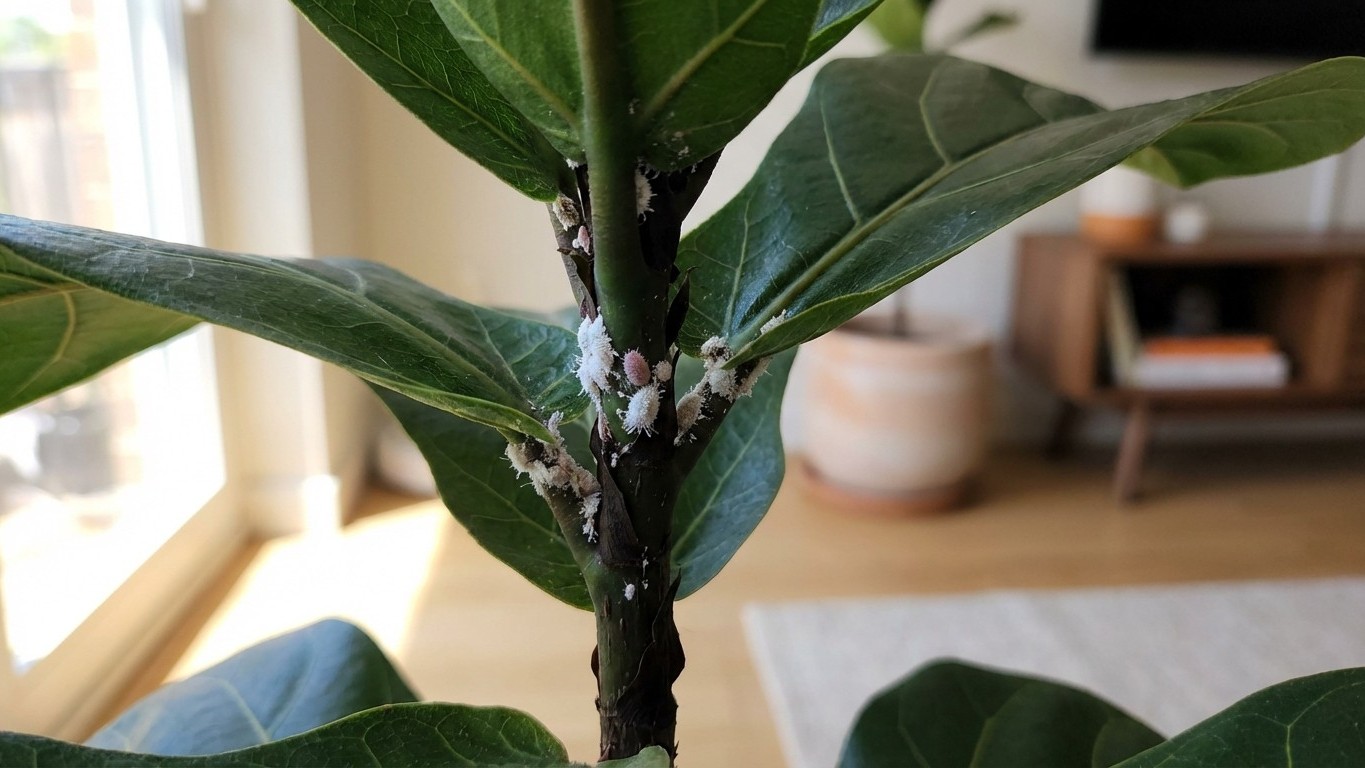
You glance at your favorite fiddle-leaf fig and notice something odd, tiny white tufts clinging to the stem joints, like someone pressed a cotton ball against the bark. That is not a quirk of the plant. That is a mealybug colony already at work, quietly draining your plant of the sap it needs to survive. The good news: if you catch them early and follow a clear, step-by-step approach, knowing how to get rid of mealybugs on houseplants is entirely within reach, no toxic sprays required, no risk to your kids or pets.
What Are Mealybugs? Identification on Indoor Plants
What Do Mealybugs Look Like?
Mealybugs are pink, soft-bodied insects covered with a white, waxy, cottony material. That white “fluff” helps protect them from excessive heat and moisture loss.
Outdoors, natural predators keep them in check. Indoors, they have no such opposition, which is exactly why your living room makes such an ideal breeding ground for them.
They typically range from about 1/16 to 1/4 inch depending on species and age. Their color runs from white to pale gray, with some showing a slight pinkish or yellowish tint. The texture is dusty and waxy, and the body is oval, segmented, and soft — adults often look “plumper” than the young.
When females bunch together on a stem, the effect is almost like clumps of popcorn, unsettling once you know what you are looking at.
A common identification pitfall:
because of their appearance, mealybugs may be confused for cottony cushion scale or woolly aphids.
The difference?
Cottony cushion scale females have a red-brown body color and a plume of white fluff extending from their bodies, while aphids, including woolly aphids, tend to be more active, sometimes have wings, and are less concerned with finding a crevice to hide in.
Scale insects, by contrast, stay anchored in one spot and appear brownish. Mealybugs move (slowly), and their white coating is the tell.
Life Cycle and How They Spread Indoors
Female citrus mealybugs lay up to 600 small, yellow eggs within a protective mass of white, cottony threads.
Those eggs hatch into nymphs called “crawlers” — the most mobile and dangerous stage.
Newly hatched nymph stages are mobile and spread fast. They are tiny, barely visible, and often mistaken for dust.
By the time you spot them, dozens may already be traveling to adjacent pots.
Indoors, the full life cycle takes about six weeks, and it never stops because mealybugs don’t face freezing temperatures.
That relentless cycle is what makes them so exhausting to fight.
A single treatment can kill adults while eggs and tiny crawlers survive, so the infestation “mysteriously” returns unless you treat on a repeat schedule.
Patience, not just products, is the real weapon here.
Signs and Symptoms of a Mealybug Infestation
How to Recognize Damage on Leaves and Stems
Cottony white wax is usually the first sign of their presence.
Beyond that visual clue, the damage compounds quickly.
Mealybugs damage plants by sucking sap, and their feeding can result in yellowing leaves, stunting, dieback, or death of the plant. They also secrete honeydew that supports the growth of black sooty mold on plant parts.
That dark, sticky film is not a disease in itself, but if it coats enough leaf surface, it blocks photosynthesis and the plant slowly suffocates.
Small populations of mealybugs are often hard to detect because they wedge themselves into crevices such as leaf axils or the bases of stems. However, as their numbers increase, mealybugs of all sizes can be found on all surfaces of plants.
Look under leaves, along stem joints, and even at the base of the pot, mealybugs can create nests on the outside of the pot and even under the pot. Look for any white cotton-like mass stuck to crevices between stems and hard surfaces: under the lip of the pot, under the pot near drainage holes, and even under saucers.
One symptom that trips up many plant owners:
yellowed or wilted foliage may indicate an underground mealybug infestation, particularly common in African violets.
If you notice your leaves turning yellow without any obvious pest on the foliage, it is worth checking why are my houseplant leaves turning yellow — and checking whether root mealybugs are the hidden culprit. Similarly, leaves that begin to curl or droop under stress may point to sap-sucking damage; the guide on indoor plant leaves curling causes can help you cross-reference your diagnosis.
Why Do Mealybugs Attack Your Houseplants?
Conditions That Invite Them In
The stable warmth of a home is basically a mealybug resort.
Plants growing indoors or in greenhouses are especially vulnerable because year-round mild temperatures favor mealybug populations, and indoor plants are usually not exposed to the natural enemies that often keep mealybugs under control outdoors.
Your windowsill collection has no ladybugs to save it.
Diet matters too — on both sides.
Mealybugs are attracted to plants with high nitrogen content and soft growth, as well as warm environments with plenty of water. If you are overfeeding or overwatering your plants, they may become a target.
A lush, nitrogen-pumped plant is essentially a buffet.
Avoid unnecessary applications of nitrogen fertilizer on plants with mealybugs; high rates of nitrogen coupled with regular irrigation may stimulate tender new plant growth as well as mealybug egg production.
The Plants Most Vulnerable to Mealybugs
Among houseplants, aglaonema, coleus, cactus, dracaena, ferns, ficus, hoya, jade, orchids, palms, philodendron, schefflera, poinsettia, and various herbs including rosemary and sage often have problems with aboveground mealybugs.
Notice that cacti and succulents are on that list — a common misconception is that drought-tolerant plants are pest-resistant. They are not.
The citrus mealybug especially likes soft-stemmed and succulent plants such as coleus, fuchsia, croton, jade, poinsettia, and cactus.
And where do they come from in the first place?
They are almost always introduced on infested plants that are brought into homes, making it critically important to scrutinize all purchased or gifted plants for pests before bringing them into your house.
That potted herb from the grocery store, that orchid from a friend, always quarantine new arrivals for at least two weeks before they join your collection.
How to Get Rid of Mealybugs on Houseplants
Manual Methods: Cotton Swabs, Brushing, and Isolation
First things first: isolate the affected plant immediately.
Mealybugs can easily crawl from one plant to another, especially when leaves or branches overlap, so one contaminated plant could spread mealybugs to all your houseplants.
Move it to a separate room if possible.
Dipping a cotton swab in household alcohol and dabbing it on individual mealybugs can control light infestations. Mealybugs treated with alcohol will turn light brown in color.
Satisfying? Absolutely. Complete? Not on its own.
Masking tape can actually pick up the adults and any nearby larvae with minimal damage to the plant, dabbing only kills the ones you are able to spot, whereas masking tape pulls off anything that is not part of the plant (works best for plants with a stiff, waxy coating rather than hairy or delicate leaves).
Do not forget the pot itself.
If you treated the whole plant but missed one of the nests on the outside of the pot, there would be hundreds of newly hatched mealybugs eagerly migrating back onto the plant.
Wipe down the rim, sides, bottom, and saucer with a cloth dampened with diluted rubbing alcohol.
Natural Treatments: Soap, Alcohol, Neem Oil : Recipes and Precautions
To get rid of mealybugs, isolate the plant, remove visible insects with 70% (or less) isopropyl alcohol, then spray insecticidal soap or neem thoroughly, including leaf undersides, every 7 to 10 days until no mealybugs appear for at least 3 to 4 weeks.
That timeline is non-negotiable. Stopping early is the number one reason mealybugs come back.
Neem oil deserves special mention.
Neem oil disrupts the growth and development of pest insects and has repellent and antifeedant properties. Best of all, it is non-toxic to honey bees and many other beneficial insects.
For indoor use, dilute cold-pressed neem oil with water and a few drops of dish soap as an emulsifier, then apply with a spray bottle, reaching every leaf axil and stem joint.
Soaps and oils can burn the foliage of some plants, so test them on a leaf or two before treating the entire plant.
For infested soil, especially if you suspect root mealybugs, change the soil after all visible bugs are gone and thoroughly clean the pot before repotting, as this is where mealybugs lay their eggs.
Roots can be rinsed under lukewarm water and inspected before going back into fresh, sterile potting mix.
Chemical Treatments: When to Use Them and What to Consider
For the vast majority of home infestations, natural methods are sufficient — and far safer for the air quality in a living space.
There are some systemic insecticides labeled for houseplants and mealybugs that contain the active ingredient imidacloprid, but these are only recommended for highly valuable plants that cannot easily be replaced.
Think twice before reaching for a systemic product in a room where children or pets spend time.
Chemical control is difficult because of the protective nature of the wax covering the insects.
A product that sounds powerful on the label may bead right off the mealybug’s waxy armor without making contact. That is why consistent physical removal combined with natural contact sprays outperforms a single chemical application every time.
How to Prevent Mealybugs from Coming Back
Daily Habits and Monitoring
Prevention is infinitely easier than treatment.
Quarantine new plants for 14 days before placing them near your collection. Inspect weekly, leaf axils, undersides, and the soil line. Clean leaves regularly, as honeydew and dust make pests easier to miss. Avoid over-fertilizing, since soft, lush growth attracts sap-feeders.
Make leaf inspection part of your regular watering routine.
Check the underside of leaves, in new leaf folds, and around the growing tips for signs of pests.
Two minutes per plant, once a week, that is all it takes to catch an infestation before it becomes an emergency. A magnifying glass is not overkill; it genuinely helps spot crawlers before they establish colonies.
Strengthening Plant Defenses Through Environment and Care
A stressed plant is an easy target.
Temperatures of about 25°C and high relative humidity are optimal for many mealybugs, so while you cannot control your thermostat to defeat pests, you can avoid creating warm, stagnant microclimates around your plants by ensuring good air circulation. Space pots so they are not touching.
Good overall plant health is the best long-term defense. A well-watered (not over-watered), appropriately fed plant with proper light produces firmer tissue that is harder for sap-suckers to penetrate. For a full overview of how to keep your collection thriving, the guide on indoor plants care varieties houseplants covers the fundamentals — the right conditions for each species go a long way toward pest prevention.
Also, thoroughly sanitize your gardening tools between uses, along with any plant pots you reuse.
A contaminated pot is a common source of reinfestation that most people overlook entirely.
Mealybugs and Other Common Houseplant Problems
When Mealybugs Share the Plant with Other Pests
Mealybugs rarely travel alone. The honeydew they secrete attracts ants, and the weakened state of the plant can invite opportunistic pests like spider mites or fungus gnats.
Ants feed on the honeydew that mealybugs produce and will even protect the bugs from predators to ensure this food supply, so if you spot ants near an indoor pot, look more closely for the insect colony underneath.
Sooty mold, that dark film on leaves, can be mistaken for a fungal disease when it is actually just a byproduct of mealybug or scale feeding. Before treating for mold or disease, always check for an underlying pest problem. The broader guide on houseplant problems walks through this diagnostic process in detail, helping you distinguish between the many things that can go wrong with a single plant.
When to Look Beyond Mealybugs
If you have treated for mealybugs but your plant is still declining, leaves still yellow, growth still stunted, the problem may be compounded. Root rot, overwatering, or a separate pest may be co-occurring.
Because mealybugs are so good at hiding in nooks and crannies, they often go unnoticed until their population has exploded, by which point, the plant may have accumulated more than one stressor. Cross-referencing with the resources on houseplant problems is a smart move when the recovery is slower than expected.
FAQ: Your Questions About Mealybugs on Houseplants
How do I get rid of mealybugs on indoor plants naturally?
Mealybugs can be removed by dabbing them with rubbing alcohol, washing plants with soapy water, or using neem oil regularly.
Combine all three approaches and repeat every 7–10 days for at least a month. Thoroughness and consistency beat any single product.
What are the first signs of mealybugs on houseplants?
The first and most obvious clue is a light, fluffy wax substance around the crevices of your plant. This substance is usually white, but can be stained black by sooty mold.
Sticky residue on leaves and slowed growth are secondary signals that show up as the infestation grows.
Will mealybugs spread to my other plants?
Mealybugs easily move to nearby plants, so infected plants should be isolated immediately.
Crawlers move across shelves and pot rims fast. Quarantine affected plants, clean nearby surfaces with diluted alcohol, and monitor weekly.
The sooner you isolate, the smaller the problem stays.
Dealing with mealybugs is, at heart, a patience game. The biology works against you, six-week life cycles, hidden larvae, eggs tucked into pot crevices — but so does the impulse to declare victory too early. Treat consistently for at least four weeks after you last see a bug, keep your new plants in quarantine, and give your existing collection the environmental conditions they actually need rather than the ones that inadvertently invite pests. A healthy, well-tended plant is genuinely less attractive to a mealybug than a stressed one. The question worth sitting with: are your plants currently thriving, or just surviving?