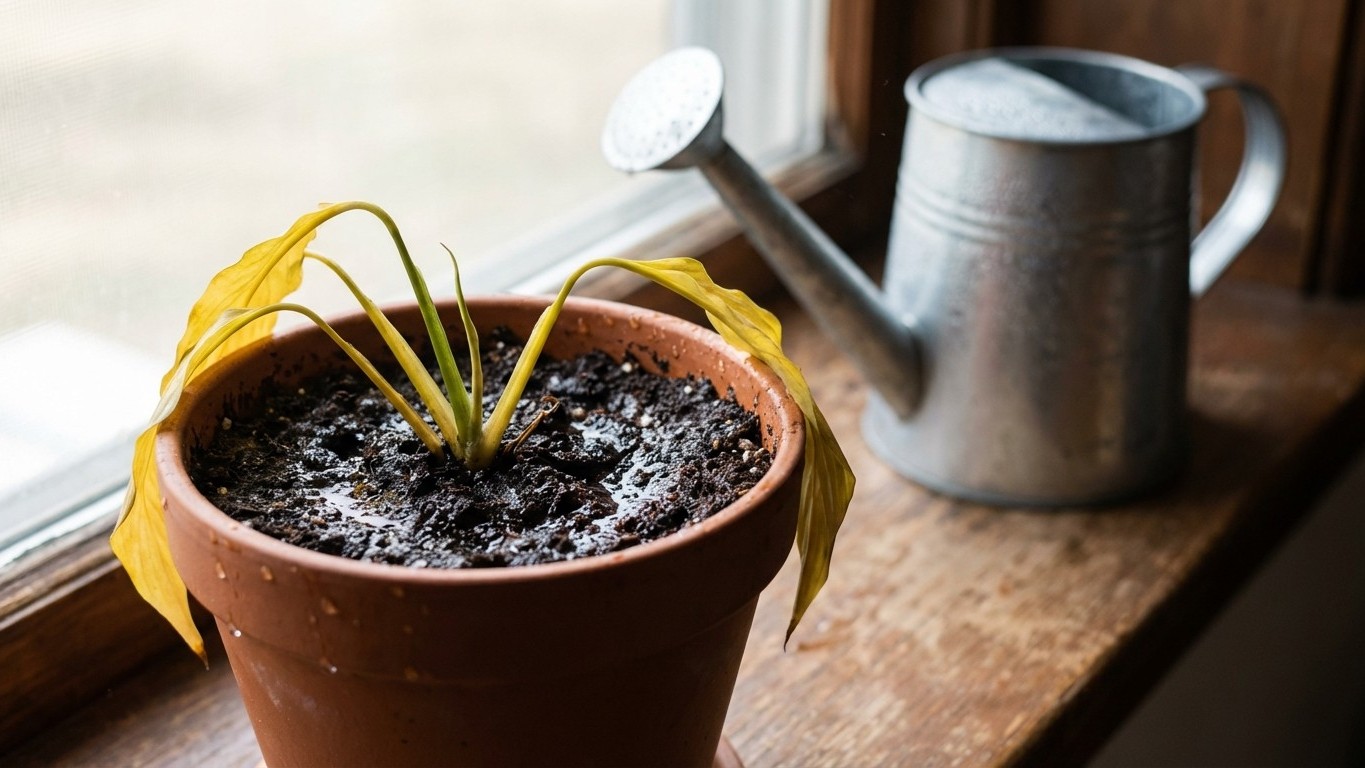
You water your plant on Sunday. Again on Wednesday. By Friday it hasn’t moved, the leaves droop, and you assume it needs more water. So you water it again. This loop, well-intentioned but quietly destructive, is how overwatering kills more houseplants than neglect ever could. The good news: once you know what to look for, the whole problem becomes much easier to solve.
Why Too Much Water Is a Slow Sentence for Your Plant
What Happens Underground First
Plant roots need to breathe, even though they’re buried in the potting mix. When plants are overwatered, the roots suffocate and die — throwing the plant out of balance, since roots are responsible for absorbing moisture and releasing it through the leaves.
Think of it like this: drowning the soil is the equivalent of putting a plastic bag over someone’s head and asking them to work normally.
Root rot usually develops when soil stays too wet for too long. Plant roots need oxygen as well as water, and in saturated soil they simply can’t “breathe.” Without oxygen, roots weaken, die, and begin to decay.
The tragedy is that this process is invisible.
Root rot starts in your plant’s root zone, hidden by soil, and stays out of sight and out of mind until it’s advanced.
By the time anything looks wrong above ground, serious damage is already underway.
The Wider Fallout
When the soil is consistently saturated, it deprives the roots of oxygen, leading to the growth of root-rotting fungi and bacteria, which attack and decay the roots. Damaged roots are unable to take up water and nutrients effectively to keep the plant alive and healthy.
So the plant effectively starves — despite sitting in a soaking pot.
Excess water can lead to various problems, including root rot, lack of oxygen in the root zone, nutrient deficiencies, and susceptibility to diseases.
A weakened plant also becomes easy prey for pests, compounding the damage further.
For a broader understanding of how light, temperature, and humidity interact with watering, the fundamentals are all covered in our guide to indoor plant care.
Reading the Warning Signs
What the Leaves and Stem Tell You
If a plant is overwatered, it will likely develop yellow or brown limp, droopy leaves — as opposed to dry, crispy leaves, which are a sign of too little water.
That texture difference is your first real diagnostic clue. Soft and mushy versus dry and papery: two completely different problems that can look deceptively similar at first glance.
If your plant is dropping old and new leaves alike, you’ve likely overwatered. The shedding leaves can be green, brown, or yellow.
Another overlooked signal:
if the leaves develop brown spots or edges encircled by a yellow halo, that’s a bacterial infection due to overwatering.
And at the stem base,
if it begins to feel mushy or unstable, you’ve overwatered. The soil can even begin to give off a rotten odor.
Clues in the Pot and Substrate
Excessively wet or soggy soil, especially if it has a foul odor, is a sign of overwatering and poor drainage, which can contribute to root rot.
If you spot green growth, mold or algae, on top of the soil, that’s not decorative.
Fungus or mold can grow directly on top of the soil if you’ve overwatered time and time again. The presence of fungus gnats is also a common sign of overwatering.
When you suspect things have gone wrong deeper, take the plant out of its pot and inspect the roots directly.
Healthy plant roots are firm and white. Unhealthy, rotting roots are soft and brown. If they’re really far gone, rotten roots are mushy black.
Overwatering vs. Underwatering: The Critical Distinction
This is where most plant owners get confused — and making the wrong call makes everything worse.
Paradoxically, overwatered plants often wilt, much like underwatered plants. The difference is that overwatered plants feel soft and mushy because their roots are rotting, inhibiting water uptake.
The key diagnostic step is always to check the soil first.
Unlike overwatered yellow leaves, underwatered yellow leaves usually turn crisp and brown within a few days of turning yellow. Curling, crispy, or lightweight brown leaves are another sign of underwatering.
The soil tells the rest of the story:
dry soil, or soil that is pulling away from the sides of its container, is a sure sign of underwatering.
With overwatering, the opposite is true — the pot feels heavy and the substrate stays persistently wet.
An easy way to check if your container plants are overwatered or underwatered is simply to pick them up. If the plant feels relatively lightweight for its size, it is more likely underwatered. If it feels heavy for its size, it is likely overwatered.
Mastering how often to water houseplants by season is one of the single most effective habits you can build, and it addresses both extremes at once.
Common Mistakes That Lead to Overwatering
Overwatering is watering your plants frequently without allowing the substrate to dry out. Overwatering is NOT watering your plants with a lot of water.
This distinction matters more than most people realize. The problem isn’t generosity — it’s frequency without checking.
One of the most common causes of overwatering is sticking to a rigid watering schedule. Instead of watering every few days automatically, get into the habit of checking the soil before watering.
Calendars don’t account for cloudy weeks, winter dormancy, or the fact that a plant near a north-facing window drinks far less than one in a sunny south-facing spot.
The container itself is another silent accomplice.
Plants are at risk for root rot when their soil is too dense to drain properly or their containers don’t have good holes that allow excess water to drain away.
Decorative pots without drainage holes are particularly risky — water accumulates at the bottom with nowhere to go, and roots sit in that puddle indefinitely.
Use a high-quality, well-draining potting mix that allows water to flow freely through the soil. Avoid heavy or compacted soils that retain excess moisture.
Adding perlite or horticultural grit to your potting mix is one of the simplest upgrades you can make.
This issue is especially prevalent during times of slow growth, whether due to the short days of winter or for plants placed in lower-light areas.
In winter, many houseplants go semi-dormant — that means less water, less often.
Keeping the same watering frequency year-round is one of the most common mistakes, and one of the most damaging.
Adjusting Your Routine to Avoid Overwatering
Know Your Plant Before You Reach for the Can
A ZZ plant and a fern are not the same.
Succulents and cacti thrive in dry conditions. Tropical plants like ferns or Calatheas prefer steady moisture.
That gap in needs is enormous.
Plants that need moist or humid environments, such as ferns, peace lilies, and pothos, are less prone to root rot if overwatered, while cacti and succulents, which need a free-draining compost, can get root rot more easily.
Getting familiar with the origins of your plants, desert dwellers versus jungle floor species, gives you an immediate sense of how thirsty they should realistically be.
Our complete indoor plants care varieties houseplants guide covers the specific needs of dozens of common species, which is worth bookmarking before your next watering session.
Reliable Methods for Testing Soil Moisture
The finger test remains the gold standard.
Stick your finger into the soil up to your first knuckle; if it feels dry, it’s time to water.
For deeper pots, a wooden chopstick works just as well, you can test the soil with your finger or use something like a wooden chopstick. If it comes up with wet soil, check on it again in a few days. If it comes out dry, then you can water.
The weight method is another underused technique.
You can pick up your plant and check the weight. A dry plant is a lot lighter than a wet plant due to the amount of moisture the potting mix can hold. Over time, you should be able to develop a good sense of how light your plant should feel when it’s time to water.
Moisture meters are available for those who want a more precise reading, though
some people prefer them over the fingertip test, just take care, as water meters can malfunction and may not be calibrated for the type of plants you have.
Smart Watering Techniques
Instead of frequent shallow watering, water deeply and let the soil dry out between watering sessions. This encourages deeper root growth and helps plants become more drought-tolerant.
When you do water,
deliver water slowly to the base of the plant rather than from overhead.
Always check what’s underneath:
always empty your cachepot or plant saucer of any excess water. Never leave your plant sitting in water, that’s an invitation for root rot to move in.
Plants typically need more water during the growing season (spring and summer) and less during the dormant season (fall and winter) — and this includes houseplants too.
Light exposure also plays a direct role:
more sun means more evaporation and more frequent watering, while plants in low light drink more slowly.
Understanding these variables is what separates a thriving plant collection from a struggling one. Our article on best light for indoor plants (low light vs bright indirect) explains exactly how light placement should influence how you care for each plant.
Rescuing a Waterlogged Plant
Assessing the Damage and Repotting
Speed matters here.
It is often possible to save an over-watered plant, provided you act quickly. If the roots are not completely rotted and the plant still retains healthy parts, it can recover. The sooner excess water is corrected, the greater the chances of recovery.
The rescue process follows a clear sequence. First, stop watering immediately. Then remove the plant from its pot and inspect the roots.
Carefully remove the plant from its pot, gently brush away any loose soil, and cut out any black or mushy roots with sharp gardening trimmers. Be sure to use an alcohol wipe in between each cut to avoid the spread of root disease.
If some healthy white roots remain, recovery is very possible.
If all of your roots are mush, it’s too late, time to think about something new. But if some healthy, firm, white roots are still hanging in there, there’s hope.
Dispose of the soil where the root rot occurred, then wash the pot thoroughly with a bleach solution (or repot the plant in a sterile container). It’s very important to sterilize the environment before repotting — otherwise the root rot will just take hold again.
Fresh, well-draining potting mix is non-negotiable at this stage.
Supporting Recovery
Moving your plant to a well-ventilated spot with bright, indirect light will help it dry out faster and give it the energy it needs to recover. Avoid placing it in direct sunlight, as this can stress the plant further. Proper airflow helps the soil dry out between waterings and prevents fungal growth.
Resist the urge to fertilize during recovery.
It’s recommended to avoid applying fertilizers during the recovery process. When you repot the plant into fresh soil, the new potting mix contains sufficient nutrients to support the plant’s immediate needs. The focus should be on allowing the plant’s root system to regain strength and vitality.
Patience here is not passive, it’s active care.
It can take between one and two weeks for a plant to dry out and start the recovery process from being overwatered.
Once new growth appears, that’s your green light to gradually resume a normal (and now smarter) watering routine.
FAQ: Avoiding Overwatering
Can you save a plant that’s been overwatered? Yes, in many cases.
Overwatered plants can recover if the damage isn’t severe. It’s advisable to intervene by ceasing watering, allowing the soil to dry out, and enhancing drainage.
The moment you act is the moment recovery begins.
How do you adjust watering frequency by season?
You may need to adjust watering seasonally, as plants generally need more water during their growing season (spring and summer) and less during the dormant season (fall and winter).
A plant that needed watering every five days in July may need it every twelve days in December.
What’s the clearest way to tell overwatering from underwatering? Check the soil and the texture of the leaves.
If a plant is overwatered, it will likely develop yellow or brown limp, droopy leaves — as opposed to dry, crispy leaves, which are a sign of too little water.
Wet soil plus drooping leaves is overwatering. Dry, pulling-away soil plus crispy leaves is underwatering. Both can look like wilting, context is everything.
The plants sitting in your home right now are giving you signals constantly. Yellow and limp, or crispy and curled; heavy pot or light; musty smell from the soil or bone-dry substrate. The skill isn’t in following a schedule, it’s in learning to read those signals and adjusting accordingly. What would change in your routine if you stopped watering by the calendar and started listening to your plants instead?