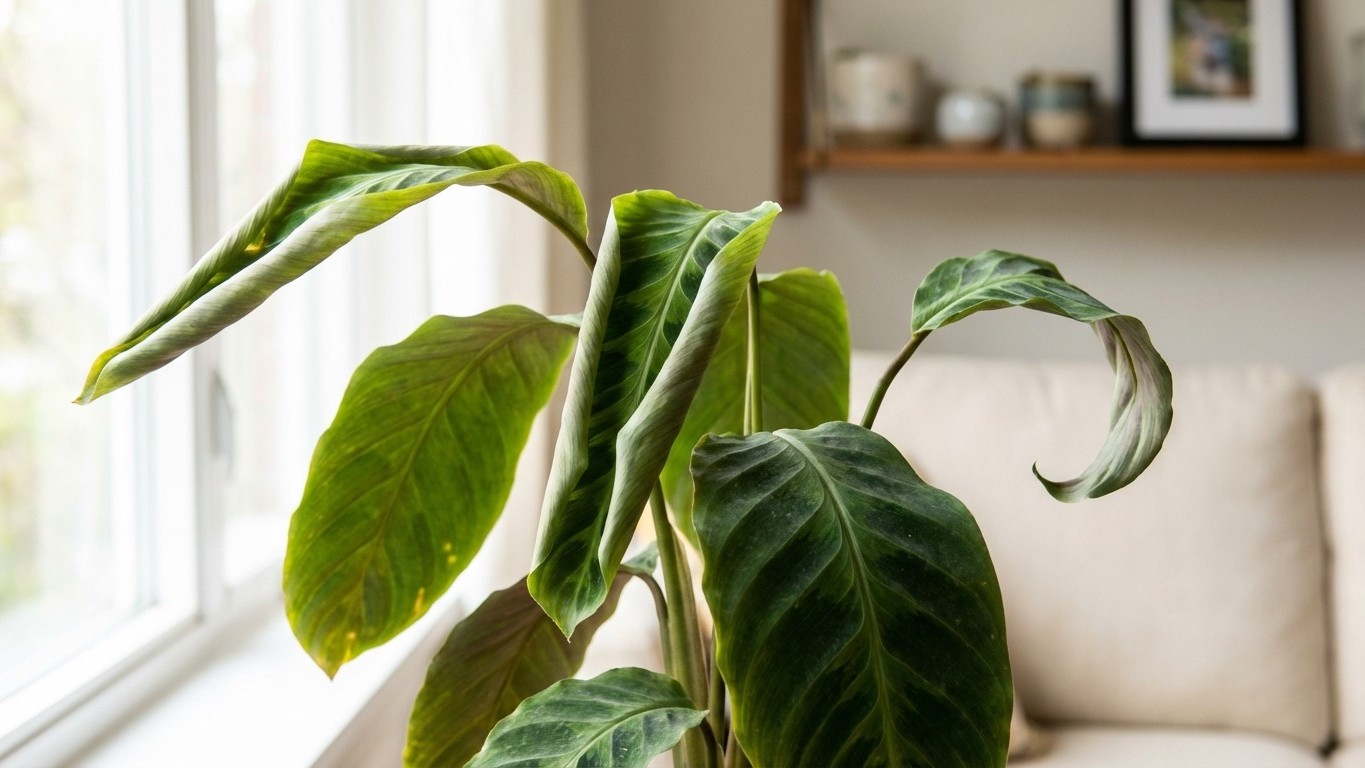
A leaf that starts to curl is a plant’s way of changing its surface area, like a person squinting into bright sun or pulling their sleeves down in cold air. It looks simple. The causes rarely are.
Indoors, leaf curl often appears before yellowing, spotting, or leaf drop, which makes it one of the best early warning signs you can catch. The trick is to stop guessing, because “more water” fixes one scenario and accelerates another. Same symptom, opposite solution.
This guide focuses on indoor plant leaves curling causes with a systematic approach: what you’re seeing, what it usually means, how to confirm it quickly, then what to do without turning your living room into a laboratory.
Why do indoor plant leaves curl?
What “leaf curling” really looks like
Curling can mean several shapes, and the shape matters:
- Edges rolling upward (a “canoe” shape): often linked to light stress, heat, or low humidity.
- Leaf folding inward along the midrib: common with dry air, underwatering, or pest feeding on tender growth.
- Downward clawing: can show up with root stress (including overwatering), excess fertilizer salts, or sudden environmental swings.
- New leaves staying rolled: sometimes normal for a day or two, but persistent tight rolls often point to humidity or root pressure problems.
One more detail: curled leaves can feel different. Papery and crisp suggests dehydration at the leaf level. Thick, leathery curling often points to roots under stress or ongoing pest pressure.
Which indoor plants get this problem most often?
Some houseplants are simply more vocal. Prayer plants (Calathea/Goeppertia, Maranta) often curl when humidity drops or watering is inconsistent, especially in winter heating. Spider mites tend to target thin-leaved tropicals and anything sitting near a radiator or sunny window. Ficus, peppers grown indoors, and many flowering houseplants can show distorted, curled new growth when thrips feed on developing tissue. extension.umd.edu
Succulents can curl too, but it often looks like shriveling or wrinkling rather than a soft leaf “cup.” Different mechanics. Same need for diagnosis.
Main causes of leaf curling
Too little or too much light
Light stress indoors is rarely about “not enough sun” in a general sense. It’s about mismatch: a plant adapted to medium indirect light placed in intense direct sun for several hours, or a plant kept in dim light while you water as if it were growing fast.
Too much direct light often shows as upward cupping plus fading, bleached patches, or crisping on the most exposed areas. Too little light tends to correlate with weak, stretched growth, softer leaves, and slow drying soil that sets you up for root problems later.
Practical checkpoint: did the curling start within 3 to 10 days of moving the plant closer to a window, or after seasonal sun angle changes? February light in the U.S. can be deceptively strong on clear days, even if the air feels cold.
Wrong watering: too much or too little
Underwatering and overwatering can both lead to curling because both end with the same outcome: leaves can’t maintain stable internal pressure.
With underwatering, you often see curling paired with droop, dry potting mix, and leaves that feel thinner or crisp at the edges. Browning and curling are commonly listed signs. healthyhouseplants.com
With overwatering, roots can lose function due to low oxygen and rot. Then the plant can look thirsty even though the soil is wet, because damaged roots can’t deliver water properly. Watch for yellowing, leaf drop, musty soil odor, mold, and fungus gnats hovering near the pot. thespruce.com
If you want a broader “everything on one page” diagnostic approach, connect this symptom to your full plant health checks in houseplant problems.
Air too dry (low ambient humidity)
Dry air is a quiet cause because you can water perfectly and still get curling. Indoor heating can push humidity down, and many tropical houseplants respond with curled leaves, crisp edges, and increased spider mite risk. Some guides put a comfortable band for humidity-loving houseplants around roughly 40% to 60% in winter care discussions, with the pickier plants wanting more stability. bhg.com
Everyday clue: if your skin feels dry, your lips chap, and your towels dry fast, your plants probably feel it too. Plants don’t care that it’s “cozy.” They care that transpiration is spiking.
Pests: aphids, thrips, spider mites (and a note on mealybugs)
Sap-suckers distort leaves because they damage cells while the leaf is still forming, or they drain fluids from mature tissue. Curling can be the first obvious sign.
- Aphids: cluster on soft new growth and undersides; heavy feeding can twist and curl leaves, often with sticky honeydew. extension.umn.edu
- Thrips: cause silvery streaks or scarring, black specks of frass, and deformed or curled young leaves. extension.umd.edu
- Spider mites: thrive in warm, dry conditions; look for stippling (tiny pale dots), fine webbing, and overall dulling, sometimes with curling as damage increases. tomsguide.com
- Mealybugs: more about cottony clusters and weakening, but they can contribute to distortion, and often show up alongside other stressors. uaf.edu
Important: pests and dry air often travel together. If your humidity is low, spider mites become a “when,” not an “if,” on susceptible plants. tomsguide.com
Thermal stress: heat, drafts, abrupt changes
A plant placed beside a heater, above a vent, or near an exterior door experiences repeated micro-shocks. One hour warm and dry, the next hour cold and drafty. Leaves curl to reduce water loss and protect tissue.
The timing is usually fast: 24 to 72 hours after the plant’s microclimate changes. The culprit is not the average room temperature, it’s the swings.
Nutrient issues or substrate problems
Leaf curl can follow:
- Salt buildup from frequent fertilizing or hard tap water, which stresses roots and can cause tip burn and distortion over time.
- Compacted, degraded potting mix that repels water when dry, then stays wet too long when finally soaked.
- Poor drainage (no drainage hole, saucer left full), keeping roots chronically oxygen-starved.
This category is where many people lose weeks. They keep adjusting light and watering, while the real issue is that the root environment has become physically wrong.
Detailed diagnosis by associated symptoms
Color clues: yellowing, spots, brown tips
Use leaf curl as the headline, then read the “subtitles”:
- Curling + yellowing leaves: can be overwatering, root stress, or pests. If yellowing is your dominant symptom, cross-check with why are my houseplant leaves turning yellow.
- Curling + silvery streaks + tiny black specks: strongly suggests thrips. extension.umd.edu
- Curling + stippling + fine webbing: classic spider mites, especially in dry air. tomsguide.com
- Curling + sticky residue (honeydew): often aphids (or sometimes scale). extension.umn.edu
- Curling + brown crispy edges: frequently low humidity or underwatering, sometimes sun scorch on exposed leaves. bhg.com
Localized curl vs generalized curl
Where it happens narrows the list quickly.
Only new growth is curled or distorted: think thrips, aphids, or mineral/salt stress, because new tissue is most sensitive and pests often feed there. Thrips are especially known for deforming expanding leaves. extension.umd.edu
Only the side facing the window curls: suspect direct sun, heat from glass, or a drafty window gap. Rotate the pot and see if the next leaves behave differently.
Whole plant curling gradually: look at watering rhythm, root condition, potting mix, and humidity. This is the “environmental baseline” category.
Quick diagnostic tables (symptoms → likely causes)
Table 1: What you see on the leaf
- Silvery streaks or scarring → thrips feeding damage is high on the list. extension.umd.edu
- Black specks on undersides → thrips frass can look like pepper. uaf.edu
- Tiny pale dots, overall “dusty” look → spider mites, especially if you also see webbing. tomsguide.com
- Sticky shine → honeydew from aphids, often with curled leaves on tender growth. extension.umn.edu
- Crisp edges and tips → low humidity, underwatering, or sun scorch depending on placement. bhg.com
Table 2: What the soil and pot tell you
- Soil bone-dry, pulling from pot edges → underwatering or hydrophobic mix that needs re-wetting technique. livingetc.com
- Soil wet for many days, musty smell → overwatering risk and possible root rot. healthyhouseplants.com
- Fungus gnats present → chronic moisture, drainage issues, or decomposing organic mix; leaf curl may be secondary to root stress. thespruce.com
If gnats are part of your picture, link your next step to how to get rid of fungus gnats in houseplants, because treating curl without fixing the wet substrate loop rarely holds.
Solutions and best practices by cause
Adjust light and placement
Move in small steps. A stressed plant responds better to a 1 to 2 meter shift than a complete relocation every two days.
- If you suspect too much direct sun: pull the plant back from the window, use a sheer curtain, or shift to bright indirect light.
- If you suspect too little light: move closer to the brightest window that doesn’t blast direct midday sun onto the leaves, and expect the soil to dry faster afterward.
- Rotation: turn the pot a quarter turn weekly to even out stress patterns.
A simple rule I trust: change one variable, then observe for 7 to 14 days. Constant tinkering produces constant confusion.
Fix watering without guesswork
Skip fixed schedules. Indoor evaporation changes with seasons, HVAC use, and even whether you cooked pasta yesterday.
- To address underwatering: water thoroughly until excess drains, then let the pot drain fully. If the mix is hydrophobic and water runs straight through, bottom-watering for 20 to 30 minutes can rehydrate the root zone.
- To address overwatering: pause watering, increase light slightly if appropriate, improve airflow, and check that the pot drains freely. If the mix stays wet too long, repot into a fresh, better-aerated substrate may be necessary.
One high-signal test: after watering, the plant should look better within hours if thirst was the primary issue. If it stays limp for days while the soil is wet, roots are likely involved.
Increase humidity in a way that actually lasts
Misting is popular because it feels like action. It’s often short-lived. If your goal is stable humidity, you need methods that change the room’s moisture balance.
- Humidifier: the most reliable option for consistent results, especially in winter heating season.
- Plant grouping: plants create a small humid pocket through transpiration, helpful in tight spaces.
- Pebble tray: modest effect, best used as an assist rather than the main strategy.
- Relocation: a bright bathroom can be a natural humidity zone if light is adequate.
Watch for the combination: curling plus crisp edges plus spider mite pressure. Better humidity reduces leaf stress and removes a key advantage for mites. tomsguide.com
Identify and treat pests (natural and chemical options)
First move: isolate the plant. Pest problems indoors are social problems.
Next, confirm what you’re dealing with:
- Thrips: inspect undersides, look for streaking and black specks; shaking foliage over white paper can help reveal tiny moving insects. gardeningsolutions.ifas.ufl.edu
- Spider mites: check for stippling and webbing; a white paper test can dislodge mites for spotting. tomsguide.com
- Aphids: look for clusters on new growth, sticky honeydew, and cast skins. ipm.ucanr.edu
Then choose an approach:
- Mechanical removal: rinse with water spray (especially for aphids), wipe leaves, prune heavily damaged tips.
- Low-toxicity sprays: insecticidal soap or horticultural oils are commonly recommended for soft-bodied pests, always test on a small section first.
- Repeat treatments: most pest control fails because it happens once. Many life cycles require weekly follow-ups for several rounds.
For thrips specifically, university and IPM resources emphasize that damage often concentrates on young tissue and can deform leaves as they expand, so catching them early saves the plant’s future leaves even if current damage stays visible. extension.umd.edu
Prevent thermal shock and drafts
Move plants away from vents, radiators, and frequently opened doors. If you can feel a temperature change on your hand when you stand near the plant, the plant feels it more.
- Keep leaves from touching cold window glass.
- Avoid placing plants directly under strong AC flow in summer.
- Stabilize. Consistency beats “perfect” conditions that change daily.
FAQ: Leaf curling, common mistakes to avoid
Why are my indoor plant leaves curling inward?
Inward curling is often a water-balance response: underwatering, dry air, or sap-sucking pests. Pair the curl direction with texture: crisp edges suggest dehydration at leaf level, while distorted new growth suggests pests like thrips or aphids. extension.umd.edu
How do I tell if curling is from underwatering or disease?
Start with the soil and speed. Underwatering usually comes with dry mix and quick improvement after a thorough watering. Overwatering-related root issues can mimic thirst but the soil stays wet, may smell musty, and symptoms don’t resolve after watering. Fungus gnats are a frequent clue that moisture is excessive. healthyhouseplants.com
Which pests cause leaf curl on houseplants?
Aphids can twist and curl leaves, especially on fresh growth. Thrips commonly deform expanding leaves and leave silvery scarring and black specks. Spider mites, favored by dry indoor air, cause stippling and sometimes curling as damage progresses. extension.umn.edu
Can dry air make leaves curl?
Yes, especially for humidity-loving tropicals. Low humidity is associated with curling and crispy edges, and it also increases spider mite pressure, which can add a second layer of curling and discoloration. bhg.com
How can I treat curling leaves naturally?
“Natural” works best when it means targeted and consistent: adjust placement, stabilize watering, increase humidity, physically remove pests with rinsing and wiping, and use insecticidal soap or horticultural oil where appropriate. Quarantine is a natural method too, and it prevents the problem from becoming a collection-wide issue.
When to worry: signs curling points to a serious problem
Curling is common. These situations deserve faster action:
- Curling plus rapid leaf drop over 7 to 14 days, especially if the soil is wet, suggests root failure risk.
- New growth consistently distorted across multiple leaves points to pests like thrips, because that damage becomes “baked in” as leaves expand. extension.umd.edu
- Musty smell, mushy stems, persistent wet soil indicate an overwatering loop that can escalate toward rot.
- Webbing visible means spider mites are already established, and you’ll need repeated treatments plus humidity correction. tomsguide.com
One hard truth: curled leaves don’t always flatten back out. The goal is healthy new growth. Old damage is your “receipt” of past conditions.
Useful resources for a full indoor plant diagnosis
Leaf curl rarely lives alone. If your plant is sending multiple signals, use these related pages to build a complete diagnosis path:
- indoor plants care varieties houseplants for baseline care by plant type and environment setup.
- houseplant problems for a broader troubleshooting hub (yellow leaves, pests, disease patterns).
- why are my houseplant leaves turning yellow if curling comes with chlorosis or widespread yellowing.
- how to get rid of fungus gnats in houseplants if wet soil and gnats suggest root-zone imbalance.
Next time you spot curling, try this: change only one variable, document the date, and watch the next two leaves that emerge. The plant will tell you if your diagnosis was right, but only if your care stops moving the target.