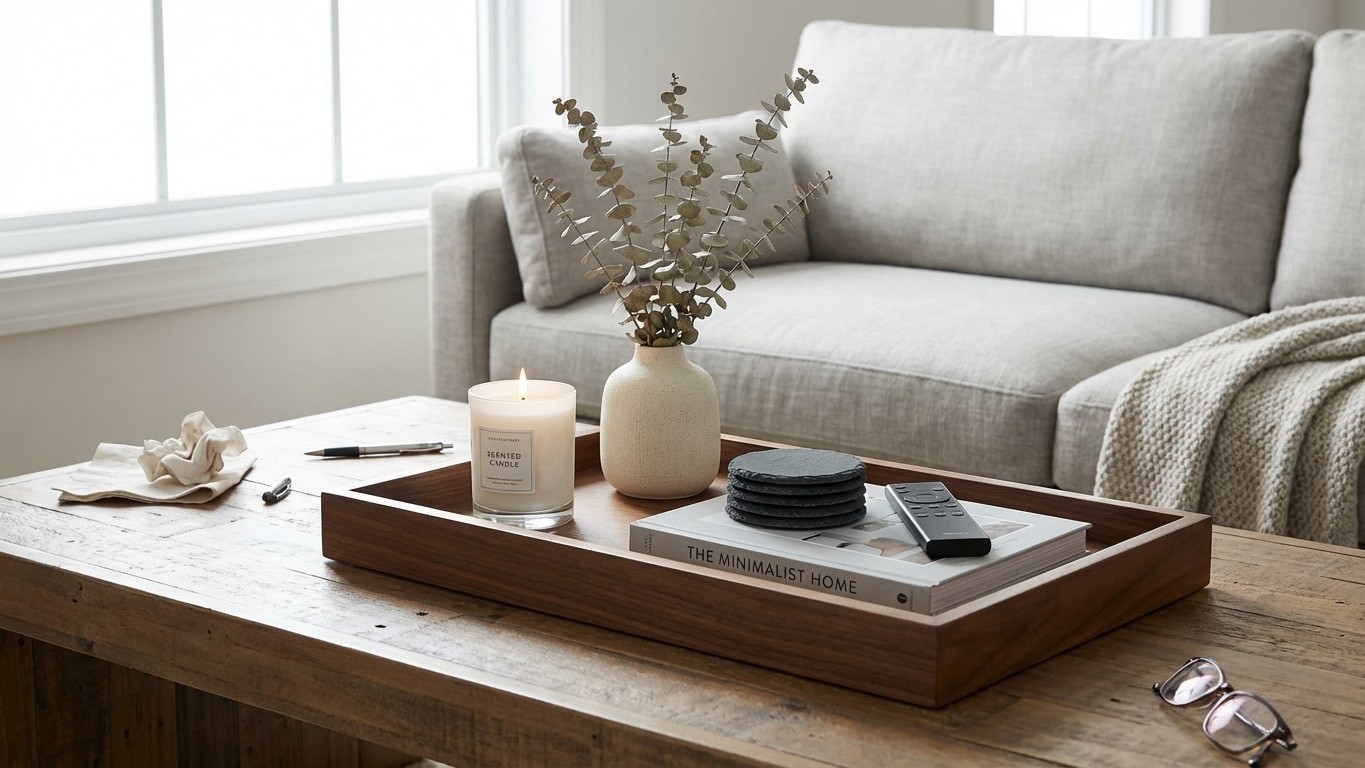
The coffee table reveals more about us than we care to admit. Cluttered with remote controls, abandoned mugs, a tissue box mournfully close to empty — this was my own living room, before a stylist changed everything with one deceptively simple object: the tray.
One Saturday afternoon — gray, the kind that presses you indoors — I found myself hosting a friend-of-a-friend, a professional stylist in high demand. She walked in, took a single look at my coffee table, and paused. No judgment, just curiosity, as if trying to solve a puzzle. “Mind if I show you something?” she asked, already reaching for a sleek wooden tray near my kitchen. In three minutes, my table looked… intentional. The difference was uncanny. The coffee table had become, in her hands, not a dumping ground but a curated stage.
Key takeaways
- Discover why scattered objects on your coffee table trigger stress and mental clutter.
- See how a tray can magically turn everyday mess into a stylish, unified display.
- Learn the secret behind the ‘tray trick’ and why it changes the psychology of your space.
Why We Scatter—and Why It Matters
This isn’t about snobbery. The tendency to scatter objects across any horizontal surface is nearly universal. It’s the natural consequence of modern life—keys tossed, mail flung, the TV remote lingering like an uninvited guest. If you live with kids, pets, or a spouse who needs everything “within reach,” the mess multiplies. Yet, research in environmental psychology consistently shows the tie between cluttered spaces and increased stress. Visual chaos amplifies mental chaos. Ever notice how you can’t quite relax when a table is overrun?
It turns out, there’s a fine line between “lived-in” and “overwhelmed.” The smallest shift in presentation changes the psychology of a room. When items are scattered, our brains see them as tasks—something left unfinished, one more thing to deal with. Contain them, even loosely, and the same objects become décor.
The Tray Trick—Unpacked
The tray trick is as basic as it sounds: a tray as boundary, corral, and silent stylist. Yet, the effects run deeper than you’d think. Suddenly a cup and a candle and a stack of coasters are related—they belong. It’s curation by constraint. Nothing is random if it shares a border.
Here’s what happens: The tray demands that only a handful of items reside on it—three to five, tops. There’s a gentle discipline at play. A favorite book or magazine, a slim vase with something alive (even eucalyptus from last week’s grocery run), and the remote, unapologetically present but no longer visually offensive. Now, your coffee table exudes intent—like the difference between dumping groceries onto your counter versus setting out a meal. Same objects; different story.
Why does this work? Neuroscientists might point to “visual grouping”—our brain’s instinct to perceive items within a common border as a single unit. Interior designers call it “vignetting,” creating little scenes-within-scenes. But all you feel is peace: the room suddenly under control, mood shifting with the mere addition of a tray.
Borrow a Stylist’s Eye—Without the Stylist
Walk into any boutique hotel lobby or home décor catalog—trays reign supreme. There’s a lesson here: professionals use boundaries to create a sense of order, even when the objects themselves are ordinary. You can do the same. No, you don’t need to buy a designer piece—any shallow box, basket, or slab can serve (as my own stylist-friend proved, commandeering something from the kitchen).
The magic isn’t the tray itself—it’s what you put on it. Three objects is a sweet spot, five if you’re feeling bold, but always in odd numbers (nature’s rule). A scented candle, a textured box to hide matches or hair ties, a small ceramic dish for earrings you discard at day’s end. Suddenly, even practical clutter feels like a conscious design choice. There’s also a subtle bonus: trays signal “take care.” It’s almost as if placing something inside invites you to return it there, maintaining order that lasts longer than a single afternoon.
Anecdote time: a friend visiting after my own tray transformation came away with strange resolve. “It feels calmer in here,” she said, unprompted, as though the tray had absorbed some invisible static from the room.
When the Trick Doesn’t Work—And What That Teaches
Not every table, not every home, will respond the same way. Oversized trays can monopolize small surfaces, while petite trays get lost on cavernous tables. Plus, the trick can encourage a different kind of hoarding—the “display obsession.” You might start accumulating objects just to fill the tray, inviting new clutter under a sophisticated disguise.
Even so, the tray method teaches boundaries—a rare commodity in interiors and, sometimes, in life itself. Choosing what deserves to be in the spotlight is a discipline. It forces you to reflect: do I love this item, or is it simply here because I didn’t know where else to leave it?
In this sense, a tray isn’t just décor. It’s a gentle invitation to edit. Kind to the eye, and even kinder to the mind. Call it mindfulness with handles.
What Else Could We Contain?
If a simple tray can transform a coffee table, what other scattered patterns in our homes—or our daily routines—might benefit from fresh boundaries? The more we think of our spaces as stories we choose to tell, the less we’ll surrender them to randomness. Maybe this is about more than a coffee table after all. Maybe it’s about living intentionally—one useful, beautiful border at a time.