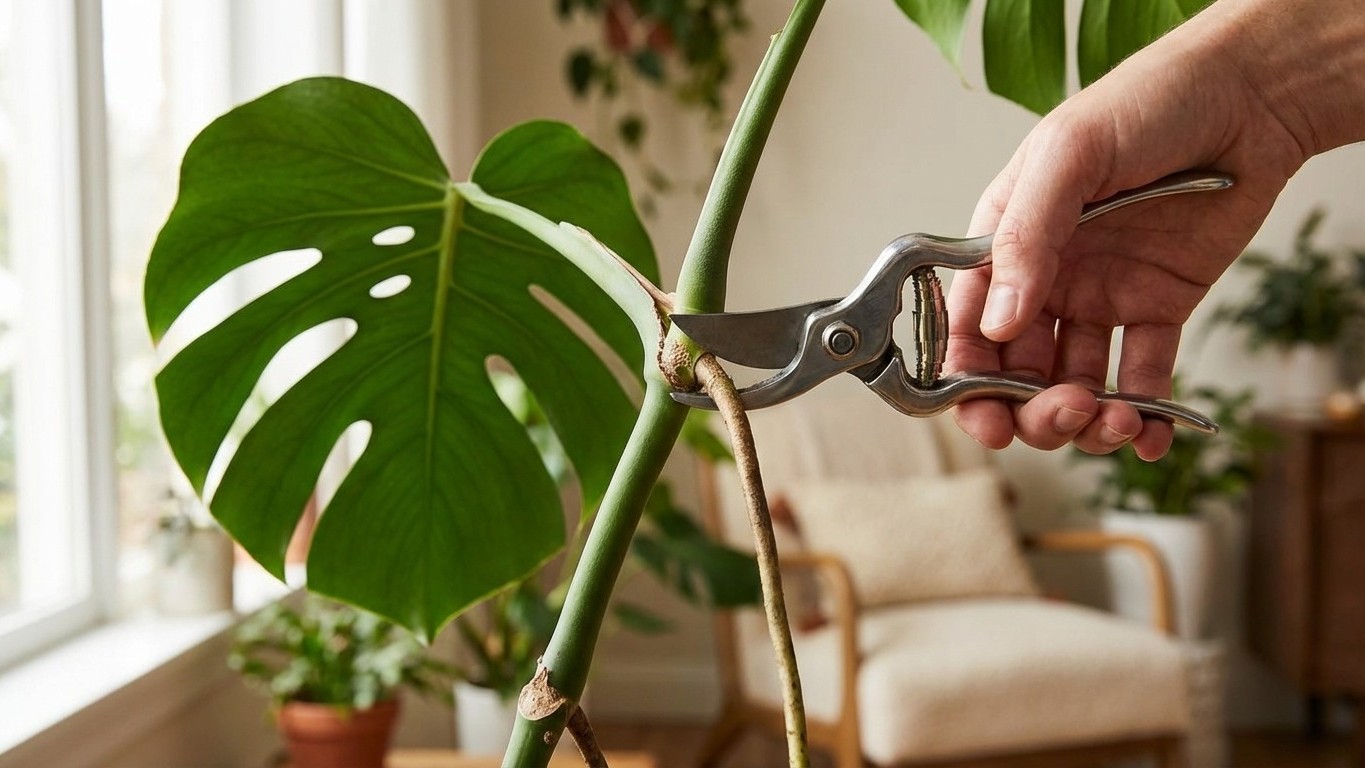
March feels like the right time to grab the pruning shears. The days are getting longer, your Monstera is starting to wake up, and there’s that irresistible urge to tidy things up before the growing season kicks in. So you start cutting. And then, somewhere around the third or fourth snip, you realize you may have just made a very expensive mistake.
That was me, two springs ago. My Monstera deliciosa had been growing steadily for three years, its split leaves fanning out across an entire corner of my living room. By March, it had developed a few yellowing lower leaves and some leggy stems that were reaching awkwardly toward the window. Seemed simple enough: prune the problem areas, encourage fresh growth, move on. What I didn’t account for was where I was cutting, and more specifically, what I was cutting off in the process.
Key takeaways
- A single misdirected cut can stop an entire branch from growing for months
- Timing matters: pruning too early in March when the plant isn’t yet in growth mode compounds the damage
- Most people remove the wrong plant parts—and leave alone the aerial roots that actually help their Monstera thrive
The Mistake That Looks Completely Reasonable
The most common March pruning error with Monsteras isn’t cutting too much, though that Happens too. It’s cutting at the wrong node. Monsteras grow from a central stem, and each leaf emerges from a node, that slightly raised, knobby joint along the vine. Aerial roots sprout from the same spots. When you cut directly through a node, or worse, remove a stem segment that contains the only active growth point in that section, you’ve essentially told the plant: this branch stops here. Forever.
I removed what looked like a “dead” section of stem, brown, dry, slightly shriveled at the base. Except it wasn’t dead. The aerial root attached to it was actively absorbing moisture from the air, and two nodes above my cut point were preparing to push out new leaves. I’d pruned with my eyes instead of my knowledge. The plant didn’t die, but that entire section stalled for nearly five months before it produced anything new, which on a slow-growing tropical feels like an eternity.
The fix is straightforward once you know it: always cut just below a node, never through one. Leave at least one healthy node on any stem you want to keep growing. If you’re removing a stem entirely, cut close to the main trunk without damaging it, and check for aerial roots before you commit to the cut.
Why March Specifically Makes This Worse
Timing compounds the problem. In early March, a Monstera that’s been sitting in lower indoor light all winter is still running on reduced metabolic energy. The plant hasn’t fully shifted into active growth mode yet, that usually happens when daylight consistently exceeds 12 hours and indoor temperatures stabilize above 65°F. Cut too aggressively before that transition, and the plant has to redirect its limited energy reserves toward wound repair instead of new growth.
Think of it like waking someone at 5am and immediately asking them to run a marathon. The energy is technically there, but the system isn’t primed for it.
The sweet spot for Monstera pruning is mid-to-late March in most U.S. homes, or even early April if your space stays cooler. By then, you’ll notice new leaf sheaths beginning to unfurl, that papery, pale green casing that wraps around an emerging leaf. That’s your green light. The plant is clearly in growth mode, meaning it has the metabolic capacity to recover from pruning stress quickly.
What You Should Actually Remove (and What to Leave Alone)
Yellow leaves at the base of the plant are usually a sign of age or low light, not disease. Remove them by cutting the petiole (the stalk connecting the leaf to the stem) close to the main vine. This is a safe, low-risk cut that genuinely helps the plant redirect energy upward. No node is compromised, no growth point is lost.
Aerial roots are a different story. Many people snip them because they look messy or get tangled in things, and honestly, I sympathize, they can look chaotic. But these roots actively help the plant uptake water and nutrients, especially in dry indoor environments. If you need to manage them, tuck them into the soil of the pot rather than cutting them off. Your Monstera will thank you by pushing out larger, more fenestrated leaves over the following months.
The stems that genuinely need removing are the ones producing consistently small, un-fenestrated leaves despite good light and humidity conditions. This often means the node is exhausted or the stem has grown too far from the light source. Cut these back to a healthy node lower on the plant, and you’ll likely see a more vigorous shoot emerge in its place within four to six weeks.
One More Thing Nobody Warns You About
Monstera sap. It’s a mild irritant, technically containing calcium oxalate crystals, and while it won’t send you to the emergency room, it can cause skin irritation and serious eye discomfort if you touch your face after handling cut stems. Wear gloves. This sounds overly cautious until the one time you don’t bother and spend an afternoon with itchy, inflamed wrists.
Use clean, sharp tools as well. A dull blade tears plant tissue instead of cutting it cleanly, which dramatically increases healing time and opens the plant to fungal issues. Wipe your pruning shears with rubbing alcohol before and after, especially if you’ve been working with other houseplants. Monstera root rot and fungal problems spread faster than most people expect in the early spring warmth.
My Monstera eventually recovered fully, and it’s now more vigorous than before, partly because I finally understood its structure well enough to stop guessing. But I think about what I cost it: nearly half a growing season of potential. For a plant that can live 20 to 30 years indoors, that’s a rounding error. For an impatient plant parent in March, it feels like much more. The real question isn’t whether to prune your Monstera this spring. It’s whether you actually know what you’re looking at before the blade comes down.