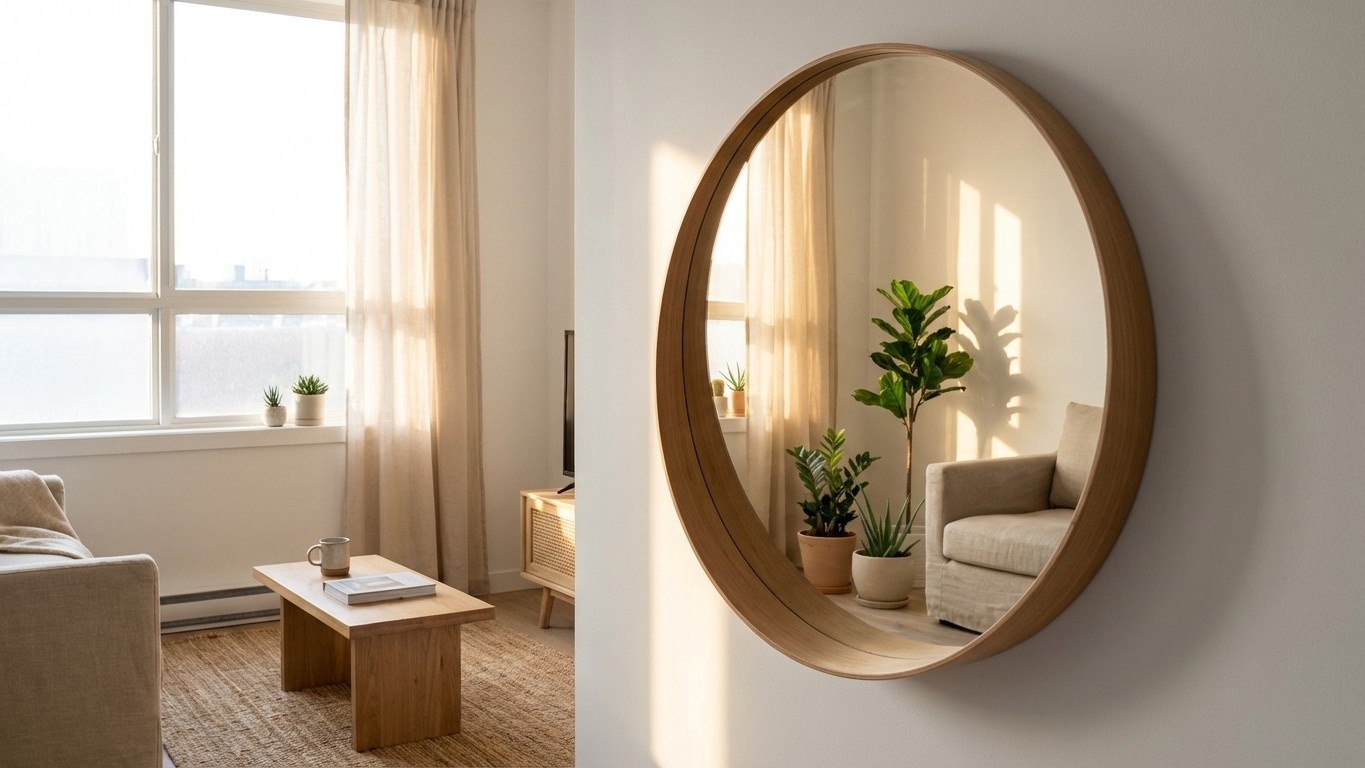
One simple rule, one dramatic shift: that’s the story of how my perpetually dim apartment finally brightened. You expect city living to mean compromise, sacrifice the dream of sun-drenched mornings for affordable rent and walkable streets. But no one warns you that a single misjudged mirror can keep even the bravest daylight out. Until it doesn’t.
Let’s picture a Saturday in February. Sun pushes through the window just enough to tease shadows across the couch. The walls, painted a careful neutral, look perpetually gray. I’d tried everything: desk lamps, “daylight” bulbs, luminous posters, a curious collection that managed only to underline what wasn’t there. Someone, inevitably, will Suggest mirrors. They’re in every small-space guide, sandwiched between wall hooks and under-bed storage.
And yet, my experience with mirrors was a disappointment. I hung one directly across from my biggest window, certain I’d cracked the code. The result? It bounced a patch of light awkwardly onto the hallway wall, nowhere near where I needed it. Most days, it just reflected the bland expanse of my neighbor’s building. A reality check, in glass. Clearly, just “adding mirrors” doesn’t guarantee magic.
Key takeaways
- Why your mirror placement might be blocking light instead of reflecting it.
- The physics-driven design rule professional decorators swear by.
- How a small change brought warmth, light, and mood shifts to a cramped space.
The Light Path: What Designers Actually Do
Professional designers don’t randomly dot mirrors around like disco balls. The trick is choreography. The guiding rule? Place your mirror adjacent to the source of light, not directly across from it. It sounds counterintuitive, and that’s exactly why most of us get it wrong the first time. The principle is rooted in physics: when you position a mirror perpendicular, or at a slight angle to your window, you catch the light as it streams in and send it deeper into the room.
I tested this theory beside my living room window, placing the mirror on the wall to the right. Around 10 a.m., sunlight caught the glass and ricocheted across my dining table. For the first time, the far side of the apartment felt alive, plants perked up, surfaces glowed. That patch of floor where I used to toss my backpack after work? It got its own golden hour. People talk about “bounce light” like it’s a high art, but in practice, it’s surprisingly democratic. Anyone with a mirror and a window can try it.
Beyond Reflection: Mirrors as Mood Shifters
Mirrors multiply more than lumens. They shift feelings about space itself. In a home where every square foot counts (my lease says 440, but I’d like a recount), clever reflection means the illusion of another doorway, a window where none exists, a little room to breathe. The mirror, suddenly, is not just functional, it’s psychological.
This trick even holds up to bigger, “grown-up apartment” scrutiny. Friends visiting from larger houses start eyeing my now-brighter walls, their own design wheels turning. Guests gravitate unconsciously toward the new brightness, drawn as much by mood as by the backdrop for selfies. There’s a reason hotel lobbies rarely look gloomy: mirrors stand guard at the periphery, ready to double the drama of every lamp and window.
Practical Tweaks for Real-Life Spaces
Not every window sits in an ideal spot, and not all wall space is mirror-ready. Maybe there’s a bookshelf, or a curious radiator, or (as in my case) a thermostat daring you to design around it. In those cases, angling a smaller mirror atop a credenza or leaning it on a shelf can yield a similar effect. The rule holds: think sideways, not straight on. If you’re in a studio, worry less about perfect symmetry, let the mirror “catch” the light as it enters, then guide it to where you spend the most time.
I’ve seen people layer mirrors with art, combining the reflected brightness with personality. An old friend, deeply suspicious of “decorative” trends, placed a small hexagonal mirror behind her kitchen faucet. Result? She doubled her morning sunlight and stopped grumbling about gloomy breakfasts, an architectural espresso shot.
The Mirror’s Secret Limitations
Not every mirror pays off equally. A cheap, overly tinted glass can yield harsh glares or strange color casts, especially once artificial light comes into play. For those hunting flea markets or big-box bargains, aim for clear (not smoky) glass, and larger sizes wherever possible. A single, quality mirror almost always outperforms a scattered array of small, decorative versions, unless you’re staging a funhouse, steer clear of too many competing angles.
Some mirrors are simply too heavy or precious for safe mounting, particularly in rental apartments where negotiation with studs and screws is a weekly sport. In that case, leaning mirrors are your friend: set one on the floor and nudge it into position, letting chance and sunlight collaborate.
Apartment dwellers obsess over privacy, understandably. You may hesitate to catch the view of a neighboring window, or feel exposed by a large reflective surface. The trick is to angle mirrors so you see more sky or green, trees, even the top of a city lamp, than the intrusive glance of another tenant. The right placement not only bounces light, but subtly edits what you “invite” into your space.
Mirrors, Light, and the Passage of Time
If you live somewhere with real seasons, the lesson unfolds across the calendar. In June, light finds its way deep into every corner. By January, the sun drops at a lethargic angle, barely brushing a windowsill. The adjacent mirror’s job? Keep that fleeting warmth alive just a little longer. The effect isn’t merely visual: as my thermometer ticked up by a hair, I realized the right placement can marginally boost perceived warmth too. It’s almost like putting a down comforter on your apartment’s mood.
Here’s the twist: the day you finally nail the mirror placement, the apartment doesn’t just look brighter, it feels right-sized. The window, stubborn as it is, stops being an adversary. Instead, you learn to work with it, sidestepping design dogma for simple experimentation. Today, my “small, dark” apartment often hosts the sunniest gatherings on my floor. Yet it all started with a basic, almost embarrassing oversight: mirrors aren’t magic until they learn to dance with your light.
Which leads to an invitation, not a commandment: what parts of your home crave a brighter chapter, and what hidden angles might surprise you if you give them a chance? Sometimes, the art of living well starts with letting a little more light in, sideways.