Every morning, as you prepare breakfast or wash dishes, you might feel that familiar ache in your lower back or tension in your shoulders. What if we told you that this discomfort isn’t inevitable—it’s actually the result of a design flaw that’s been hiding in plain sight for nearly a century?
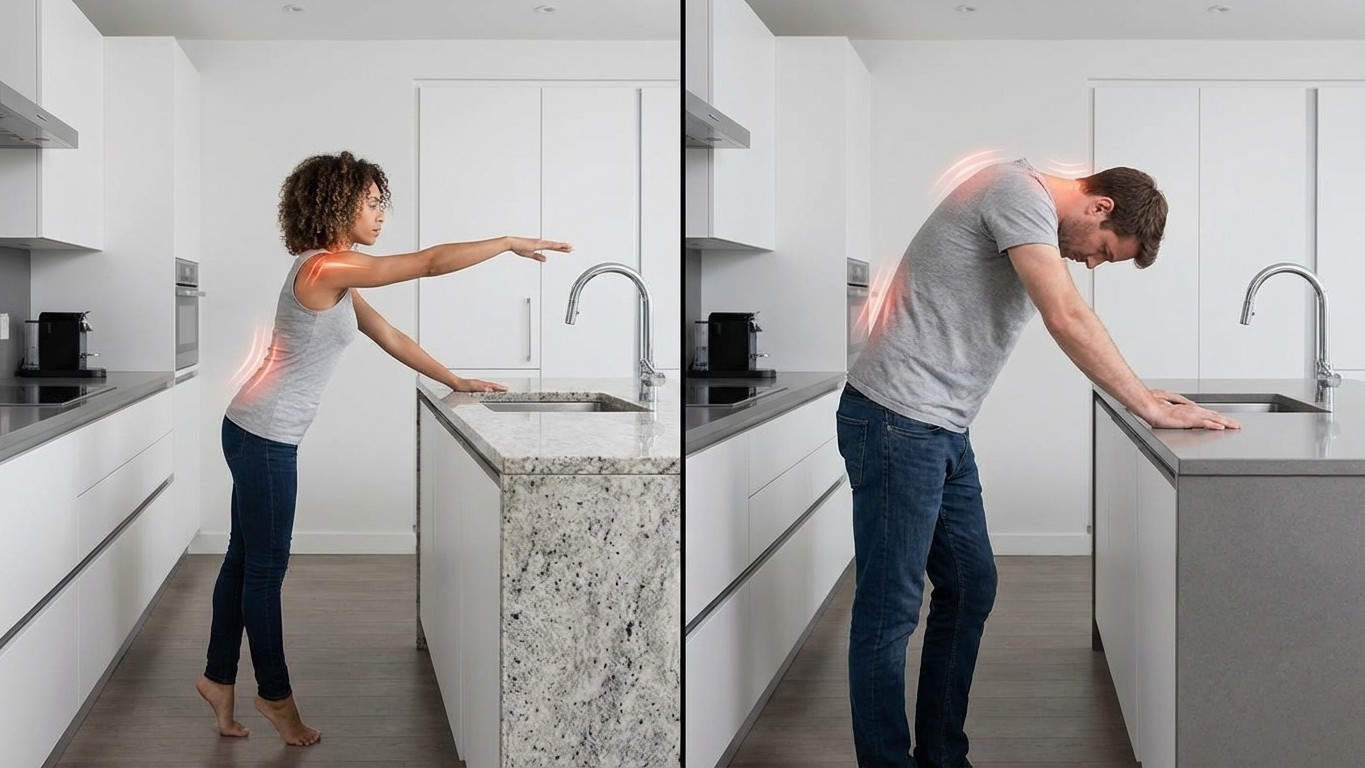
The standard countertop height of 36 inches is too low for most people, established in the 1930s when people were on average shorter than they are today—and it was probably too low even then. A study conducted at the University of Illinois in the 1940s inspired this standardization, based on the average height of women at the time (5 feet, 3 inches). But here’s the uncomfortable truth: people who are taller than 6 feet or shorter than 5 feet may experience discomfort when working on a standard 36-inch countertop, with taller users often needing to bend forward, while shorter users strain their shoulders and arms.
The implications of this outdated standard are staggering. While the 36-inch height is designed to accommodate the 5th percentile female to the 95th percentile male, meaning it works well for about 90% of the adult population, this statistic is misleading. In reality, “working well” doesn’t mean “working optimally.” For most people, the standard countertop height of 36 inches is too low, with the optimum height for most cooks falling between 37 and 39 inches.
The Hidden Science Behind Proper Counter Height
Understanding proper counter height isn’t about arbitrary measurements—it’s about biomechanics. For determining work surface heights, what matters most is the distance of your elbows from the floor, as the elbow is the critical hinge governing all lower arm activity in a kitchen. Ergonomically, the ideal countertop height is 4–6 inches below your elbow when standing, which minimizes shoulder and back strain.
The “elbow test” provides a simple way to determine your optimal height: when your palms are flat on the worktop, your elbows should be resting with your forearms at a 45-degree angle. This position allows your arms to work efficiently without forcing your spine into compromised positions.
When counters are too low, users tend to lean forward to put their elbows back in optimal relation to the countertop, causing the back to suffer. Conversely, counters that are too high force you to raise your shoulders and arms unnaturally, creating tension in your neck and upper back. If after preparing a large meal your lower back is killing you, your countertops are too low; if the pain is in your upper back and shoulders, they are too high.
The Real Numbers: Why Standard Height Fails Most People
The mathematics of ergonomic design reveal just how inadequate the standard has become. Kitchen counters are 36 inches high because that’s considered ideal for the average American adult, which is 5’9″ for men and 5’4″ for women, allowing most people to comfortably chop, cook, and clean without straining their backs, necks, and shoulders. However, this “average” approach ignores the reality of height distribution.
According to studies, approximately 68% of men fall within the range of 5 feet 6 inches to 6 feet 1 inch, while the median height for women is around 5 feet 4 inches. But this leaves a significant portion of the population—potentially 30% or more—working at suboptimal heights daily. The problem becomes even more pronounced when considering that the typical American man now stands 1.75 meters tall (69 inches) and the typical American woman stands at 1.65 meters (65 inches).
For those outside the narrow “average” range, ergonomically correct countertop heights can range from 30 inches for a 4’6″ user to 42 inches for a 6’6″ user. This dramatic range shows just how inappropriate a one-size-fits-all approach truly is. Between 38 and 39 inches works better for persons who are taller than average, while 32 inches is perfect for people who are shorter than average height.
Breaking Free from the Standard: Solutions That Actually Work
The good news is that you’re not trapped by decades-old standards. Modern kitchen design increasingly embraces the concept of customized work heights. You do not have to keep all of your kitchen counters at the same standard height—you can have custom heights for your sink area, different countertop heights for your kitchen island, and even different heights for your stove area.
Professional designers now regularly implement multi-level solutions. Multi-height counters and adjustable surfaces offer inclusive solutions, while anti-fatigue mats or step platforms can help fine-tune height without remodeling. For dedicated food preparation, some people prefer 1-2 inches lower than standard (34-35 inches), as this slight drop makes chopping and kneading easier on the shoulders.
For households with multiple users of significantly different heights, two or more ergonomically designed zones can serve as prep, serving, or bar seating areas, allowing users to customize space next to the work area for their preferences. This approach recognizes that kitchens must work well for the snack-getter as well as the main cook, requiring adaptability so the space can be used comfortably and efficiently by different users with different requirements.
The revolution in kitchen ergonomics isn’t just about height—it’s about acknowledging that a kitchen designed on “one size fits all” will fail to serve those who are shorter, taller, or disabled. By understanding the science behind proper counter height and demanding better from our kitchen designs, we can finally break free from a nearly century-old mistake that has been causing unnecessary pain and discomfort in millions of homes.
Your kitchen should work for you, not against you. The next time a contractor automatically suggests standard height counters, remember: the optimal height for a kitchen counter should depend on the height of the primary users, and adjusting accordingly can prevent backaches caused by stooping or straining. After all, you’ll be spending countless hours in this space—shouldn’t it be designed to keep you comfortable and pain-free?