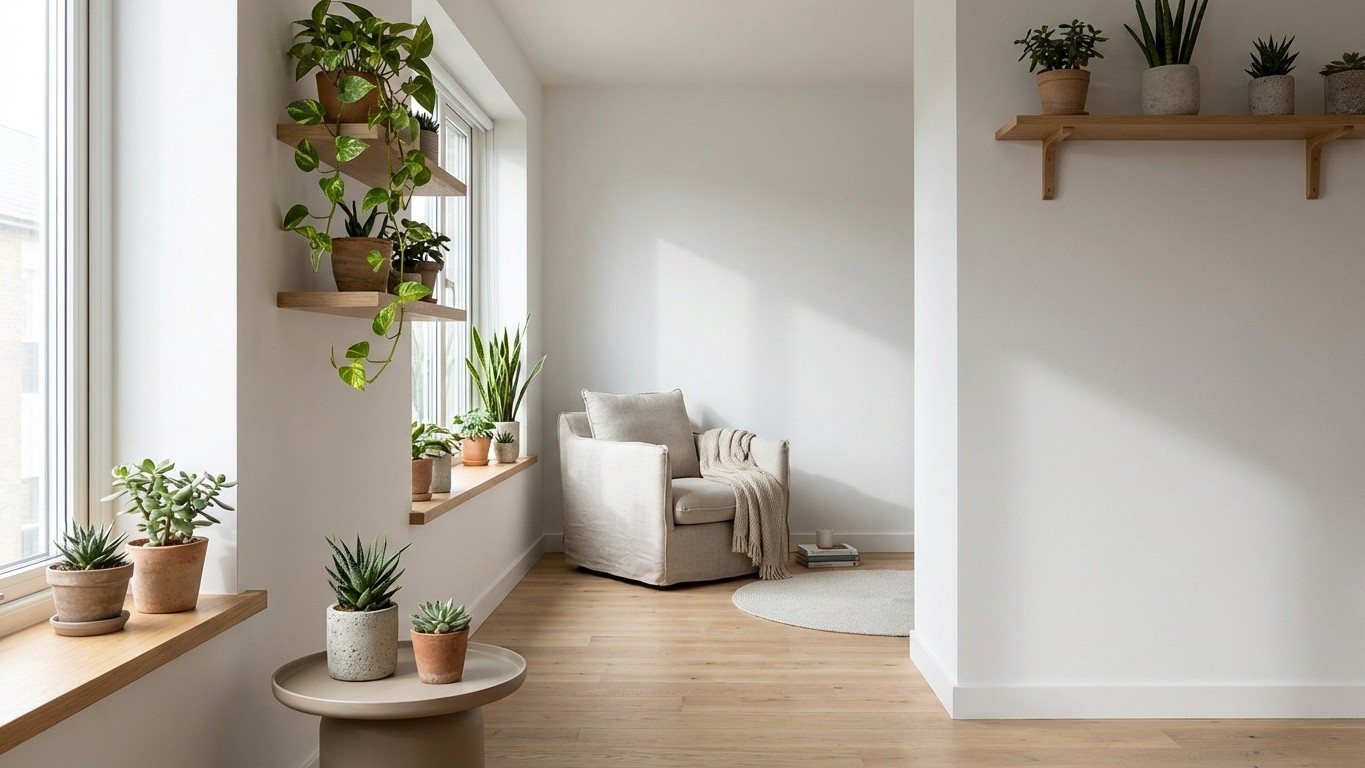
Picture this: 400 square feet, a north-facing window, and a serious case of green envy every time you scroll through Instagram feeds full of lush, leafy interiors. The good news?
compact plants can transform even the smallest apartment into a vibrant and refreshing home — small living spaces, such as cozy apartments and studios, can still feel vibrant and lush with the right indoor plants.
The trick isn’t owning more plants. It’s choosing smarter ones.
Studies show that having indoor plants can reduce stress, improve mood, and increase productivity. Even in limited spaces, small apartment indoor plants create a natural atmosphere that helps balance the pace of city life.
That’s a significant return for a few pots on a shelf. What follows is a genuinely practical guide, not a generic list, built around the real constraints of apartment living: tight square footage, uneven light, curious pets, and the occasional forgotten watering.
Why Compact Plants Win in Small Apartments
The space-to-impact ratio is everything
The best apartment plants thrive in indirect light, tolerate occasional missed waterings, and grow slowly. Each one should offer a high height-to-footprint ratio, so you get presence without taking over floors.
This is the core logic behind choosing compact varieties over large statement plants. A fiddle leaf fig might look spectacular in a magazine spread, but in a 500-square-foot studio it becomes furniture, and demanding furniture at that.
For small living areas, choose plants that stay small, or grow varieties with a slender upright or trailing habit that will fit in limited spaces.
The distinction matters more than most people realize. A snake plant and a monstera deliciosa can both sit in a 6-inch pot at the store. Six months later, one is still tidy in the corner; the other has annexed your reading chair.
Beyond decoration: real functional benefits
Houseplants can also help purify the air and eliminate toxins. Several plants help remove formaldehyde, benzene, trichloroethylene, and carbon dioxide from the air, according to NASA’s Clean Air study, which are chemicals linked to headaches, respiratory problems, and other health issues.
For city dwellers whose apartments tend to trap indoor pollutants from cleaning products and furniture off-gassing, this is more than a nice-to-have.
Your kitchen garden can double as a mood booster. Fragrant herbs like basil, mint, rosemary, and lavender smell incredible. Also, offer subtle therapeutic benefits.
Multifunctionality is the defining principle of small-space living, and plants are no exception.
How to Choose the Right Plant for Your Space
Controlled growth and adult size
Adult size is the single most underrated selection criterion.
There are quite a few dwarf snake plant varieties, including Starfish, Green Jade, Gold Star, Golden Hahnii, and Black Gold. These smaller ones (under 12 inches) grow slowly and won’t outgrow their 4-inch pots any time soon.
Staying in a small pot is itself a growth-limiting strategy — the root space constrains the canopy.
Keep pots small and step up slowly, because overpotting reduces airflow around compact roots.
The mini monstera (Rhaphidophora tetrasperma) is a perfect case study.
Often mislabeled as “Philodendron Ginny,” it matures at 18–20 inches indoors and climbs gently on 6-inch moss poles.
Vertical height, minimal footprint. That’s the ideal small-apartment plant profile.
Low-maintenance reality for urban lifestyles
The snake plant is one of the easiest indoor plants to grow. It’s drought-tolerant, requires minimal sunlight, and purifies indoor air naturally. This resilient plant thrives in both bright and dim environments, making it one of the most low-light houseplants for apartments.
For people juggling work-from-home schedules, weekend travel, and the general chaos of city life, a plant that punishes neglect is a plant you will eventually kill.
If you want a plant that genuinely does not mind being ignored, the ZZ plant is your new best friend. It stores water in thick underground rhizomes, which means missed waterings aren’t a big deal.
The ZZ and snake plant are effectively the two benchmarks: if a more demanding species interests you, compare it honestly against these two before committing.
The Top 12 Compact Plants for Small Apartments
Miniature and tabletop varieties
Many small plants, like succulents and fittonia, stay under 12 inches tall, making them perfect for small pots or shelves.
Fittonia (nerve plant) is a standout here.
Fittonia, or nerve plants, are known for their vibrant veined leaves. These small indoor plants are available in shades of pink, red, and white, making them a colorful choice for any space. Fittonia prefers high humidity, making it a good small indoor plant for bathrooms or kitchens.
The pilea peperomioides deserves its own sentence.
The plant’s compact shape (usually maxing out around 30 cm tall), fast growth, and eye-catching silhouette make it ideal for small apartments, student flats, and creative studios alike.
It also propagates effortlessly, one healthy mother plant regularly produces a dozen offsets a year, which you can pot separately or share with neighbors. A plant that multiplies your green collection without multiplying your spending. Hard to beat.
Pilea peperomioides became popular thanks to its relatively compact size, vibrant green leaves, and ease of care and propagation.
Place it about a meter from a bright window, rotate the pot every few days to maintain its symmetrical shape, and water when the top inch of soil dries out. That’s genuinely the full care routine.
Trailing and hanging varieties
Pothos is often called the “beginner’s best friend.” It grows quickly, tolerates low light, and can thrive in soil or water. Its cascading vines make it perfect for hanging baskets or shelves. For renters or small-space dwellers, pothos is the definition of easy indoor plants for small spaces.
Add a scindapsus (satin pothos) for a slightly more textured leaf, or a tradescantia for vivid purple and silver foliage, both trail beautifully and forgive irregular watering.
Hoya is another trailing gem worth the space on a high shelf. Its waxy leaves and occasional fragrant flower clusters make it decorative year-round, and its relatively slow growth keeps it manageable.
With their cascading foliage and eye-level appeal, hanging plants like spider plants or string of hearts create a lush, inviting atmosphere in any room and are well-suited for a variety of indoor conditions.
Vertical growers and space savers
Snake plants are easy to care for and are also useful for purifying the air. These plants grow vertically, so they’re ideal for tight corners that are in need of some greenery.
The sansevieria (snake plant) and zamioculcas (ZZ plant) both share this slender vertical profile, dramatic visual presence, tiny footprint. A columnar cactus achieves the same effect with even less water demand, though placement near a bright window is non-negotiable for cacti.
Air-purifying and edible multitaskers
Peace lilies improve indoor air quality by filtering pollutants. You can pair them with other air-purifying varieties for a healthy, beautiful space. The peace lily’s graceful shape fits seamlessly into corners, making it a great compact indoor plant that adds both beauty and function.
Aloe vera does double duty as a skin-soothing first aid staple and a genuine low-maintenance succulent, just like other succulents, it prefers that its soil is completely dry between waterings. These small potted plants are handy to keep around if you have any minor burns, like a sunburn.
A compact herb garden on the kitchen windowsill earns its spot every single day. Basil, mint, and rosemary stay small in individual pots, provide fresh ingredients, and fill the room with scent. The kind of multifunctionality that a purely decorative plant simply cannot match.
Quick comparison: dimensions, light, and décor strengths
To make plant selection concrete, here’s a practical overview of the twelve varieties covered in this guide:
- Pilea peperomioides — Max ~12 in. | Bright indirect | Sculptural, Scandinavian-style
- Fittonia (nerve plant) — Under 6 in. | Low to medium | Colorful veined leaves, terrarium-friendly
- Mini monstera (R. tetrasperma) — 18–20 in. | Bright indirect | Fenestrated leaves, climbs a moss pole
- Pothos — Trailing | Low to bright | Cascades from shelves, incredibly adaptable
- Scindapsus / Satin pothos — Trailing | Low to medium | Silvery satin texture
- Tradescantia — Trailing | Medium to bright | Purple/silver foliage, fast-growing
- Hoya — Trailing | Bright indirect | Waxy leaves, fragrant blooms
- Snake plant (Sansevieria) — 6–48 in. depending on variety | Any | Modern, vertical, air-purifying
- ZZ plant — Under 14 in. (compact form) | Low | Glossy deep-green leaves, nearly indestructible
- Columnar cactus — Vertical | Bright/direct | Architectural, zero-maintenance
- Peace lily — Under 18 in. | Low to medium | White blooms, air-purifying, corner-ready
- Aloe vera — Under 12 in. | Bright indirect | Functional, succulent, windowsill-perfect
Explore our full guide to houseplant varieties to go deeper on each genus, with light requirements mapped to specific window orientations.
Making the Most of Every Inch: Space Strategies That Work
Go vertical first
Vertical gardening is a creative, space-saving way to bring greenery into small rooms. Instead of using up valuable floor space, wall planters or floating shelves let you display plants vertically, freeing up room while adding a stylish, eye-catching touch to your décor.
The ceiling, the wall above the sofa, the back of a door, all underused real estate in most apartments.
Hanging plants save floor space and also create a lush, vertical garden effect that can transform a bland room into a green oasis.
If drilling is off-limits (common for renters),
no-drill solutions like Command hooks, tension rods, over-the-door hooks, suction cups, or freestanding racks let you hang plants without damaging walls or ceilings.
A tension rod across a window opening, loaded with three or four hanging planters, creates an entire living curtain without a single hole in the wall.
Grouping and layering for visual depth
Arrange odd-numbered clusters and vary heights to create depth without crowding. Repeat planter colors and leaf patterns across the room to link zones and reduce visual noise. Build simple triangles using one tall apartment plant, one medium plant, and one trailing plant.
This is the secret interior stylists use: it’s not about the number of plants, it’s about the composition. Three well-placed plants feel richer than seven scattered randomly.
Mix and match small planters with different textures, ceramic, terracotta, glass, for a modern, cozy vibe.
The containers are part of the decor. A single terracotta pot on a floating shelf reads as an afterthought; three coordinated pots at varying heights read as intentional design.
The bathroom and kitchen: overlooked green zones
Bathrooms are often the least decorated rooms in an apartment and aren’t always the first place that comes to mind when considering where to put plants. Bathrooms with windows make ideal locations for houseplants due to their humid environments and light from the window. Setting a plant on a step stool or creating a plant shelf adds a burst of green to brighten up your daily routine.
Fittonia, peace lily, and Boston fern all thrive in exactly this kind of warm, humid, low-light environment.
Common Questions About Plants in Small Apartments
What if I have very little natural light?
Living in an apartment doesn’t mean giving up on houseplants, even if your windows are limited, north-facing, or mostly blocked by other buildings. A lot of houseplants prefer consistency over perfect conditions. When you choose the right plants plus the right lighting, adding greenery to a small space can be surprisingly easy.
ZZ plants, snake plants, and pothos are the reliable trinity for low-light apartments. For the boldest low-light options, see our curated list of low light indoor plants.
How to care for multiple plants without losing track?
Group indoor plants by care needs on a rolling cart, then roll it closer to a window on bright days.
This single organizational move simplifies watering schedules dramatically — thirsty plants in one cluster, drought-tolerant ones in another.
Group plants together with similar growing needs for more efficient care.
Two watering sessions a week, each targeting a specific group, beats trying to remember the individual schedule of seven different species.
Humidity, mold, and the overwatering trap
Too many plants in a poorly ventilated apartment can push indoor humidity beyond healthy levels.
Monitor indoor relative humidity and keep it below 60% to deter mold growth.
The fix is simpler than it sounds:
opening windows allows fresh air to circulate, which benefits your plants by providing them with the airflow they need to grow stronger and healthier. Also, helps prevent mold. Good air circulation reduces indoor humidity levels, making it harder for mold to thrive in damp, stale air.
Overwatering is the leading cause of both root rot and mold in small-apartment plant collections.
Before watering, lift the pot. If it feels light (like a half-empty coffee mug), water thoroughly until runoff appears. If heavy, wait 24 hours and retest.
This “lift test” takes two seconds and eliminates most guesswork.
Avoid overwatering: excess water in plant soil can create its own mold problems. Make sure each plant is in a well-draining pot and that you’re watering appropriately for each plant type.
Expert Mistakes to Avoid
Overpopulation and runaway growth
If you have a small apartment, don’t overcrowd the space with plants.
This sounds obvious but is genuinely difficult to resist once you catch the plant hobby bug. The practical threshold varies by space, but a useful rule: if you can’t comfortably water every plant without moving furniture, you have too many.
Leave breathing room around each pot so leaves dry quickly and airflow stays healthy in small apartments.
Fast-growing plants also deserve an honest pre-purchase conversation with yourself.
After 50 years of indoor gardening, it’s clear how fast some plants can take over a room. A Golden Pothos may need pruning four times a year to keep it in check.
Trailing plants are beautiful, and they spread. A quarterly trim keeps them in shape without sacrificing their decorative impact.
Matching plants to your actual lifestyle
If you travel frequently for work, drought-tolerant species are not optional, they’re non-negotiable. ZZ plants, snake plants, and cacti can handle a two-week absence. Peace lilies and fittonia cannot.
If your apartment has limited sunlight or you travel often, the ZZ plant is a reliable companion.
Similarly, households with pets need to cross-reference the ASPCA’s toxic plant database before buying.
Proven non-toxic options include button fern, parlor palm ‘Nana,’ Pilea glauca, and dwarf ZZ plant.
For anyone just beginning their plant journey, the path of least resistance is genuinely the best path. Our guide to the best indoor plants for beginners maps out species that forgive common mistakes, overwatering, underwatering, neglect, while still delivering real visual impact. From there, the full depth of what’s possible with indoor plants care varieties houseplants opens up naturally, at your own pace.
Going Further: Build Your Green Space Intentionally
The real question isn’t “which plant should I buy?” It’s closer to: what do you actually want from your green space? A calm morning ritual with herbs in the kitchen window? A sculptural corner that frames your reading nook? A trailing curtain of pothos that softens the edge of a bookshelf? Each answer points to a different selection strategy, and now you have the vocabulary to make that choice deliberately, rather than impulse-buying whatever looks good at the garden center on a Saturday.
Start with two or three compact varieties, get to know their rhythms, then expand.
Pick two or three compact apartment plants, place them where the light is kind, and keep a simple water rhythm for steady growth.
The plants that last longest in small apartments are the ones chosen with intention, matched honestly to your light, your schedule, and the space you actually have, not the space you wish you had.