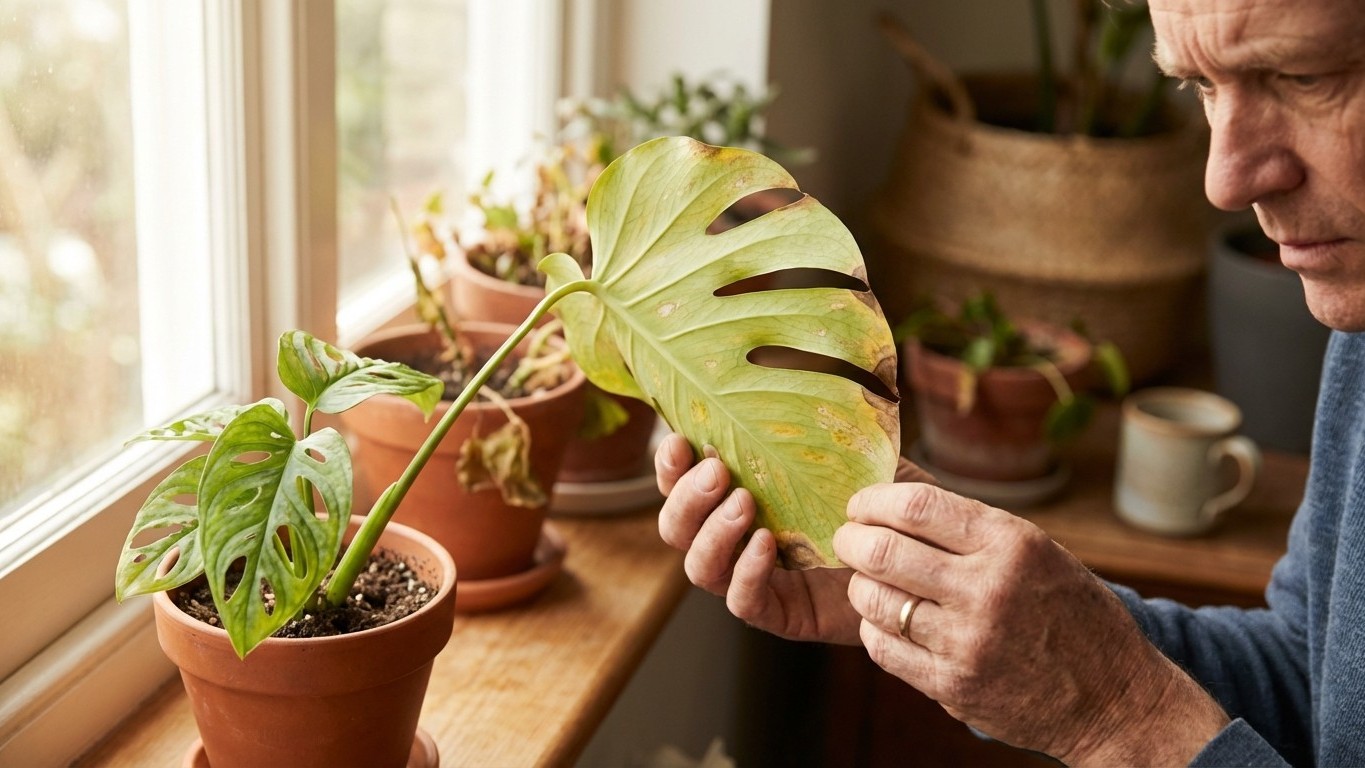
Your monstera droops. Your pothos sprouts yellow patches. Your fiddle-leaf fig has been dropping leaves every week for two months. Houseplant problems have a way of creeping in quietly, until suddenly the whole plant looks like it’s given up. If you’re wondering why is my houseplant drooping or why are my houseplant leaves turning yellow, the good news is that most issues are diagnosable, and most are fixable, as long as you know what you’re actually looking at. The key move every indoor gardener needs to learn is how to distinguish a cultural problem (wrong watering, wrong light) from a pest invasion or a fungal disease, because the treatment for each is completely different. Spray neem oil on an overwatered plant and you solve nothing. Cut back on water when spider mites are your real enemy, and you may just make them thrive.
This guide walks you through the full diagnostic process, from reading your plant’s leaf signals to identifying the critter hiding under your fern’s fronds, with concrete, actionable solutions at each step. For specific pest issues like spider mites, you’ll also want to learn how to treat spider mites on indoor plants effectively, or if you’re dealing with those white, cotton-like insects, discover how to get rid of mealybugs on houseplants. Think of it as the triage kit you keep on your phone next to your watering reminder.
Understanding Houseplant Problems: Physiological vs. Pest vs. Disease
Before reaching for any treatment, the single most valuable skill is knowing which category of problem you’re dealing with.
It is important to distinguish between signs of pest feeding injury and symptoms of improper care due to overwatering or underwatering, improper fertilization, root diseases, or adverse environmental conditions such as insufficient light or humidity.
Misdiagnosis is the number one reason houseplants decline despite their owners’ best efforts.
Physiological disorders are caused by the plant’s environment, too much water, too little light, dry air, mineral build-up in the soil. They tend to be gradual, symmetrical, and uniform across the plant – for example, you might notice indoor plant leaves curling causes related to environmental stress. Overwatering, in particular, can lead to serious issues like root rot in houseplants signs and treatment. Pest damage, by contrast, tends to be localized: you’ll see chewed edges, stippled patches, sticky residue, or actual insects if you look closely enough. Small flying insects around the soil, for instance, often indicate fungus gnats – learn how to get rid of fungus gnats in houseplants to tackle this common issue. Diseases (fungal, bacterial, viral) often show as distinct spots with defined borders, powdery coatings, or sudden, dramatic collapse.
When disease attacks a plant, it’s easily visible. Growth slows, stunts, or becomes spindly; leaves may yellow, show white powdery blotches, or develop spots.
Pest damage, meanwhile,
can include discoloration of older leaves or the entire plant, yellowing or bronzing leaves with speckling, the presence of webbing, small particulates on leaves or the crotches of branches, and the presence of honeydew on and underneath plant structures, which can lead to sooty mold growth and ant infestations.
Reading the Visual Signals First
Grab your plant and look — really look. Flip a few leaves. Check the stem base. Examine the soil surface.
Indications of inadequate plant care include soft stem bases, a lack of flowers on houseplants expected to bloom, wilting, yellowing of entire leaves, leaf drop, excessively long stems, and brown leaf tips or leaf margins.
A plant with uniformly yellow lower leaves and soggy soil is almost certainly overwatered. A plant with tiny bronze specks on top of the leaves and fine webbing underneath almost certainly has spider mites. The visual context, which leaves are affected, where on the leaf, and in what pattern — tells the whole story.
Yellow, Brown, and Falling Leaves: Diagnosing the Cause
Yellow leaves are the most common reason people search for houseplant help. They’re also the most misleading symptom, because essentially everything causes them.
Foliage may become yellow because of too little light, too little fertilizer, insect pests, or mites — but most often, yellowing is a symptom caused by overwatering.
Start there.
For a deeper dive into this specific symptom, including a full breakdown by leaf position and pattern, the guide on why are my houseplant leaves turning yellow covers every scenario in detail.
Overwatering vs. Underwatering: The Eternal Question
Both extremes can kill a houseplant, and both can cause surprisingly similar symptoms — wilting, yellowing, leaf drop. The way to tell them apart: check the soil and the roots.
Wilting is usually caused by underwatering or excessive light but may also be due to root decay from soil pathogens, often associated with overwatering or poor drainage.
Push your finger two inches into the soil. Bone dry? Underwatered. Soggy and compacted? Overwatered.
Soft stem bases usually indicate overwatering. Soggy soil can result from overwatering or poor drainage.
An underwatered plant is fixable with a good soak and a more consistent routine. An overwatered plant is a race against root rot.
Check for drainage in the pot, examine the roots, and if most are dark, soft, and dead, it is better to discard the plant.
Harsh, but honest.
Light: Too Much, Too Little, Both Cause Yellow
Leaves may yellow (or fade to a dull color) if exposed to too much direct sunlight, usually outer foliage or newer growth, or may yellow in too low light, usually lower, older growth towards the inside or bottom of the plant.
The position of the yellowing matters enormously here. New growth yellowing near a south-facing window in summer? Sunburn. Older inner leaves fading to pale green in a dark corner? Light starvation.
Most tropical and indoor plants prefer indirect or filtered light over direct sun.
Nutrient Deficiencies and Tired Soil
Yellowing, browning, and death of lower leaves is generally caused by nitrogen or iron deficiency. Pot-bound plants are especially susceptible. Regular application of fertilizer and repotting periodically in fresh soil avoids this problem.
A plant that hasn’t been repotted in three years and lives in compacted, depleted soil is essentially starving.
If your potting soil is old and “tired” or has become compacted, it may be time to repot the plant and refresh the soil, good to do at least every 2 to 3 years, even on very old, mature plants.
Other Environmental Stressors: Air, Drafts, Repotting Shock
Black, brown, or yellow leaf tips may be caused by a lack of humidity (dry air) or by accumulation of salts and minerals from water or fertilizer.
Central heating in winter drops indoor humidity well below what most tropical plants tolerate.
Increase humidity by misting, providing a humidifier or pebble tray, or grouping plants together.
Cold drafts from windows or air conditioning vents are another underrated culprit —
chilling the plant can also cause leaf drop.
When leaves curl rather than simply turn yellow, that’s often a separate issue worth investigating; the full picture is in this resource on indoor plant leaves curling causes.
Common Houseplant Pests: Identification and Treatment
Pests often thrive indoors due to stable temperatures and the lack of natural predators.
Outside, a ladybug population would decimate your aphids within days. Inside, nothing stops them but you.
With no natural enemies indoors, inspect your houseplants weekly for insect pests like mealybugs and scale.
Weekly. Not monthly.
The Usual Suspects: Mealybugs, Aphids, Spider Mites, Thrips, Scale, and Fungus Gnats
Mealybugs are unmistakable once you know them.
They are small, sap-sucking insects covered in a white, cottony substance that typically cluster in large numbers on plant stems, leaves, and sometimes roots.
They drain plant sap, leading to stunted growth, leaf yellowing, and leaf drop — and they produce honeydew, causing sooty mold.
First response:
a cotton swab can be used to apply rubbing alcohol directly to scale insects or mealybugs.
Aphids reproduce at an almost absurd pace.
All aphids are parthenogenic and can give birth to nymphs rather than laying eggs. They often reproduce asexually as nymphs are born pregnant, which allows populations to build rapidly under favorable conditions.
Heavy aphid feeding causes wilting or curling of leaves, distortion of new growth, and excessive honeydew accumulation.
A forceful spray of water in the shower, repeated every few days, handles mild infestations well.
Spider mites are the stealthy ones.
These tiny arachnids thrive in hot, dry conditions. Dracaena, figs, hibiscus, ivy, Norfolk pine, and scheffleras can be affected. They feed on the undersides of leaves and create stippling, gray and bronze discoloration, premature leaf drop, and fine webbing.
The escalation is fast: yellow spots turn to yellow leaves, then a dead plant.
For the full treatment protocol, see the dedicated guide on how to treat spider mites on indoor plants.
Thrips are nearly invisible at first.
Extremely small (1/16 inch) insects whose nymphs feed on flowers and the undersurface of leaf tissue, causing streaking and distortion of flowers and foliage — buds often fail to open.
Under favorable conditions, thrips can complete their entire life cycle in two weeks.
That speed makes early detection non-negotiable.
Fungus gnats are annoying more than dangerous to established plants, but their larvae are another story.
Adults (1/8 inch) cause no damage but swarm over soil in the pot. White larvae, however, feed on organic matter and roots, reducing the vigor of plants.
The full elimination strategy, including soil drenches with BTI bacteria and yellow sticky traps — is detailed in this guide on how to get rid of fungus gnats in houseplants.
Natural vs. Chemical Treatments
The general hierarchy: start gentle, escalate only if needed.
Before looking for a chemical solution to a pest problem on houseplants, several effective control alternatives should be considered. Do not expect the problem to be solved with one application — some of these alternatives require persistence, but they can give good control.
Neem oil and insecticidal soap handle the vast majority of infestations when applied consistently.
Insecticidal soap is a natural insecticide, generally made of potassium salts of fatty acids extracted from palm, coconut, olive, castor, and cottonseed plants. When soft-bodied insects are sprayed with insecticidal soap, their cell membranes are disrupted and the insects perish. It is not considered toxic to humans or animals.
For chemical options,
when possible, alternate the pesticide used from one application to the next, as some pests develop resistance quickly.
And always treat outdoors when possible, you may want to treat your plant outdoors and then bring it inside after the pesticide has dried completely.
Houseplant Diseases: Fungal, Bacterial, and Viral
Disease only occasionally plays an important role in the indoor life of a houseplant, provided it was healthy when purchased. Recognizing diseases on plants is sometimes more difficult than recognizing insect or mite pests because pathogens cannot usually be viewed directly. Frequent inspection and monitoring are important to identify and manage problems before serious damage occurs.
Root Rot: The Silent Killer
Root rot is the houseplant disease most people encounter — and the one they most often diagnose too late.
Waterlogged soil, either from overwatering or compacted soil that lacks air pockets, causes roots to suffocate and die. Root problems usually surface as a plant that remains wilted even though the soil is adequately moist.
That paradox, wilting in wet soil, is the telltale sign.
Remove the plant from the pot and check the roots. You’ll know it’s root rot if, instead of healthy white roots, you’re seeing black, mushy roots.
Healthy roots should be white, entirely so or at least under their outer covering.
Trim off all affected roots with sterile scissors, repot into fresh, well-draining mix, and reduce watering significantly.
Powdery Mildew, Gray Mold, and Leaf Spot
Powdery mildew causes distortion and a gray-white powdery coating on the leaves and stems of houseplants, especially African violets, succulents, and begonias.
Powdery mildew doesn’t kill plants outright, but greatly weakens them. It is associated with poor air circulation.
Improving ventilation around your plants is the first fix; neem oil applied as a foliar spray handles active cases.
Gray mold (Botrytis cinerea) attacks older foliage and flowers, causing brown, wet spots on leaves or flowers. Dusty gray spores are visible on infected tissue.
When it dries, the fungus releases spores into the air, spreading to other plants.
Remove affected material immediately and improve air circulation.
Fungal leaf spot shows as a circular pattern with various shades of brown and yellow — not unlike a bullseye. Bacterial leaf spots appear as irregular dark spots that look water-soaked in the center, with a halo or margin around them that is lighter brown or yellow.
Pick off and destroy infected leaves. Do not mist leaves. Sprays of copper soap, chlorothalonil, or other labeled fungicides can reduce future disease incidence.
Viruses: When Isolation Is the Only Answer
Viruses manifest as distorted, streaked, or mottled leaves, or by diminishing plant growth and flowering. Most viruses are incurable — and many are contagious. If you suspect a virus, isolate the affected plant and provide perfect care to rule out other diseases.
The troubling part:
virus transmission can occur through the multi-use of pruning scissors without washing between uses, re-using old potting mix, and pests that spread from plant to plant.
Sterilizing your tools isn’t just good hygiene, it’s disease prevention.
Quick Diagnostic Table: Symptoms, Causes, and Solutions
When you’re standing over a struggling plant and need answers fast, this table gets you to a probable diagnosis in seconds:
- Uniform yellow leaves + soggy soil: Overwatering / root rot, reduce watering, check drainage, examine roots
- Yellow lower leaves only + dry soil: Underwatering or nitrogen deficiency, water more consistently, fertilize
- Brown leaf tips + dry air: Low humidity or salt build-up, increase humidity, flush soil
- Stippled leaves + fine webbing underneath: Spider mites, isolate, treat with neem oil or insecticidal soap
- White cottony masses on stems: Mealybugs, dab with alcohol, apply neem oil
- Sticky leaves + tiny dots or bumps on stems: Scale insects, scrape off manually, treat with horticultural oil
- White powder on leaves: Powdery mildew, improve airflow, apply neem oil
- Black mushy roots + wilting despite moist soil: Root rot, repot with fresh mix, trim affected roots
- Tiny flies hovering over soil: Fungus gnats, let soil dry between waterings, apply sticky traps
Prevention: The Habits That Keep Houseplants Healthy
Most houseplant problems are preventable. Not all, but most. The two most powerful prevention tools are observation and proper quarantine.
Regular Observation: Your Weekly Check-In
Monitoring is key in caring for plants and dealing with any issues that crop up. When you are caring for your plants, take a good look at their foliage, stems, and soil. Be on the lookout for signs of pests and disease.
Linking this check to an existing habit, watering day, weekend coffee, makes it automatic rather than aspirational.
Check for pests when you water, fertilize, or clean plants. Some insects like springtails and fungus gnats will move due to the water, making them easier to detect. Use yellow or blue sticky traps to detect flying insects like whiteflies, fungus gnats, winged aphids, and thrips.
Quarantine New Arrivals and Adapt Care to the Season
Every new plant that crosses your threshold is a potential Trojan horse.
Isolate new plants from plants already in the home for six weeks to ensure that any pest brought in will be less likely to spread. While plants are isolated, carefully examine them for signs of pests or damage on a regular basis, about once a week. Pay particular attention to the undersides of leaves, where pests are most often found.
Seasonal adjustments matter just as much.
It is best to have a regular, consistent watering routine that is seasonally adjusted to reflect the active or dormant growth periods.
A monstera that thrives on weekly watering in July may only need water every 10–14 days in January when light levels drop and growth slows. Applying summer-level care in winter is one of the most common ways overwatering begins.
Soil choice is another underrated variable.
Never pot indoor plants using garden soil. Avoid using soil from open bags of potting soil that have sat outside — save that for outdoor pots.
Garden soil compacts heavily in containers, restricts drainage, and introduces pathogens that commercial sterile mixes don’t carry.
Always use a sterile potting mix rather than garden soil, which can introduce pests and diseases to indoor plants.
Provide a plant with the growing conditions it needs so that it is more likely to grow vigorously. Stressed plants tend to be more susceptible to pests.
That single sentence contains the entire philosophy of preventive houseplant care. A well-fed, correctly lit, properly watered plant resists pests the same way a well-rested person resists colds, not perfectly, but far more effectively than one running on empty. For a full reference on care requirements by species, the comprehensive resource on indoor plants care varieties houseplants is the place to start.
Frequently Asked Questions About Houseplant Problems
Why are my plant’s leaves suddenly turning yellow?
Sudden yellowing, as opposed to gradual, often points to a rapid environmental shift: a cold draft, tap water shock, sudden relocation, or the onset of overwatering.
The most frequent causes are too little light, too little fertilizer, insect pests, or mites — but most often, yellowing is caused by overwatering.
Check the soil moisture first, then inspect the leaves for pests before changing anything else.
Which pests attack houseplants most often?
Common houseplant pests like aphids, mealybugs, spider mites, and fungus gnats can threaten indoor plants, requiring vigilant care and treatment.
Scale insects and thrips round out the regular cast of offenders. The specific pest often depends on the plant:
spider mites commonly infest indoor plants like ficus, calatheas, and ivies,
while
mealybugs are often found on hoyas, succulents, orchids, and pothos.
How can I tell if my plant is overwatered or underwatered?
Both cause wilting and yellowing, which is confusing. The soil test is decisive: if the top two inches are bone dry, you’ve underwatered. If the soil feels wet days after watering or has a sour smell, overwatering is the culprit.
Slip the plant from its pot. Blackened roots and a sour or ammonia odor are sure signs the root system is unhealthy.
What natural solutions work for houseplant diseases and pests?
Neem oil is the most versatile natural option — effective against fungal diseases, aphids, mealybugs, and spider mites.
To address spider mites naturally: increase humidity to deter mites, clean leaves with water regularly, apply neem oil or insecticidal soap, and isolate affected plants immediately.
For fungus gnats,
reduce watering to allow the top layer of soil to dry out, discouraging larvae development, do not allow water to stand in the saucer, and apply yellow sticky traps to catch adult gnats.
Going Further: Resources to Deepen Your Diagnosis
Houseplant problems reward patience and specificity. The more you train yourself to distinguish a pale stippled leaf from a yellowed one, a cottony white mass from powdery mildew, a soggy soil smell from a healthy earthy one, the faster your response time becomes, and the higher your plants’ survival rate.
The internal links throughout this guide connect to deeper dives on each specific condition. Use them as the next step once you’ve narrowed your diagnosis. And if the symptom you’re seeing doesn’t fit neatly into any category described here, trust your instincts, isolate the plant, and investigate the undersides of its leaves. That single habit, practiced consistently, catches the majority of problems before they spiral. The question worth sitting with: how many plants have you lost that a weekly five-minute inspection might have saved?