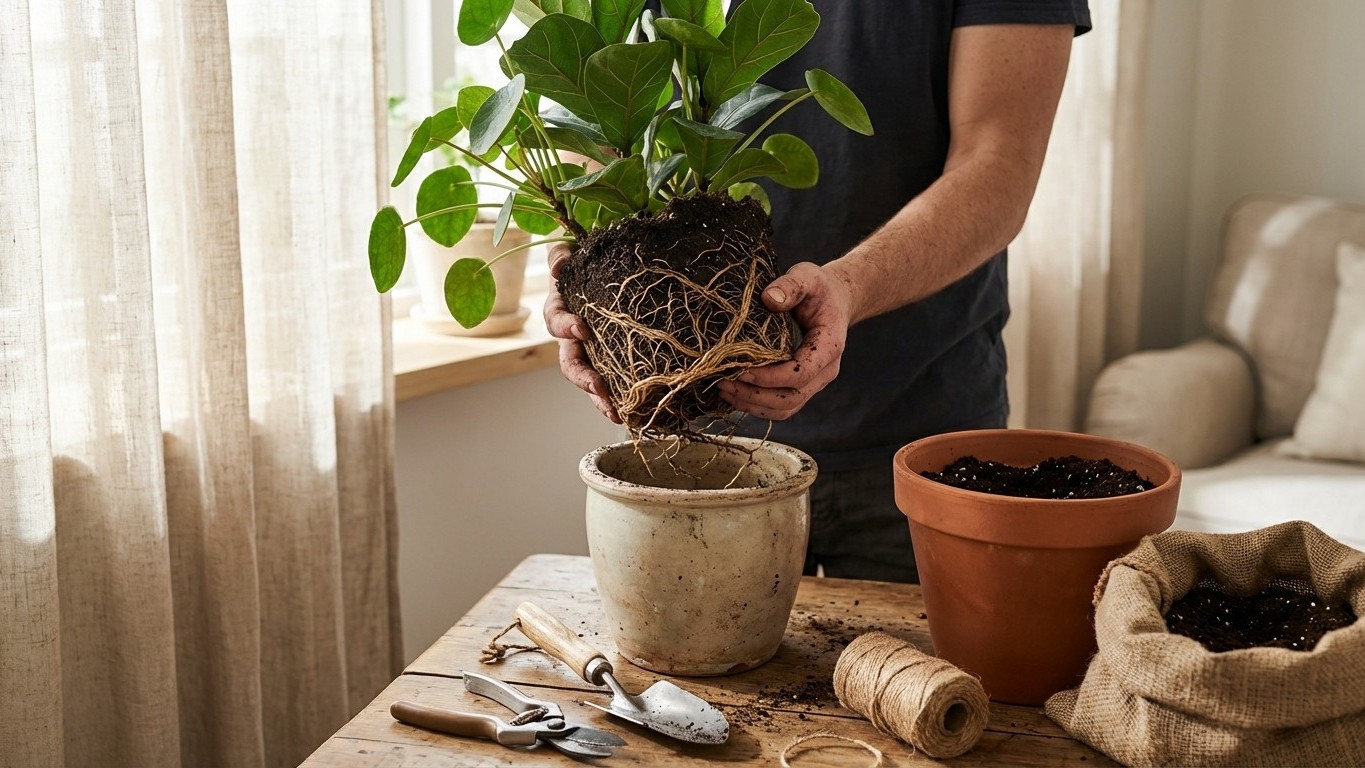
One day your indoor plant looks “fine.” The next, watering turns into a weird ritual: you pour, it drains instantly, and the leaves still look thirsty by evening. You didn’t suddenly forget how to care for plants. The calendar shifted, the roots moved, and the pot stayed the same.
That’s the real question behind when to repot indoor plants: not “Is it spring yet?” but “Is the plant asking for a reset?” Repotting is less about being punctual and more about reading signals, then choosing the least stressful moment to act.
This page is your practical timing guide. Signs first. Seasons second. Frequency third. No mythology, no rigid schedules, and a few rules that will save you from repotting out of guilt.
Why and when to repot an indoor plant?
Repotting is a controlled disturbance. You’re changing a plant’s root environment: space, oxygen, water flow, nutrient access. Done at the right time, it feels like opening a window in a stuffy room. Done at the wrong time, it can feel like moving house during an illness.
The consequences of repotting too early or too late
Repot too early, and you often create a moisture problem. Extra unused soil stays wet longer, especially in low winter light, and roots that prefer air start to suffocate. Result? A plant that looks “overwatered” even when you’re being careful, because the pot simply dries too slowly.
Repot too late, and you push the plant into a cycle of stress. Roots circle the pot, water runs straight through, fertilizer seems useless, and growth slows even in good light. In everyday terms, it’s like trying to live well on a mattress that has lost its shape. You can keep sleeping on it, but your body will complain.
Benefits of repotting for plant health
A well-timed repot brings three main benefits: renewed root room, fresher substrate structure, and better water management. Many people focus only on “bigger pot,” but the bigger win is often “better soil architecture,” more air pockets, less compaction, cleaner drainage.
If you want to go deeper on mixes and containers, the companion page on best soil for indoor plants is the right rabbit hole: it connects substrate choice, pot type, and fertilization to long-term stability.
How to recognize the signs it’s time to repot
Plants don’t read calendars. They show symptoms. Your job is to interpret them without panic, because one yellow leaf rarely means “repot now,” while three consistent signals usually do.
Visible roots or roots coming out of the drainage holes
Roots peeking from the bottom holes are the classic sign, and for good reason: the root system has explored every available pocket of space. You might also see roots circling on the surface, especially in plants with dense fibrous roots.
Concrete test: lift the nursery pot (or slide the plant out carefully if it’s easy). If you see a tight spiral of roots that holds the pot shape like a mold, you’re dealing with a root-bound situation. That doesn’t always demand an urgent upsize, but it does mean timing matters now, not “sometime this year.”
Slowed growth or yellowing foliage
Slower growth can be seasonal, especially in winter, but the red flag is slow growth during active-light months. If it’s late spring or early summer and your plant hasn’t produced new leaves in weeks, roots may be crowded or the substrate may be exhausted.
Yellowing leaves are trickier. They can indicate overwatering, underwatering, lack of light, pests, or nutrient issues. Repotting can help when yellowing is linked to poor root oxygen or compacted soil, but it can also make things worse if the plant is already stressed. Think “diagnose first, repot second.”
Substrate that dries too fast or holds water poorly
Pay attention during watering, because water behavior is a blunt truth-teller. When there are more roots than soil, water can rush down the sides and out the bottom before soaking in. You water twice, the pot still feels light, and you end up in a loop of frequent watering that never quite works.
The opposite problem happens too: old substrate becomes fine and compacted. Water sits on top, takes ages to absorb, then the pot stays wet for days. That’s not “rich soil.” It’s suffocation with a nice label.
Drainage and flow deserve their own focus. If you want a targeted guide on holes, amendments, and watering technique, see how to improve drainage for potted plants. Timing gets easier when your pots behave predictably.
Choosing the right time of year to repot
Season matters because it changes recovery speed. Repotting is like a haircut plus a change of shoes, the plant needs energy to adapt, and energy comes from light and warmth.
The best seasons: spring and early summer
For most indoor plants, the safest window is spring through early summer, when daylight increases and growth is naturally more active. In practical terms for the United States, many growers aim somewhere between March and June, adjusting for your local light and indoor temperature.
Why this window works: new roots form faster, damaged root tips recover quickly, and the plant can Actually use the fresh substrate rather than sitting in it. It’s also the time when you’re likely to notice active growth, which is a reliable “green light” for repotting.
Exceptions: plants to repot out of season (special cases)
Some situations don’t wait for spring. Root rot, a broken pot, severe hydrophobic soil that refuses to absorb water, or a pest issue tied to soil can justify an off-season repot. The goal shifts from “optimize growth” to “prevent decline.”
Another exception is newly purchased plants that are clearly in the wrong substrate for home conditions. Even then, rushing can backfire. A plant that just moved from greenhouse humidity to a dry Apartment is already adapting. Sometimes the smartest move is to stabilize light and watering first, then repot once you see fresh growth.
Flowering is its own category. Many plants resent root disturbance while Blooming. If the flowers are the reason you bought the plant, it’s usually wiser to wait until the display finishes, then repot when the plant pivots back to leaf and root growth.
How often to repot depending on the plant and its age
Frequency isn’t a moral rule. It’s a reflection of growth rate, root style, and how quickly the substrate breaks down in your home. A bright apartment with heating can age soil faster than you expect. A cooler room with gentle light can keep pots stable for years.
Annual, biennial, or decade-long rhythms depending on species
Fast growers in strong light can outpace their pots in 12 to 18 months. Many tropical foliage plants fall into this category when conditions are good. Repotting yearly can make sense, especially while the plant is still sizing up.
Plenty of houseplants do well with a 2 to 3 year rhythm. Some even prefer being a bit snug, which can encourage stability and, in certain species, better blooming. The goal isn’t maximal root space. It’s a root environment that stays airy and functional.
Then there are slow growers that can go much longer, sometimes many years, especially if you refresh the top layer of soil and manage feeding carefully. The limiting factor becomes substrate structure, not pot size.
Variations by plant type (succulents, tropical plants, and more)
Succulents and cacti often prefer a tighter pot and a fast-draining mix. They typically need repotting less often, unless the mix has broken down or you see signs of moisture staying too long. A common mistake is upsizing too aggressively, then wondering why the plant rots despite “hardly watering.”
Tropical foliage plants can be vigorous. When light is adequate, their roots and leaves respond quickly to fresh substrate. These plants often benefit from repotting more frequently during their growth phase, then less often once they reach a stable size.
Bulb-like and rhizome plants (think thickened storage organs) can push pots apart or become unstable when crowded. Here the trigger can be physical: tipping, cracking pots, or the plant lifting itself upward.
If you want a broader map of plant categories and what “normal” looks like across types, the hub page indoor plants care varieties houseplants helps you compare growth habits, watering behavior, and typical repot triggers.
Factors to consider before repotting
Repotting is not just “plant plus new pot.” Timing also depends on the plant’s current workload: fighting pests, recovering from drought, blooming, or adjusting to a new room. Choose your moment like you’d choose the day to deep-clean your home: not when you’re sick, not when you’re moving, not during a heatwave.
Overall plant condition (stress, disease, flowering)
If a plant is actively stressed, dropping leaves rapidly, or showing signs of disease, repotting can either help or push it over the edge. Your decision should be based on the cause.
Repotting is helpful when the root environment is the problem: sour-smelling soil, chronic sogginess, compacted mix, or obvious root rot. In that case, delaying can be worse than the repot stress.
Repotting is risky when the problem is external: a sudden cold draft, light shock, or pest infestation on leaves. Fix the environment first, then repot once the plant has regained momentum.
Light and temperature at the moment of repotting
Light is fuel for recovery. If your home is dim in winter, repotting becomes a gamble: the plant may sit still, leaving wet soil around slow roots. If you can provide bright conditions and steady warmth, out-of-season repotting becomes more feasible.
Temperature matters more than most people admit. Roots slow down in cool conditions. If you repot on a day when the room is chilly, then water, you’ve created the Perfect slow-dry scenario.
Practical rule: if you’re repotting off-season, keep the plant warm, keep light consistent, and water conservatively until you see new growth.
Frequently asked questions about repotting houseplants
How do you know when to repot indoor plants?
Look for clusters of signals rather than a single symptom. The most reliable set is: roots emerging from drainage holes or circling densely, water draining too quickly (or refusing to absorb), and stalled growth during a bright season. Add instability, tipping, or a cracked pot, and the case gets stronger.
If you’re unsure, do the gentle inspection: slide the plant out slightly and check whether soil still exists between roots. If it’s mostly roots with little substrate, timing has arrived.
What is the best month to repot houseplants?
There isn’t one universal month because homes and climates differ. Still, many indoor gardeners in the U.S. find the sweet spot in spring, often from March through May, with a workable extension into early summer if the plant is actively growing.
A better way to pick the “month” is to follow the plant: repot when you see fresh new growth starting and the light in your space is noticeably stronger than midwinter.
Can you repot houseplants in winter?
Yes, but it’s conditional. Winter repotting tends to be smoother when your indoor conditions mimic a growing season: warm room, bright window exposure, stable care. It’s also justified when you’re solving a problem that can’t wait, like root rot or a pot that’s physically failing.
Two situations commonly invite regret: repotting a dormant plant that is doing nothing, or repotting a plant that is flowering and likely to drop buds under stress. Winter is not “forbidden,” it’s just less forgiving.
How often do indoor plants need repotting?
Many houseplants land somewhere between every 1 to 3 years, but that range hides the real variable: your conditions. Bright light and regular watering can accelerate growth and substrate breakdown. Low light can slow everything down, including the need to repot.
Use “check intervals” instead of “repot intervals.” For fast growers, assess every 10 to 12 months. For slow growers, every couple of years may be enough. The plant’s water behavior will usually tell you before the calendar does.
What happens if you never repot a plant?
Sometimes, nothing dramatic happens for a while, especially in slow growers. Then the slow decline begins: compacted substrate, erratic watering, reduced nutrient availability, roots circling and strangling their own space, and increased sensitivity to mistakes.
In daily life terms, it’s like driving a car without ever changing fluids. You can get away with it, until one day the system stops being forgiving.
Useful links: go further on repotting and care
If this page answered the “when,” the next step is mastering the “how,” because technique influences timing. A careful repot in the right substrate can let you wait longer next time. A rushed repot into a poor mix forces you to intervene again sooner.
- Need the step-by-step method, plus common mistakes? See how to repot a houseplant.
- Choosing mixes, pots, and fertilization strategy in one place: best soil for indoor plants.
- Drainage problems, soggy soil, and how pot setup changes watering outcomes: how to improve drainage for potted plants.
- For a wider view of plant types and care expectations: indoor plants care varieties houseplants.
One last idea worth keeping: repotting is not a yearly tradition, it’s a response. If you start treating watering day as a diagnostic moment, not a chore, you’ll spot the repot window early, before your plant has to shout. Which plant in your home is quietly hinting that it wants a new start this spring?