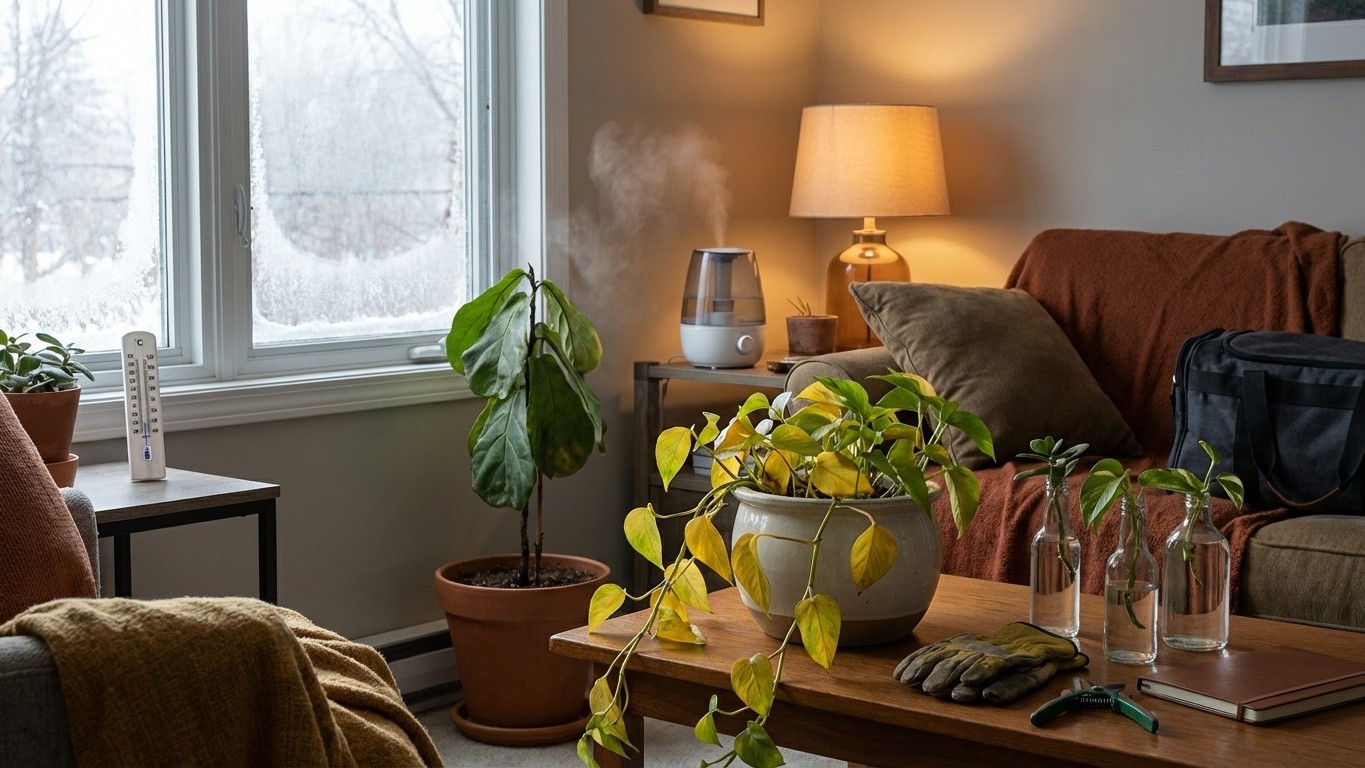
December arrives, and half your pothos is yellowing, your fiddle leaf fig is sulking by a drafty window, and you’re about to leave for two weeks over the holidays. Sound familiar? Winter is the single most demanding season for indoor plants care varieties houseplants, and for good reason: everything the plant relies on, light, warmth, humidity, drops at once. What makes it worse is that most of the standard care routines people follow in spring simply don’t work in January, especially when you need to know how to keep houseplants alive while on vacation.
This guide treats winter as a complete operational shift, not just a tweak to your watering schedule. It covers the core seasonal adjustments, what to do when you’re away, the logic of winter pruning (for detailed guidance, see our comprehensive guide on how to prune indoor plants), and whether propagating in cold months is worth your time (for more detailed techniques, see our guide on how to propagate houseplants (cuttings)). Think of it as your annual care calendar, compressed into one practical reference.
Why Seasonal Routines Matter More Than You Think
From spring to fall, longer days and warmer temperatures push plants to produce new growth (for comprehensive guidance, see our guide on how to make indoor plants grow faster). In winter, when days shorten and temperatures drop, that growth slows down or halts entirely, and plants enter a period of dormancy.
That biological shift is the foundation of everything that follows. A plant that isn’t actively growing doesn’t need feeding, barely needs watering, and is far more sensitive to stress from overcare than from neglect.
The trouble is that our domestic routines don’t adjust. We keep watering on the same schedule we used in August. We forget that the heater is now running six hours a day, turning our living room into something resembling a dry desert.
Indoor humidity levels are always lower than those in a greenhouse, and during winter when furnaces are running, indoor air can be as dry as desert air.
That’s not a poetic exaggeration, it’s the actual physiology of your heated apartment working against your plants.
Winter Care for Indoor Plants: The Core Adjustments
Light: Compensating for Short Days
In winter, the sun slips lower in the sky and light levels near windows drop up to 50%.
Fifty percent. That means a plant that was thriving at a north-facing window in summer may be operating in near-darkness by December.
Houseplants that grew near a sunny eastern or northern window in summer may need a southern or western exposure in winter, and plants near western or southern windows that needed filtered light in summer may now be able to withstand direct sun. For more detailed strategies on managing these lighting challenges, check out our comprehensive guide on how to care for houseplants in winter (less light).
Repositioning is the first, cheapest fix.
Plants that need the most light should go in south- or west-facing windows, close to but not touching the glass. To keep plants from leaning toward the light, rotate them a quarter-turn after each watering.
For rooms with truly inadequate natural light, artificial supplementation is an option.
Fancy “grow” bulbs and red-blue LEDs aren’t necessary for the average houseplant, a “daylight” or “full-spectrum” LED bulb equivalent to at least 60 watts will provide enough supplementary lighting to grow most plants indoors just fine.
Leggy, pale new growth is the main symptom of insufficient winter light.
Spindly, weak growth means not enough light. Don’t be afraid to prune leggy plants back — it will encourage branching.
More on that in the pruning section below. For a full breakdown of adapting to reduced light, see how to care for houseplants in winter (less light).
Watering and Humidity: The Two Biggest Mistakes
More houseplants die from overwatering than from any other cause.
In winter, that risk multiplies.
Watering is the most common winter plant care Mistake. Because plants grow more slowly, they need much less water than they do in spring and summer.
The soil test replaces the calendar:
poke your finger into the soil up to 2 inches — if it’s dry, water.
If it’s still damp two inches down, put the watering can away.
Cold water can shock roots. Always let tap water sit until it reaches room temperature before watering.
That 30-second step costs nothing and eliminates one unnecessary stressor during an already difficult season.
Humidity is the other front.
Indoor heat dries the air dramatically — often dropping humidity levels below 30%. Many tropical plants prefer 40–60% humidity.
Solutions range from simple to more involved:
place plants on a tray of water filled with pebbles, but don’t allow the bottom of the pot to sit in standing water, which causes root rot. Humidity can also be increased by misting plant leaves, using a room humidifier, and grouping plants together.
Grouping, in particular, works well because
as leaves transpire, they give off moisture, creating a slightly humid microclimate.
Temperature and Drafts
During winter, houseplants are more vulnerable to temperature extremes, which can cause stress and leaf drop. Keep plants away from heating vents and other heat sources, and avoid exposing them to cold drafts.
The gap between a warm room and a cold window pane can swing by 15–20°F within a few inches — a difference plants feel immediately.
Plants that sit in windows can be affected if the interior of the window gets too cold. Even leaves that touch cold glass may be damaged.
Cacti and succulents are the exception to this logic.
They actually thrive if kept cool during winter months, as lower temperatures encourage sturdy plants and stimulate flower bud development. Cool temperatures of 55–60°F are ideal, but don’t let them drop below 45°F.
Fertilization: When to Stop
Most plants are dormant in winter and don’t need fertilizer until late winter or spring.
Feeding a dormant plant doesn’t boost growth — it stresses the root system and invites salt buildup in the soil.
In mild climates, you can continue fertilizing through winter. In colder climates where natural light levels are low, don’t fertilize houseplants in winter — resume when outdoor plants wake up in spring.
The rule of thumb: if the plant isn’t actively pushing new leaves, don’t feed it.
Vacation and Absence: Protecting Plants Through the Holidays
Two weeks away in January is one of the most common scenarios plant owners face. The good news is that winter dormancy actually works in your favor.
If you plan to be away for a week or less, watering thoroughly before departure will be sufficient, especially during winter months when plant growth slows and some plants even go semi-dormant.
Preparation Before Leaving
A few actions taken the day before departure make a significant difference.
In addition to pruning off any dead, dying, or unhealthy-looking foliage, you can prune off any buds and flowers, which usually require more frequent waterings to stay healthy.
Move plants slightly away from their light source to slow transpiration, and group humidity-lovers together.
Temperature management matters too.
When going away in winter, turning the thermostat down to 62–65°F keeps the house cool because hot, dry air from the heater dries out indoor plants more quickly.
You want the house stable and cool, not cold, not warm and blasting dry air.
For longer absences, the RHS offers sound advice:
in winter, houseplants can be left for a week or two with no attention, except to ensure that the temperature does not fall below the minimum they can tolerate. Move plants away from windows where it can get cold, and water them before leaving.
Passive Watering Techniques
For trips longer than ten days, passive irrigation systems prevent the worst outcomes. The wick method is the most reliable low-tech option:
place one end of the wick in a water container, making sure it reaches the bottom, and poke the other end a couple of inches into the just-watered potting soil, being careful not to disturb the roots.
Cotton cord works well as the wicking material.
Another approach uses the bag method:
water your plant thoroughly and cover with a clear plastic bag to just below the lip of the planter, creating a makeshift greenhouse. Cut a couple of slits in the plastic to allow for air circulation, plants need to breathe too. Use sticks to hold the bag up and away from the foliage.
For more granular strategies matched to the specific length of your absence, see our full guide on how to keep houseplants alive while on vacation.
Pruning Indoor Plants in Winter: What the Season Allows
When and Why to Prune
The question isn’t whether to prune in winter — it’s what kind of pruning. Removing dead, yellowing, or pest-harboring leaves is always appropriate, regardless of season.
Minor pruning can be carried out throughout the year, wilting parts and dead and weak plant matter can be pruned at all times.
For anything more significant, timing shifts toward the end of winter.
The best time to prune indoor plants is right at the beginning of the growing season — for most houseplants, late winter or early spring, when days are getting longer and plants are starting to wake up.
The logic is simple: pruning triggers a growth response, and you want that response to happen when the plant has the light and energy to follow through.
If you’re thinking about a more substantial reshaping, the best time to tackle it is late winter or early spring, when spring’s longer daylight hours will give the plant the boost it needs to recover.
Mid-winter pruning of non-flowering foliage plants, however, is perfectly reasonable — particularly when the goal is to remove leggy growth caused by low-light stretching.
For non-flowering houseplants, pruning in winter will help encourage the development of new growth by the time spring arrives several months later.
How to Prune Without Causing Harm
Start with sterilized scissors or pruners to discourage the spread of disease. Sterilize cutting tools with a solution of bleach and water, or hold the pruner blades in a flame for several seconds. Make sure pruners are sharp, a dull blade results in a sloppy cut that encourages pests and disease.
The golden rule on volume:
only prune a relatively small percentage of your houseplant’s foliage at one time. Aim for at most 10 to 20% of foliage removed during a session. It is better to prune a little less than you need, as you can always go back.
Cut above a leaf node, that’s where new growth will emerge. Avoid cutting into bare stem with no nodes below, as nothing will regrow from there.
For a comprehensive technique guide covering cut placement, tools, and what to do with trimmings, explore how to prune indoor plants.
Propagating in Cold Months: Possible, With Caveats
Plants That Work in Winter
Propagating plants in winter isn’t always successful since plants grow more slowly and cuttings are generally harder to root. But if you need to salvage broken plant stems or simply want a quiet winter afternoon with some indoor gardening, propagation may still be worth a try during the colder, darker months.
Several species handle winter propagation reliably.
Golden pothos is one of the hardiest houseplants to propagate in winter because of its natural tolerance to temperature fluctuations and vigorous growth habit. This tropical vine adapts well to indoor conditions year-round and continues to grow even when temperatures dip. Pothos propagates easily via stem cuttings, making it a reliable choice for cold-weather propagation.
The Chinese money plant (Pilea peperomioides) is a fantastic candidate for winter propagation because it naturally thrives in cooler climates. This evergreen perennial evolved in the mountain forests of China at high altitudes, so it’s well-adapted to cool, humid conditions that mimic a typical winter home. Its natural resilience to lower temperatures means it will continue to produce offshoots and root successfully even when the days are shorter.
Philodendrons, tradescantia, spider plants, and African violets round out the reliable winter propagation list.
Keys to Winter Propagation Success
Propagation takes a little longer in winter than in spring, which can increase the chances that some cuttings will rot before they root. However, by adjusting your propagation setup, you can help cuttings root faster and boost your propagation rates.
Two adjustments matter most: light and humidity.
In winter, when growth is slower and conditions are less ideal, it’s especially important to take a healthy cutting. Look for a growing stem or leaf without blemishes, that is not wilting or dry.
From there, creating a mini humidity chamber makes a real difference:
cover the container with a large plastic bag to create artificially high humidity, which is important since the cuttings don’t have roots to take up moisture and the leaves will continue to lose water.
Place in bright indirect light, not direct sun, which combined with a plastic covering can scorch the cuttings.
The best time to propagate houseplants is in spring to early summer when plants do most of their growing, winter propagation is always a secondary option, not the ideal window. That said, for a practical guide to all methods including water, substrate, and sphagnum moss, see how to propagate houseplants (cuttings).
Your Winter Houseplant Checklist
Translating all of this into a usable seasonal rhythm means thinking in four modes: what to do before winter hits, what to do during the darkest months, what to handle before a vacation, and what to revisit as late winter brings longer days. Here’s a condensed framework:
Before winter (October–November): Move light-hungry plants to south or west windows. Clean glass panes to maximize light transmission. Set up pebble trays or a humidifier. Stop fertilizing.
During deep winter (December–January): Water only when the top 2 inches of soil are dry. Let tap water reach room temperature before use. Remove dead and yellowing leaves. Watch for spider mites and other pests that thrive in dry, warm interiors.
Some of the most common winter pests include aphids, whitefly, scale, and spider mites, inspect soil, stems, and leaves including the undersides regularly.
Before any absence: Water thoroughly, prune dead growth, lower the thermostat slightly, set up a wick or bag system for trips over 10 days.
Late winter (February–March):
If you want to strengthen the plant and make it branch and grow thicker, schedule pruning for late winter when the growing season begins. In spring there is enough light to support growth, and the plant regenerates well.
Gradually resume fertilization as new growth appears.
Common Winter Mistakes (And the Fix)
The single most recurring error is continuing to water on a summer schedule.
Growth slows down in winter, so many plants need much less water. Cool temperatures and low light keep the soil from drying out too fast, but plants kept near heat vents or in a room heated with a woodstove are
an exception, they may dry out faster than expected. The finger test always wins over the calendar.
The second most common mistake: letting plants touch cold windows. A plant can look fine in October, then start dropping leaves in December for no apparent reason — often it’s leaf-to-glass contact causing cold damage without the owner ever noticing.
If you move plants closer to a window, make sure they’re not up against the cold glass or catching any drafts.
A third trap is fertilizing out of anxiety. Seeing a slow, pale plant in January and reaching for the fertilizer bottle is instinctive — and almost always counterproductive.
Fertilization should not begin until spring. Wait until active growth begins before starting your spring and summer fertilization schedule.
Finally, over-pruning during the deepest part of winter.
Hold back on any major pruning during fall and winter — your plants won’t be growing as quickly, and it could take a longer time for them to put out new growth or recover from being trimmed too much.
Save the reshaping for February. Stick to maintenance cuts now.
Frequently Asked Questions
How do I take care of my indoor plants in winter? Focus on four variables: reduce watering frequency and only water when the top 2 inches of soil are dry; maximize available light by moving plants to south-facing windows and supplementing with a full-spectrum LED; raise humidity through grouping, pebble trays, or a humidifier; and stop fertilizing until active growth resumes in spring.
Can you propagate houseplants during winter?
You can technically propagate houseplants at other times of the year as long as your plants aren’t in bloom.
Success rates are lower than in spring, but pothos, philodendrons, Pilea, tradescantia, and African violets are reliable options. Use a humidity dome, provide adequate light, and expect rooting to take longer than usual.
How do I keep my houseplants alive while on vacation in winter? For trips under a week, a thorough pre-departure watering is usually sufficient, since plants are growing slowly. For longer absences, combine a wick watering system with a plastic bag humidity dome and a slightly lowered thermostat to reduce drying.
If going away for longer than a couple of weeks, it may be preferable to arrange for a trusted neighbor, friend, or relative to water the houseplants while you’re away.
Should I prune my indoor plants during the colder months? Light maintenance pruning, removing dead, yellowing, or pest-damaged leaves, is appropriate any time. More significant reshaping is best saved for late winter or early spring, when the plant can mobilize energy to respond to cuts. Avoid heavy pruning in December or January.
What is the best way to adjust watering and lighting for houseplants in winter?
The secret to helping plants survive winter is adjusting care routines to suit seasonal growing conditions.
For watering: abandon schedules, adopt the finger test, and use room-temperature water. For light: relocate to the brightest available window, clean the glass, rotate plants quarterly, and consider a full-spectrum LED supplement for rooms with limited natural light.
Winter isn’t a season to endure with your plants, it’s a season to understand. The real question worth sitting with: how many of the plants you’ve lost over the years weren’t failing because of neglect, but because you kept caring for them exactly as you did in July?