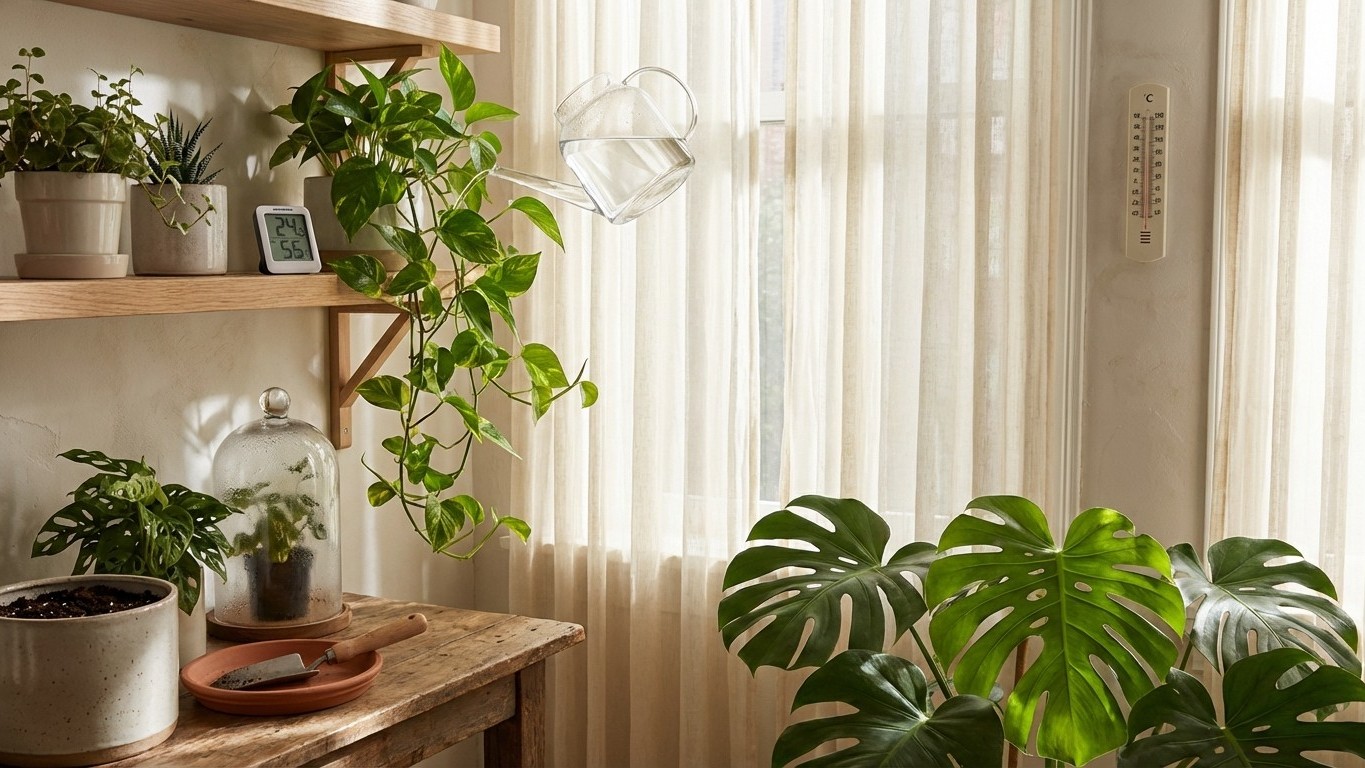
Most houseplants don’t die from pests or Neglect. They die from good intentions applied in the wrong direction. Too much water, especially when you don’t know how to avoid overwatering houseplants or how often to water houseplants, a window that offers the wrong kind of light, air as dry as a heated hotel room in January, these everyday conditions quietly stress your plants until the damage becomes hard to reverse. The good news? Once you understand the four pillars of indoor plant care, light, water, humidity, and temperature, you stop guessing and start observing. And your plants will tell you everything you need to know.
This guide is built around that idea: before buying a new pot or a fancy fertilizer, master the basics. They apply to virtually every species you’ll bring home, from the resilient pothos to the theatrical fiddle-leaf fig. For a broader overview of varieties and their specific needs, start with our indoor plants care varieties houseplants guide, it’s the pillar resource this article connects to.
Why Understanding Your Plant’s Core Needs Changes Everything
Success with houseplants is governed by careful management of light, temperature, water, nutrients, and humidity, along with using the proper potting medium.
That sentence, from Oklahoma State University’s extension service, sounds straightforward. Yet the majority of plant failures come down to one root cause: treating all plants the same, regardless of where they Actually come from.
Think about it this way. A monstera originates from the dappled shade of a Mexican or Central American rainforest floor, where humidity hovers near 80% and temperatures rarely dip below 60°F. A cactus evolved in a desert where weeks pass without rain and the sun bakes the soil. Understanding the ideal humidity for houseplants and knowing the best light for indoor plants (low light vs bright indirect) based on their natural habitat is crucial. Bringing both home and watering them on the same Tuesday schedule is like giving a marathon runner and a sprint swimmer the same training plan. The results won’t be pretty.
Every plant has a preferred temperature range, often based on its natural habitat. Understanding the best temperature for indoor plants is crucial because photosynthesis only takes place optimally at the right temperature, and whenever the temperature is too high or too low, this vital process slows down, and so does the plant’s overall health.
This is the mechanism behind nearly every care Mistake beginners make, not bad luck, just mismatched conditions.
Light: The Foundation of Photosynthesis (and the Most Misunderstood Variable)
Light is one of the most important factors for growing houseplants. All plants require light to convert carbon dioxide and water into energy, and different plants need different levels of light.
What makes light tricky indoors is that our perception of a “bright room” and what plants actually experience are very different things.
Types of Light for Indoor Plants
A bright indoor south-facing windowsill receives only 5,000–10,000 lux, while a north-facing windowsill on a winter day can drop to just 200–500 lux.
For context, full outdoor sun reaches up to 100,000 lux. Even the most light-drenched apartment offers only a fraction of what most plants’ ancestors evolved under.
Indoors, light drops off dramatically with distance: just one meter from a window, light can fall by 75%.
That’s not a small margin of error, it’s the difference between a thriving plant and one that’s merely surviving.
Four light categories matter for most houseplants:
- Direct light: Sun hitting the leaves directly, suited for cacti, succulents, and some herbs
- Bright indirect: Bright room, no direct rays, ideal for monsteras, pothos, and most tropicals
- Medium light: A few feet from a window, works for philodendrons, ficus, and bromeliads
- Low light: North-facing corners, reserved for cast-iron plants, ZZ plants, and some ferns
How to Determine Your Home’s Light Exposure
South-facing windows provide the most light: direct sunlight within 2 to 3 feet of the window, bright indirect sunlight up to 5 feet from the window, and semi-shade up to 8 feet away.
East-facing windows are the most plant-friendly, an east-facing window captures direct sun in the morning hours, when the light is rich in red wavelengths but gentle in intensity, and by noon the sun shifts higher and no longer beams straight in, leaving the room bright but shaded for the rest of the day.
Not sure how much light a specific spot gets?
Try the shadow test: put your hand in the spot at midday. A sharp shadow means bright light. A blurry shadow means medium. No shadow at all? You’re in low light.
Simple, free, and surprisingly accurate.
A common sign that a plant isn’t getting enough light:
leggy, stretched growth is an indicator of insufficient light. Cacti get thin and grow tall, while plants like pothos develop bigger spacing between leaves, a clear sign that the Houseplant is not getting sufficient amounts of light.
Matching Plants to Available Light
Plants that can tolerate full sun and bright light thrive in south-facing windows (such as cacti, aloe vera, and ponytail palms), while plants that like partial shade or moderate light do best in east- and west-facing windows (such as ficus, philodendrons, monstera, and bromeliads).
If artificial light is your only option,
specially built fluorescent plant lights or a 100-watt lamp placed about three feet above plants can supplement natural light effectively.
For a deep dive into the difference between low light and bright indirect environments, and which plants belong in each, see our dedicated guide on best light for indoor plants (low light vs bright indirect).
Watering: The Art of Reading Soil, Not the Clock
More houseplants die from overwatering than from anything else.
That statistic bears repeating, not because overwatering is hard to avoid, but because it’s so easy to commit with the best intentions. Watering on a fixed schedule feels responsible. The problem is that plants don’t operate on schedules.
What Actually Influences How Often You Water
Watering frequency depends on the potting medium used, season, amount of light, temperature, humidity, plant species, and pot size.
That’s seven variables — every one of them shifts throughout the year.
Clay pots are porous and dry out faster, while plastic pots are better at retaining moisture.
A plant in a terracotta pot sitting in a sunny south-facing window in July might need water twice a week. Move it to a north window in a plastic pot in December, and once every two weeks could be too much.
Plants typically need more water during the growing season (spring and summer) and less during the dormant season (fall and winter) — and this includes houseplants.
In practice, this means your entire watering routine should shift seasonally, not stay static year-round.
Watering Techniques That Actually Work
Top watering, the most common method, works well when done correctly.
It’s much better to give generous amounts infrequently than to give small amounts frequently. The goal is to thoroughly water the plant by covering the entire soil surface, then let the top few inches of soil dry out before watering again.
Always water until the excess water drains out of the holes.
Partial watering, where only the top inch gets wet, is one of the most common, least discussed mistakes.
Bottom watering is the alternative.
Watering from the bottom can benefit plants too: set a pot with drainage holes on a saucer or in a shallow pan
and let the soil absorb moisture upward for about 15–20 minutes. This method works especially well for plants that dislike wet foliage, like African violets.
No matter how or when the plant is watered, room-temperature water is important to avoid shock to the root system.
Cold water from the tap is a simple, common stressor that most people never consider.
Preventing Overwatering and Underwatering
The challenge is that both problems can look alike at first glance.
Too little water will result in your plant’s leaves feeling dry and crispy to the touch, while too much water results in soft and limp leaves.
The soil is your best diagnostic tool.
The simplest way to gauge your plant’s watering needs is by feeling the soil, the old trick of sticking your finger into the soil up to the knuckle has merit. If it’s soggy or has standing water, you’re overwatering. If it’s dry an inch below the surface, it’s time to water.
The most severe consequence of overwatering is root rot, characterized by a foul smell and black, mushy roots.
Once root rot sets in, recovery is possible but requires repotting and trimming affected roots — not a pleasant afternoon project. Prevention is far simpler:
houseplants should be planted in well-drained growing media such as good-quality potting soil (not garden soil).
Adding perlite to a standard potting mix dramatically improves drainage and forgives occasional overwatering.
For practical, season-by-season watering guidance tailored to different plant types, our detailed resource on how often to water houseplants breaks it down simply.
Humidity: The Hidden Variable Most Apartment Dwellers Underestimate
You can’t see humidity. You can’t feel it the same way you feel temperature. That invisibility is exactly why it’s the most overlooked pillar of indoor plant care, and the one that explains those mysterious crispy leaf tips despite regular watering.
Why Humidity Matters for Houseplants
During colder months, heating systems circulate dry, warm air throughout the house, and in summer, air conditioning systems circulate dry, cool air. Both conditions often create an environment that has less than 10 percent humidity, well below the 70 to 90 percent relative humidity levels found in the native climates of most tropical plants.
What does low humidity actually do to a plant?
When water reaches the leaves, it is released into the atmosphere through tiny openings. High humidity slows this water loss. Plants grown indoors with low humidity or in a draft lose more water through transpiration, so their root systems require more water.
The plant effectively dehydrates faster — regardless of how often you water the soil.
A common sign of insufficient humidity is browning and withering of foliage.
What Humidity Level Do Plants Actually Need?
While some tropical plants are used to humidity levels as high as 90%, a 50% to 60% humidity level is ideal for most mature houseplants.
There’s nuance here, though.
As a general rule, plants with thicker leaves can tolerate lower humidity levels
— which explains why succulents and cacti are so unfazed by dry apartment air, while ferns dramatically wilt within days.
Tropical plants like ferns, philodendrons, and orchids flourish in environments with relative humidity levels of 60% or higher, which helps prevent crisp leaf tips and promotes robust growth.
During the winter heating season, indoor relative humidity levels can easily fall below 30%.
That’s a significant drop, roughly equivalent to moving your plants from a lush greenhouse to a desert in terms of moisture availability.
Practical Ways to Raise Humidity at Home
Several methods exist, with varying effectiveness. A humidifier is the most reliable:
a humidifier is a device that adds humidity to the air through evaporation, and it’s probably the easiest way to raise the humidity in your room.
Grouping plants together also helps —
when plants are placed together in groups, the air and moisture are trapped between them, and they can also use each other’s moisture from the soil.
The pebble tray method (placing pots on a tray filled with wet pebbles) is widely recommended, though some research suggests its room-level impact is limited, the localized effect right around the plant canopy can still be helpful.
It may also become necessary to move houseplants to the Kitchen or bathroom, where air can be more humid.
Just verify that light levels in those rooms are adequate — a steamy bathroom with no window won’t save a light-hungry plant.
A hygrometer measures the amount of moisture in room air, and many thermometers already come with a hygrometer built in, acquiring a device that measures both temperature and humidity makes practical sense.
To understand the full spectrum of humidity needs by plant type, and how to spot and fix humidity stress before it becomes visible — our guide on ideal humidity for houseplants goes deeper.
Temperature: The Invisible Ceiling (and Floor) of Plant Health
Room temperature feels like a non-variable. You set the thermostat, the house stays warm. Done. Except plants experience your home very differently than you do, they’re sitting next to cold window glass in January, directly above a baseboard heater, or in the path of an AC vent they can’t move away from.
Ideal Temperature Ranges by Plant Type
During daylight hours, the typical temperature range for indoor plant life comes between 65°F and 75°F, dropping off slightly at night.
Most houseplants do best when grown at 65 to 75°F in the daytime and 55 to 65°F at night, and many houseplants actually require a temperature drop of 10°F from day to night.
That natural cycle mirrors their native environments and can even trigger flowering in some species.
The temperature preferences of indoor plants are categorized as cool, intermediate, or warm. Cool is 40 to 50°F, intermediate is 60 to 75°F, and warm is greater than 75°F.
Most common houseplants, pothos, philodendrons, peace lilies, ficus, fall into the intermediate category.
Tropical plants love warm temperatures (65–85°F) and high humidity.
Managing Drafts, Heating, and Air Conditioning
A sudden temperature change carries the possibility of burning or damping off the plant if it is set near a draft, vent, or heat source.
This is the detail most people miss: it’s not just the average temperature that matters, but the consistency of it.
Indoor plants, especially flowering varieties, are sensitive to drafts or heat from registers. Protect them from sudden, brief changes in temperature. Do not locate your indoor plants near heat or air conditioning sources.
Excessively low or high temperatures may stop growth or cause a spindly appearance, foliage damage, leaf drop, or plant failure. However, most indoor plants tolerate normal temperature fluctuations.
The real danger zone is the microclimate right at the window glass in winter —
locations near windows may be sunny during winter, but they are also cool, often 10°F colder than the middle of the room.
A plant that looks perfectly placed for light might be quietly cold-stressed every night from October through March.
For specific temperature thresholds by plant family, including how to handle seasonal transitions and heating challenges, our companion article on best temperature for indoor plants covers these details thoroughly.
Building a Consistent Care Routine
The four pillars above aren’t a checklist to follow once. They’re a framework for observation, an ongoing conversation between you and your plants. Once you’ve placed each plant in appropriate light and given it the right pot and soil mix, the daily reality of care simplifies into a rhythm.
A Weekly Care Checklist
These five actions, done consistently once a week, cover the vast majority of indoor plant care needs:
- Check soil moisture with your finger or a moisture meter before watering, never water on autopilot
- Inspect leaves for color changes, spots, crispy edges, or unusual drooping
- Confirm no plant is touching cold window glass or sitting directly above a heat vent
- Check the humidity (especially in winter) with a hygrometer, adjust if below 40% for tropical plants
- Rotate pots a quarter turn to ensure even light exposure and balanced growth
These habits take about ten minutes for a modest collection. The return? Plants that stay ahead of problems instead of recovering from them.
When to Go Beyond the Basics
The four pillars of light, water, humidity, and temperature are the foundation, but they don’t cover everything. Soil composition, fertilization, repotting timing, pest identification, and propagation all become relevant once your plants are thriving and you want to go further. Each pillar also has nuance that a single article can’t fully explore.
That’s exactly what the sister pages in this guide are designed for. Our main resource on indoor plants care varieties houseplants provides species-level guidance. For light specifics, the best light for indoor plants (low light vs bright indirect) article answers the exact questions that come up when you’re trying to place a new acquisition. Watering frequency by season is broken down in how often to water houseplants, humidity strategies in ideal humidity for houseplants, and temperature management, including heating and drafts, in best temperature for indoor plants.
Frequently Asked Questions About Indoor Plant Care Basics
How do I know if my houseplant is getting enough light?
Too little light can result in tall, lanky, small-leafed plants, while too much light can cause leaf burn on sensitive species.
If your plant is stretching toward the window or producing smaller leaves than usual, it needs more light. The shadow test (described earlier) is a quick diagnostic. For precision, a basic light meter app on your smartphone can give you foot-candle readings.
What’s the ideal watering frequency for indoor plants?
There is no universal answer — and that’s the point.
It would be great if plants followed a calendar when it came to watering needs, but they don’t, and you shouldn’t either.
Small pots may require watering every two to three days, while large pots may not need watering more than every seven to fourteen days.
The soil is your guide: water when the top inch or two feels dry for most tropical plants, and wait until the soil is nearly completely dry for succulents and cacti.
How do I maintain good humidity levels for my plants in an apartment?
The most reliable way to raise humidity levels is to use a humidifier. If you don’t have one, you can place a plant’s pot in a large saucer filled with gravel and water — being careful not to let the bottom of the pot sit in the water, as the water evaporates and fills the surrounding air with moisture.
Grouping plants together also creates a localized humid microclimate. In winter, monitoring with a hygrometer is the only reliable way to know whether your interventions are actually making a difference.
The real shift in becoming a confident plant parent isn’t about memorizing care rules. It’s about learning to look, really look, at what your plants are telling you through their leaves, their soil, and their growth patterns. That skill, once developed, makes everything else fall into place. What would your plants tell you if you checked on them right now?