
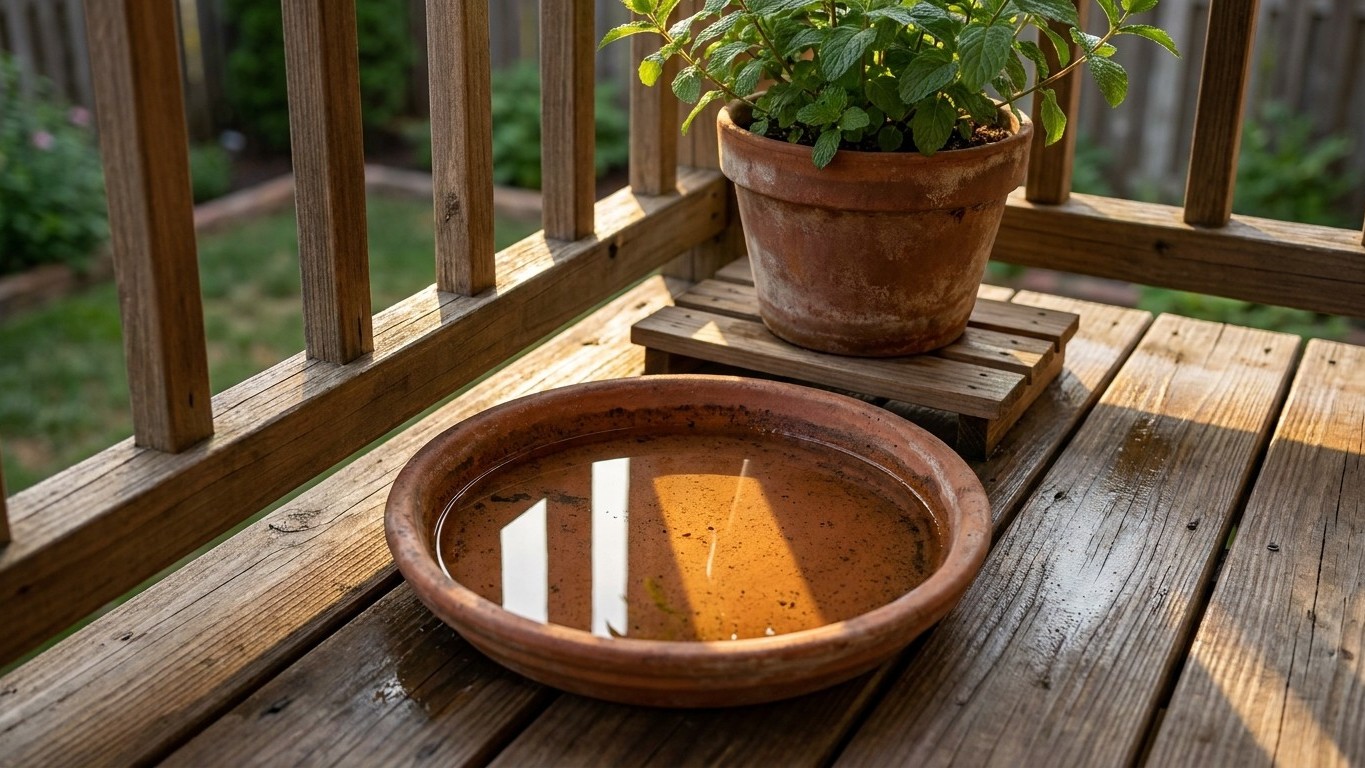
Five millimeters. That’s less than a quarter-inch, barely enough to cover the bottom of a bottle cap. And yet that shallow puddle sitting in your terracotta saucer is exactly what a female Asian tiger mosquito needs to turn your balcony into a nursery. If you have ¼ inch (0.6 cm) of standing water, that is enough for some mosquito species to lay their eggs. One gravid female can produce a staggering number of offspring from that single puddle, and she’ll be back to do it again in a matter of days.
Most gardeners think of saucers as a courtesy to their plants, a way to catch runoff and let roots sip water slowly. In practice, that little dish has become one of the most efficient mosquito factories in the American backyard. Flower pots and plastic containers were the container types most likely to contain water, and flower pots contained disproportionately more larval mosquitoes than other types of containers, with the study’s author noting that “flower pots and associated saucers underneath them” served as preferred larval development habitat. Even more telling: in that same Arizona survey, discarded tires were not a problem, with only two of 78 tires containing immature mosquitoes, and unmaintained pools contained none at all. The villain wasn’t the abandoned junk in the alley. It was the well-tended pot on the patio.
Key takeaways
- A female tiger mosquito needs less water than a bottle cap to lay hundreds of eggs that survive winter
- 74% of households unknowingly breed mosquitoes in their balcony saucers without realizing it
- One neglected pot on the fourth floor can seed mosquito problems across dozens of nearby homes
Why a Thimble of Water Is All It Takes
Tiger mosquitoes didn’t evolve around lakes or ponds. They evolved around tree holes, the tiny pockets of rainwater that collect in bark crevices. That evolutionary history explains why your saucer looks, to a female searching for a nursery, like prime real estate. The Asian tiger mosquito needs only a small amount of water to lay eggs, and bowls, cups, fountains, tires, barrels, vases and any other container storing water make a great “nursery,” with one cup of water able to produce thousands of mosquitoes.
The math gets uncomfortable fast. Female mosquitoes lay 100-300 eggs on or near standing water after a blood meal, and as little as a bottlecap of water is needed for eggs to hatch. Under the right conditions, that egg-to-adult journey moves at a pace most homeowners underestimate. Georgia’s Department of Public Health reports that during a hot summer, tiger mosquitoes can go from egg to adult in as little as one week. Skip watering your plants for a single vacation, and you may come home to a swarm rather than a saucer.
Here’s the part that trips up even careful gardeners: dumping the saucer once isn’t a fix. Tiger mosquito eggs are black, deposited individually on the interior walls of a container just above the surface of the water, not visible in the water itself but stuck to the dry surface. They cling there, waiting. These eggs are drought-resistant, and not even winter weather will kill them, hatching only when covered with water again. A quick tip of the saucer sends the water splashing onto the balcony floor, but the eggs glued to the rim can simply wait for the next watering can refill or rain shower to hatch.
The Saucer Habit Nobody Questions
Balcony gardening has boomed over the past few years, and with it, an entire ecosystem of drip trays, terracotta dishes and plastic saucers meant to protect wood decking and downstairs neighbors from water stains. Nobody sets out to breed mosquitoes. But roughly 74% of households in one dengue-prevention study did not empty water from flower pot saucers, even though emptying water from flower pots was found effective at controlling the disease. The habit of “set it and forget it” is precisely the problem.
It gets worse in dense urban settings, where balconies stack on top of each other. The Asian tiger mosquito usually does not fly more than about 1/2 mile from its breeding site, which sounds reassuring until you realize that half a mile covers an entire apartment complex, several rooftops and every balcony garden on the block. One neglected saucer on the fourth floor can seed mosquito problems for dozens of households nearby. Adult tiger mosquitoes don’t fly far from where they develop, typically staying within a few hundred feet, meaning an active daytime mosquito problem on a property is very likely breeding on that same property, not arriving from elsewhere.
This matters beyond the itch factor. Tiger mosquitoes aren’t just a nuisance biting at dusk on the patio. The Asian Tiger Mosquito is known to transmit several diseases, including West Nile virus. Its cousin species carry dengue, Zika and chikungunya, and public health agencies increasingly point to household containers, not swamps or ditches, as the real epicenter of transmission risk in American neighborhoods.
Breaking the Cycle Without Giving Up Your Plants
The fix doesn’t require tearing out your container garden. It requires rethinking the saucer itself. Pest control specialists suggest a short list of practical swaps, and none of them involve chemicals or complicated equipment:
- Empty and scrub saucers weekly, using a brush to physically dislodge eggs stuck to the walls, not just the water
- Drill drainage holes in saucers or elevate pots on small feet, bricks, or bamboo sticks so water never pools underneath
- Fill saucers with sand or gravel instead of leaving them open, which lets water drain through without collecting on the surface
- Cover any container you can’t empty with fine mesh, less than one millimeter, to physically block egg-laying females
Simple fixes include emptying the saucers completely once a week, replacing the saucers with small rocks or bamboo sticks under the pot so the water drains out of the plant completely, or putting a small amount of mosquito larvicide. For balconies with dozens of pots, a mosquito dunk containing Bti (a naturally occurring bacterium toxic only to larvae) dropped into any water you can’t eliminate offers a low-effort backstop between weekly cleanings.
The uncomfortable truth is that most urban mosquito problems are homegrown, literally. Walk your balcony this weekend and count the saucers, drip trays and forgotten watering cans holding even a fingernail’s depth of water. The best solution is often to just get rid of the saucer entirely, attaching small feet to it and drilling holes in the bottom, or buying plant pot holders that won’t hold standing water at all. Your ferns will survive without the extra puddle. The mosquitoes, on the other hand, won’t have anywhere left to start their family.
Sources : smartsolutionspestcontrol.com | garden-reclaimer.com