
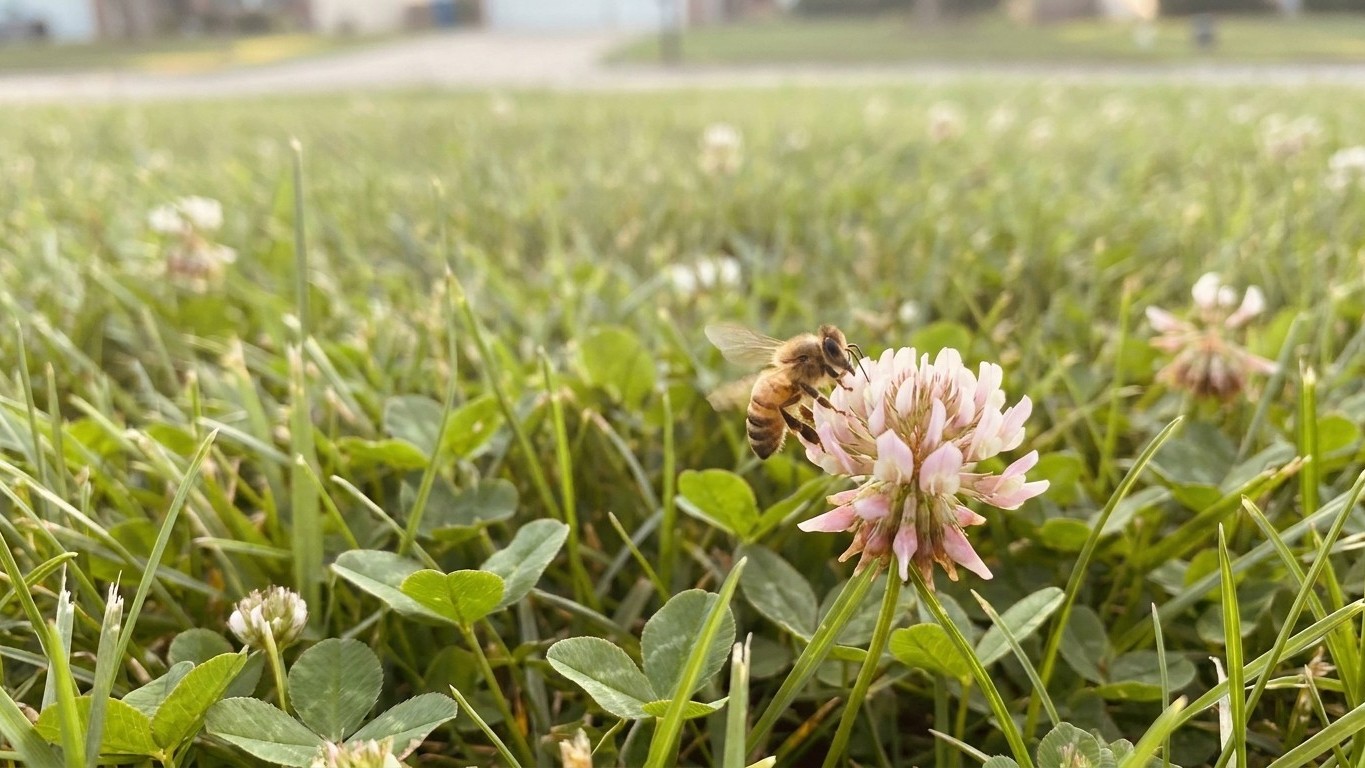
Five centimeters. That’s about two inches, roughly the height most rotary mowers default to when you’re aiming for a “tidy” look. It’s also short enough to strip a clover lawn of nearly every flower it would otherwise produce. By the time June rolled around and the bees should have shown up in force, there was nothing left for them to land on.
White clover doesn’t bloom from the leaves. The flower heads emerge on stems that rise above the creeping foliage, and if those stems get cut before they open, the plant simply doesn’t flower that round. Fewer flowers and less pollinator activity is usually a mowing-height issue, since clover mown very short rarely blooms. Mow at 5 cm every week or two, and you’re removing the flower buds before pollinators ever get a chance to find them.
Key takeaways
- Most homeowners mow their clover lawns too short, preventing flowers from ever forming
- A single ill-timed cut during bloom season can erase weeks of bee foraging in just 48 hours
- Research found 170% more pollinators on lawns mowed every 6-12 weeks versus every 2 weeks
Why height decides whether bees show up at all
Bees aren’t interested in clover foliage. Bees go for clover flowers, not the leaves. That distinction matters more than most homeowners realize. A patch of clover mowed short and kept short looks green and uniform, but from a bee’s perspective it’s functionally identical to a plain grass lawn. A clover lawn that isn’t blooming, whether just mowed, in the off-season, or between bloom rounds, draws about as many bees as a regular grass lawn.
Extension researchers who study bee-friendly lawns give a fairly consistent number. Mowing should be done at a higher height, adjusting the mower to at least 3 inches or more. That’s roughly 7.5 cm, well above the 5 cm cut that had wiped out my flower stems before they’d even opened. The University of Minnesota’s bee lawn program goes further with what it calls the one-third rule. Do not mow more than one-third of the vegetation at one time, to a height between 3.5 and 4 inches, to ensure that flowering plants survive and produce flowers to sustain pollinators. Britain’s Natural History Museum lands in a similar range, noting that short plants such as clover can be mown with blades set to about seven centimeters so the grass stays healthy, but mowing less often gives them a chance to produce the flowers that bees need.
What the research actually found when lawns were mowed less
This isn’t just anecdotal gardening advice. A 2018 USDA Forest Service study tracked residential lawns mowed on different schedules and found a clear tradeoff. Mowing every 3 weeks resulted in as much as 2.5 times more lawn flowers, including dandelions and clover, and greater diversity of bee species, though the abundance of bees was greatest when homeowners mowed every 2 weeks. letting the lawn go a little longer between cuts didn’t just mean more flowers, it meant a broader mix of bee species showing up, not only the usual honeybees.
A more recent controlled study pushed the comparison further, testing lawns left unmown for 12 weeks against plots cut every two, four, and six weeks. Floral species richness was significantly higher in patches of lawns left unmown for 12 weeks compared to control patches mown every two weeks. The pollinator numbers were even more striking: plots mowed on longer six-and twelve-week intervals had a significantly higher abundance of pollinators, over 170% higher, than the typically used mowing frequency of every two weeks. That’s not a marginal difference. That’s the gap between a lawn bees ignore and one they actually depend on.
There’s also a timing detail worth knowing if you’ve already scalped your clover once. Cutting off open blooms doesn’t just prevent future flowers, it shuts down the ones already feeding insects almost immediately. Mowing takes off the flower heads, which cuts off the bees’ food source, and within 24 to 48 hours of mowing a blooming clover lawn, bee activity drops fast. So a single ill-timed cut in late May can erase weeks of foraging opportunity right as the season is supposed to ramp up.
Getting the bees back without letting the yard go wild
The fix isn’t abandoning the mower altogether, it’s changing the settings and the calendar. Raising the deck to 7.5 to 10 cm and stretching the interval between cuts to two or three weeks during bloom season gives clover time to flower before the blades come through again. Raising the mow height, or skipping a cut during peak bloom, brings the flowers, and the bees, back. If a fully unmown look during peak season feels chaotic for a front yard, mowing only part of the lawn on a given week, rather than the whole thing at once, keeps some flowers blooming continuously while the rest stays presentable.
Timing the season matters too. Clover blooms attract bees, so barefoot walkers and the sting-averse should mow before peak bloom or choose low-flowering microclover. White clover’s bloom window runs roughly May through September in most of the country, which means the mowing height set in early spring determines whether an entire summer’s worth of forage ever materializes. Cut it at 5 cm in April and keep that height through June, and there’s no bloom to interrupt because none of it ever got the chance to form.
One detail that surprises a lot of clover-lawn owners: microclover, the compact cultivar increasingly sold for HOA-friendly yards, sidesteps this problem almost entirely. Microclover blooms across the same May-to-September window as white clover, but it puts out fewer and smaller flowers, meaning less nectar per square foot and a lot fewer bees feeding at any one time. If the goal is a genuinely tidy lawn with minimal insect traffic, that’s the trade to make deliberately, rather than accidentally scalping standard white clover and wondering where the bees went.
Sources : sciencedirect.com | nhm.ac.uk