
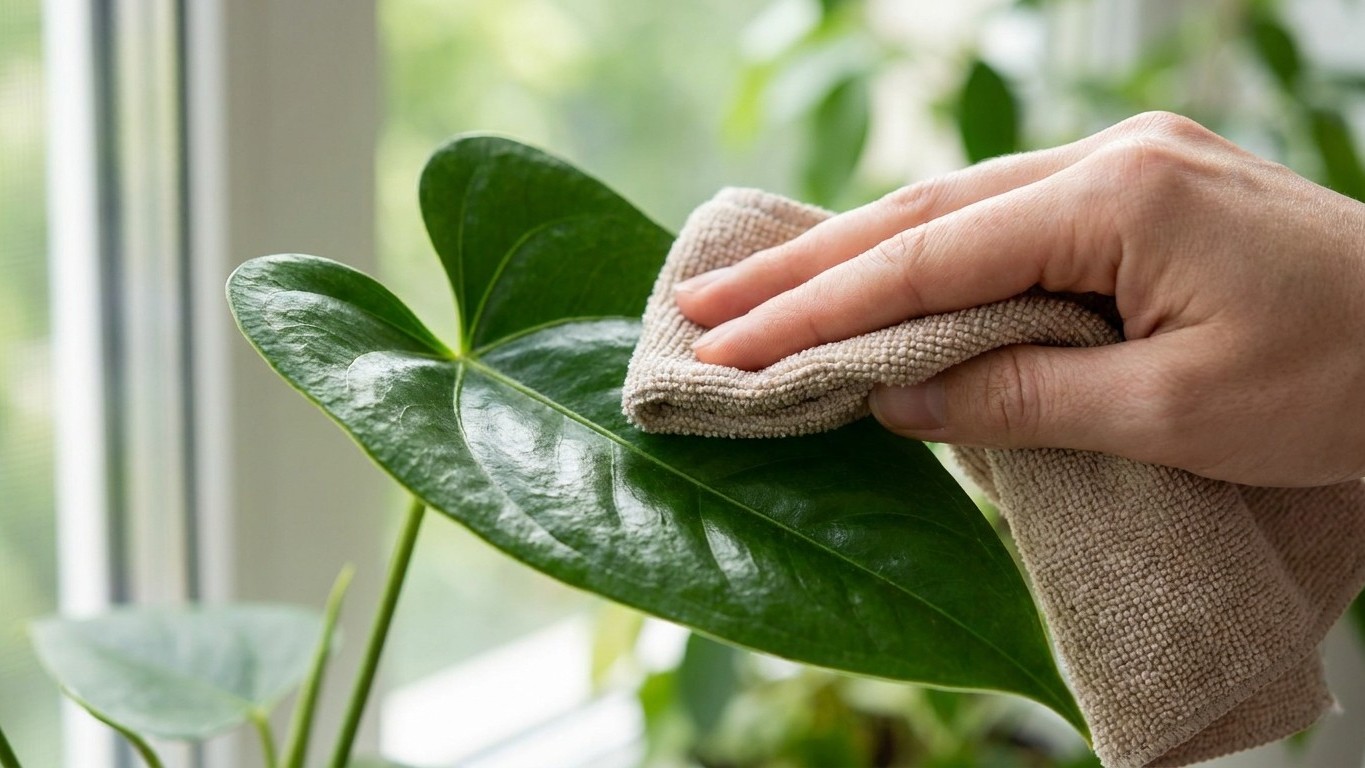
Olive oil on anthurium leaves. It sounds harmless, almost logical. The leaves look glossy, the plant looks thriving, and every photo you take gets a little more Instagram-worthy. For months, that was my Saturday ritual: a few drops on a soft cloth, a slow circular polish over each waxy leaf. The plants gleamed. I was proud. Then I mentioned it to a botanist friend, and the conversation that followed genuinely ruined my afternoon.
Key takeaways
- Olive oil seals the microscopic pores plants use to breathe, creating cumulative stress over weeks and months
- Your plant might not show obvious wilting, but it’s quietly struggling to photosynthesize and release moisture
- The glossy shine everyone chases comes from proper lighting and humidity—not from anything you apply to the leaves
What the oil actually does to the leaf surface
Anthurium leaves, like those of most tropical aroids, breathe through tiny pores called stomata. These aren’t just decorative openings, they regulate gas exchange, moisture release, and the plant’s ability to photosynthesize efficiently. When you coat the leaf surface with oil, you’re not just adding shine. You’re sealing those pores. Partially, sometimes completely, depending on how generously you apply it.
The result isn’t immediately dramatic, which is part of why the practice persists. The plant doesn’t wilt overnight. But beneath that mirror-like surface, the leaf is struggling to “exhale” water vapor and absorb the carbon dioxide it needs. Over weeks, this creates a slow, cumulative stress, the botanical equivalent of asking someone to run a marathon while breathing through a cocktail straw.
Dust and debris also bind to the oil film. So while the leaf looks cleaner initially, it becomes a magnet for particles that further block light absorption. The glossy surface you’re admiring is, from the plant’s perspective, a problem that keeps compounding.
Why this myth won’t die
The olive oil trick has been circulating in houseplant communities for years, long before TikTok amplified it. Its persistence comes down to one simple fact: it works visually. The leaves genuinely do look spectacular. Anthurium leaves have a natural semi-gloss finish, and oil intensifies that quality in a way that’s genuinely photogenic. The plant can’t tell you it’s struggling. It just quietly degrades.
There’s also a generational dimension here. The practice likely traces back to an era when houseplants were fewer and less understood, when “making something look healthy” and “making something be healthy” were conflated more easily. Some garden writers still recommend it, usually without any physiological reasoning, just the aesthetic result. That’s the kind of advice that travels far and gets questioned rarely.
Milk is another popular alternative that circulates in the same circles. It leaves a thin protein film that buffs to a shine but, like oil, creates residue buildup over time. Both are solutions to a problem (dusty, dull leaves) that has a much simpler answer.
What actually works, and why it’s almost embarrassingly simple
The botanist’s recommendation was so straightforward it stung a little after months of elaborate olive oil rituals. Plain lukewarm water on a soft microfiber cloth. That’s it. For heavily dusty leaves, a very diluted solution of water with a single drop of mild dish soap, wiped clean afterward, handles everything without leaving residue.
If you want the leaves to genuinely shine over the long term, the answer is light. Anthuriums positioned in bright, indirect light, the kind found a few feet back from an east or west-facing window — develop richer, more naturally lustrous leaves than plants kept in dim corners and compensated with oil. The glow people are chasing with bottles of olive oil is largely a consequence of good light and proper hydration.
Humidity matters too. Anthuriums are native to tropical rainforest understories, where ambient humidity regularly exceeds 70%. In a typical American home running between 30% and 50%, the leaves tend to lose some of their vitality over time. A pebble tray with water, a nearby humidifier, or grouping plants together to create a micro-humid zone will do more for leaf appearance than any oil treatment.
The longer-term damage I hadn’t considered
After speaking with the botanist, I started paying closer attention to a few of my anthuriums that had been receiving the oil treatment longest. Two showed yellowing along leaf margins, a classic sign of stress, though admittedly one with multiple possible causes. One had noticeably fewer new leaves emerging compared to a plant of the same variety I’d left untreated. Correlation isn’t causation, but the pattern was uncomfortable to ignore.
What the botanist explained that hit hardest was this: anthuriums are slow growers. They don’t bounce back from chronic stress the way a vigorous pothos might. When you impair their gas exchange over months, you’re not setting them back weeks, you’re potentially setting them back seasons. A plant that should have produced six or seven new spathes in a year might produce three. You’d never link it to the oil. You’d just assume the plant was “being slow.”
Commercial leaf shine products, sold in garden centers with confident branding, often contain the same basic issue: silicone or oil-based compounds that create the visual effect while compromising the leaf’s function. Some formulations are better than others, and a few are specifically designed to be breathable, but the default assumption that a product marketed for plant leaves is physiologically neutral isn’t one worth making without reading the ingredient list carefully.
One genuinely useful test: after any leaf treatment, press a piece of white tissue paper gently against the surface. If it picks up residue, your plant’s stomata are dealing with the same contamination. A leaf cleaned only with water leaves the tissue essentially clean. That simple test has changed how I evaluate every “plant care hack” I come across now.