
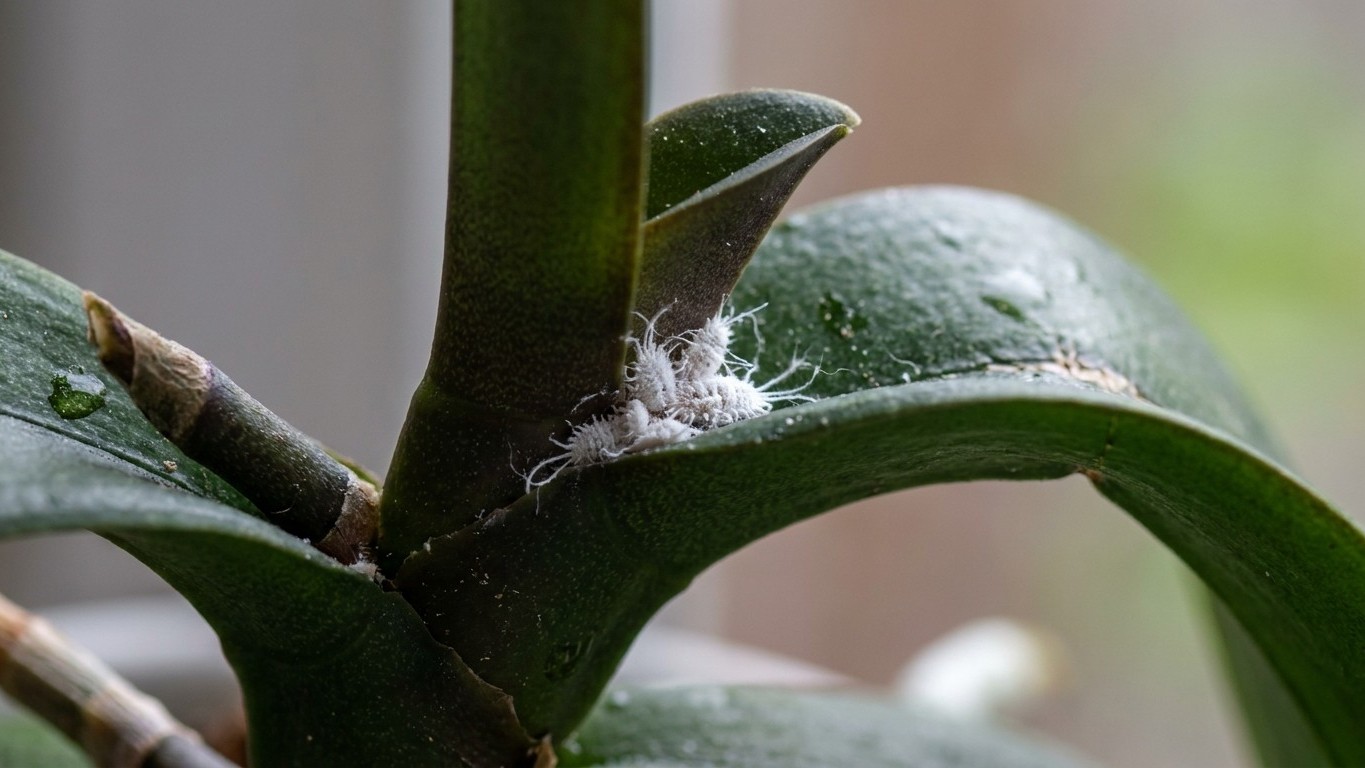
That fuzzy white tuft nestled where a leaf meets the stem isn’t dust, lint, or mold. It’s mealybugs, and the moment you wipe it away with a damp cloth and move on, you’ve likely done nothing but rearrange the problem. Mealybugs protect themselves from most pesticides by secreting waxy mealy white powder that repels water and sprays, which is where their name comes from. Underneath that cottony coating live actual insects, or their egg sacs, quietly feeding on your orchid’s sap while you think you’ve cleaned up a little household grime.
The confusion is understandable. Phalaenopsis leaves are glossy and dark green, so any pale speck stands out, and the first instinct is to assume it’s dust from a nearby shelf or windowsill. Something has been at your orchid when the leaves are stippled or there’s a suspicious white fluff tucked into a leaf axil where nothing white should be. By the time most growers notice, the insects have already settled into their favorite real estate: the tight, humid crevices where a leaf folds against the stem.
Key takeaways
- What looks like dust on orchid leaves is actually a protective waxy coating masking live insects and egg sacs
- One quick wipe removes only what’s visible—eggs and tiny nymphs hidden deeper continue multiplying undetected
- Mealybugs can spread your entire collection within weeks; isolation and repeated treatment over a month is essential
Why they choose that exact spot
Mealybugs are sucking insects that attach to the soft, green, usually newer growths of a plant, and they tend to congregate and hide at junctions where there are crevices to hide in. Leaf axils give them everything they need: shelter from light, protection from casual brushing, and direct access to tender tissue rich in sap. They are sucking insects that attack any part of the plant but tend to stay tucked away at the junction of the leaf and stem. A single cluster you spot today can represent weeks of feeding you never noticed.
What makes them genuinely alarming is the pace at which they multiply. Mealybugs reproduce rather quickly, and depending on species and temperatures, they tend to mature and lay eggs after about 24 to 73 days. That’s a narrow window between “I saw one tiny white speck” and “half my orchid collection has a problem.” Left untreated, the sap-sucking eventually shows up as damage you can’t ignore. Severe infestations cause chlorotic areas to appear on the leaves, which may darken, causing the leaf to yellow and drop prematurely.
Why a quick wipe rarely finishes the job
Here’s the part most people get wrong. A single swipe with a paper towel, or even a dedicated cleaning, only removes what’s visible on the surface. Mark Day 0, Day 7, and Day 14 in your calendar, because one cleaning round rarely catches every stage. Eggs tucked deeper in the crevice, or nymphs too small to notice, simply continue developing after you’ve declared victory.
There’s also a common assumption that rubbing alcohol alone solves everything, and that’s not quite right either. Using alcohol is not very effective against mealybugs, and can actually strip away the waxy cuticle layer of the epidermis, making it weak and even more susceptible to pests. Treated like a magic eraser, alcohol can leave your orchid’s leaves more vulnerable than the pest itself. It has its place as a spot treatment, but not as a blanket solution you spray and forget.
Meanwhile, the insects are quietly costing your plant more than sap. Mealybugs can cause loss of leaves, buds and flowers through their feeding, and they also create large amounts of honeydew which make plant parts sticky, attract ants, and provide a substrate for sooty mold. So that innocent-looking tuft of cotton can eventually drag ants and a black fungal film into the mix, turning a small pest issue into a multi-front cleanup.
What actually works
The good news: mealybugs are treatable, provided you accept that this is a process, not a one-time chore. Start by physically disrupting what you can see. Dip a cotton swab in 70% isopropyl alcohol and press it directly onto each visible mealybug cluster. This kills contact insects and dissolves some of the protective wax, but treat it as step one, not the finish line.
For anything beyond a couple of stray insects, broader coverage Matters More Than a single precise dab. Remove visible mealybugs with a cotton swab dipped in 70% isopropyl alcohol, working slowly through nodes, leaf axils, petioles, sheath bases, aerial roots, stems, pot rims, and the top edge of the substrate. Mealybugs don’t stay politely confined to the leaf you first noticed; they travel along stems and even into the growing medium.
Isolation is non-negotiable if you keep more than one orchid. The very first thing to do when you spot mealybugs is isolate the plant immediately, same day, no exceptions, since mealybugs spread easily to neighboring plants, especially when leaves are touching. For heavier infestations, alcohol swabbing should be paired with something with more lasting power. Using systemic insecticides is efficient at poisoning mealybugs and preventing them from becoming established if applied regularly as a prophylactic, while spray-on or direct-contact insecticides such as insecticidal soap and horticultural oil are among the most effective means of control, as is simply crushing them with a cotton swab.
Follow-up is where most people quit too early. Many people spray their orchids once and then expect the problem to go away, but that’s not sufficient. Recheck weekly for at least a month, since newly hatched crawlers are pale, tiny, and easy to miss the first time around. If your orchid keeps declining even after the leaves look clean, don’t rule out an underground population. Check the roots if white powder appears near the drainage holes or the plant keeps declining despite clean foliage.
One detail worth remembering the next time you’re inspecting a new orchid at the garden center: mealybugs rarely arrive on their own. They typically hitch a ride on a plant that already had a small, unnoticed population tucked into its leaf axils, which is exactly why a five-second glance at those junctions, before you ever bring a new orchid home, can save your entire windowsill collection from a much longer battle later.
Sources : bloomingexpert.com | justaddiceorchids.com