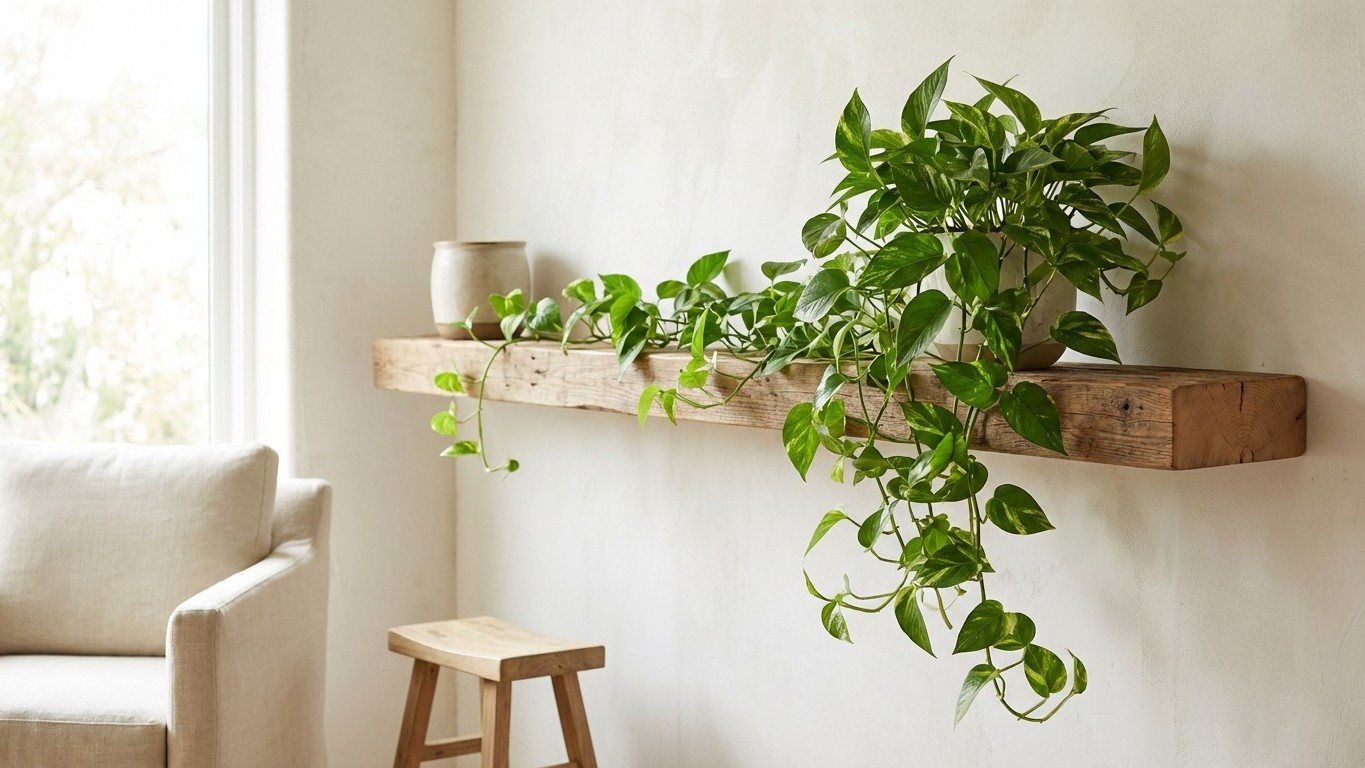
Trailing plants were supposed to be the easy win. You hang a pothos in a corner, let the vines cascade down, and suddenly your home looks like a Pinterest board. Except mine never did. The vines got tangled, the lower leaves turned yellow from lack of light, and the whole setup just looked… droopy. Not lush. Not intentional. Just droopy.
So I stopped hanging them. And what happened next genuinely changed how I think about greenery in a living space.
Key takeaways
- Why the classic ‘hang and forget’ method creates sparse, unhealthy trailing plants
- How training plants horizontally on shelves makes them bushier and fuller in weeks
- The surprising vertical trellis technique that makes leaves grow twice as large
The Problem With “Just Let It Hang”
The trailing plant advice that gets repeated everywhere, hang it high, let gravity do the work, ignores one uncomfortable truth: most homes aren’t greenhouses. The longer a vine travels downward, the farther it gets from the light source. Pothos, heartleaf philodendron, string of pearls, tradescantia, they all follow the same biology. Growth slows toward the ends, leaves shrink, and that gorgeous thick waterfall you imagined Becomes a sparse, leggy droop by the time it reaches three feet.
There’s also a maintenance angle nobody talks about. When a plant hangs at ceiling height, watering it means either dragging out a step ladder or letting the soil dry out more than the plant would prefer. Neither option makes for a thriving plant or a relaxed plant parent. I kept telling myself I just needed a better system. Turns out, I needed a different direction entirely.
Training Them Horizontally (And Why It Works)
The shift happened when I laid a small pothos on a shelf instead of hanging it. I tucked the tendrils along the shelf surface, pointing outward in both directions, and pinned them loosely in place with small clips. Within a few weeks, every node along that horizontal run had pushed out new growth. The plant looked fuller at week three than it had in a year of hanging.
The science behind this is straightforward. Vines in nature don’t actually prefer to hang, they climb or spread. Gravity-directed growth is a secondary behavior, something they default to when there’s nothing to grab. Give them a horizontal surface and they behave more like they would scrambling across a forest floor: faster, bushier, more vigorous.
Tradescantia responds especially well to this treatment. Run it along a floating shelf, let it weave between small objects, and it becomes a living border rather than a sad curtain. String of pearls, notoriously fussy when hanging because the pearls near the base tend to shrivel from inconsistent watering — does better when spread across a shallow tray of well-draining soil on a bright surface. The whole plant gets even light. The whole plant stays hydrated more consistently.
The Trellis and Frame Trick That Changed My Wall
Horizontal surfaces were one solution, but I had a long, bare wall that felt like a different problem. Shelves would have cluttered it. That’s where training plants vertically upward on a trellis, rather than letting them fall down, made an enormous difference.
A simple wooden trellis or even a series of wall-mounted hooks with fishing line creates a climbing structure that plants will grab onto enthusiastically. Pothos, in particular, produces aerial roots that actively seek something to anchor to. When it climbs, the leaves get larger, sometimes dramatically so. A golden pothos climbing a moss pole or wall trellis can produce leaves twice the size of what the same plant makes when hanging. The plant is doing what it evolved to do, and it shows.
My living room wall now has a climbing philodendron trained in a loose fan shape across a matte black trellis panel. People assume it’s wallpaper at first glance. The plant covers roughly four square feet of wall space, fills the room with actual oxygen-producing biomass, and costs me about ten minutes of maintenance a week, redirecting new growth, the occasional misting. That’s it.
Rethinking the Whole Room With This One Change
Once I stopped defaulting to “hang it and forget it,” I started seeing my living room as a surface map. Every shelf edge, window sill, bookcase top, and wall panel became a potential growing zone. The room feels more alive now, not because there are more plants, but because the ones that are there look intentional.
There’s a practical bonus that took me a while to notice: rooms with plants trained along surfaces rather than hanging from the ceiling feel less cluttered even when there’s more greenery. Hanging plants draw the eye upward and then disappoint it with sparse ends. Surface-trained plants fill your actual field of vision, the zone where you spend most of your time looking when you’re sitting on a couch.
A few things I learned the hard way worth passing along: use soft plant ties or silicone clips rather than wire, which can cut into stems. Pin new growth early, before it woodens up and becomes brittle. And leave some slack in the direction you want the plant to grow, tension encourages the plant to move away from the support, not toward it.
The trailing plant industry, if you can call it that, has a vested interest in selling hanging pots and ceiling hooks. But the most interesting thing about plants is that they don’t care about aesthetics. They follow light, water, and gravity in whatever combination gets them the best deal. Your job, as the person who has to live with them, is to give them a deal that looks good to you too.
So the next time a vine reaches past your shelf edge and you instinctively let it fall, consider pinning it back. You might be surprised how much a plant changes when you stop letting it give up.