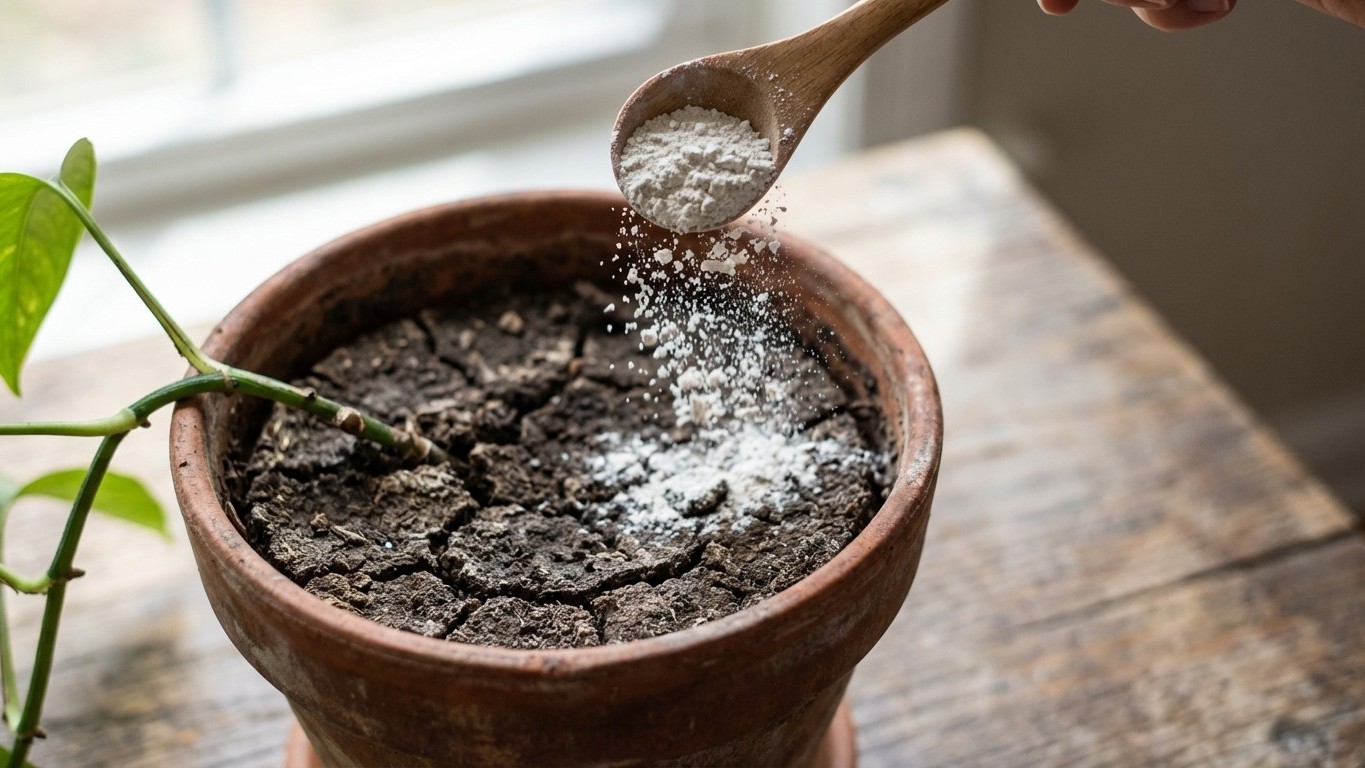
Your potting mix has turned into a brick. You know the feeling: you water a plant, and instead of soaking in, the water just pools on the surface and rushes straight down the sides of the pot. The soil has compacted so thoroughly over months of watering and root growth that air barely penetrates anymore. March, that transitional moment when indoor plants sense lengthening days and start pushing new growth, is the perfect time to fix this, with a single natural powder most gardeners already have within reach.
Key takeaways
- Why your indoor soil turns into a brick by winter and why March is the perfect fix window
- The hidden microscopic structure that makes one simple powder transform soil in two watering cycles
- The critical difference between food-grade and pool-grade—and why one choice matters for your plants
Why Indoor Soil Compacts Over Winter
Potting mix is not garden soil. It’s engineered to be light and porous when fresh, but that structure breaks down faster than most people expect. The organic components, peat, coir, composted bark, gradually decompose and compress under their own weight. Every time you water, fine particles settle deeper. Roots exert pressure. By February or March, what started as fluffy growing medium has often become dense enough to restrict oxygen flow to the root zone, which is precisely when plants need that oxygen most, as they shift out of winter dormancy.
The problem compounds itself. Compacted soil dries unevenly: the outer edges of a pot can be bone dry while the center stays stubbornly wet. That imbalance creates the exact conditions that invite root rot, fungus gnats, and general plant misery. Repotting is one fix, but it’s disruptive, time-consuming, and sometimes unnecessary if the roots haven’t actually outgrown the container.
The Powder: Food-Grade Diatomaceous Earth
Food-grade diatomaceous earth, often abbreviated DE, is the amendment that changes the equation. Formed from the fossilized remains of microscopic aquatic organisms called diatoms, it looks like a fine white powder but behaves more like millions of tiny hollow cylinders under a microscope. Those micro-structures absorb excess moisture, then release it slowly as the surrounding soil dries out. The physical effect on compacted soil is significant: the sharp, porous particles wedge between compressed organic matter, creating and holding open small air channels that roots can actually use.
A teaspoon of DE contains more surface area than you’d expect from something that fits in a spoon. Its particle structure is why it has been used in grain Storage for centuries, it absorbs the waxy coating from insects, desiccating them without chemical intervention. For plants, the benefit is structural rather than pest-related, though the mild insect-deterrent effect is a welcome side effect when you’re dealing with fungus gnat larvae in your potting mix.
One clarification that matters: food-grade is the operative word here. Pool-grade diatomaceous earth is chemically treated and heat-processed into a crystalline form that can be harmful to lungs and has no business near houseplants. The food-grade version is physically (not chemically) active, and it’s widely available at garden centers, pet stores, and online retailers at very reasonable prices, usually a few dollars for a bag that will last an entire growing season.
How to Apply It in March for Maximum Effect
The application method matters more than the quantity. Dumping a pile on top of the soil achieves almost nothing : DE needs to reach the root zone to work. For moderately compacted pots, use a thin chopstick, skewer, or pencil to aerate the soil first: make 8 to 10 holes about 3 to 4 inches deep around the perimeter of the pot, avoiding the center where the main root mass tends to concentrate. Then mix roughly one tablespoon of DE per quart of existing potting mix into the top two inches of soil, and pour a diluted application of water to help carry the fine particles down through the channels you’ve created.
For more severely compacted soil, a partial refresh works better. Remove the plant, gently shake away the outermost layer of old mix (without disturbing the root ball), and blend the loosened material with DE at a ratio of about one part DE to five parts potting mix before repacking around the roots. This approach takes fifteen minutes and avoids the full repotting disruption while genuinely reviving the soil structure. March timing works in your favor here: plants starting spring growth tolerate minor root disturbance far better than they do in winter dormancy.
Some gardeners mix DE with perlite for extra aeration. Perlite adds lightness; DE adds moisture regulation. They work differently but complementarily, and combining them at roughly equal parts as a soil amendment addresses both drainage and air circulation in one step. If your potting mix tends to stay wet for more than a week after watering, that combination is worth trying.
What to Expect After Treatment
The change isn’t overnight, but it’s real. Within the first two watering cycles, you’ll notice water absorbing more evenly across the surface rather than channeling down the sides. Soil that previously took ten days to dry adequately will often reach the right moisture level in five or six, which means more consistent watering schedules and, for plants like monsteras, pothos, and peace lilies, visibly perkier growth as oxygen returns to the root zone.
One thing DE won’t do: replace a pot that genuinely needs fresh mix. If your plant is root-bound, with roots circling the drainage hole or emerging from the soil surface, no amendment substitutes for actual repotting. But for the large majority of indoor plants that simply live in soil that’s gone stiff and tired, DE offers a low-effort, low-cost reset that respects the plant’s existing root system.
The broader question this raises is how much of our plant frustration comes from soil conditions rather than anything we’re doing wrong with watering or light. Most houseplant problems that get blamed on overwatering are Actually drainage failures, the water has nowhere to go because the soil has lost its structure. Treating the structure, rather than adjusting the schedule, might be the shift that changes everything for your indoor garden this spring.