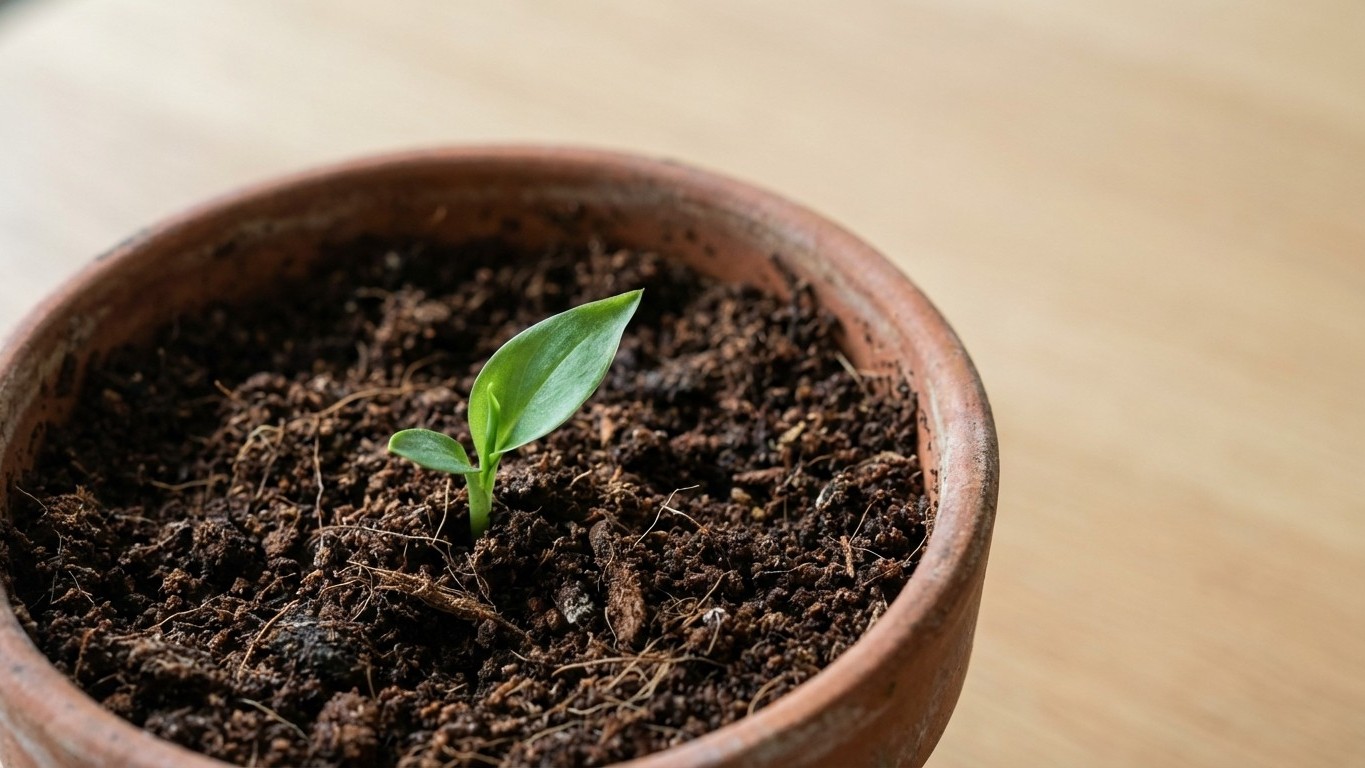
Somewhere around my third consecutive failed tomato season, I stopped blaming the weather and started looking at what was actually in my pots. Not on top of the soil, not the roots, the soil itself. What I found, or rather what I learned was already there, changed how I think about feeding plants entirely.
Most of us treat potting soil like a passive medium, a neutral stage where roots grip and water drains. We assume the real nutrition comes from what we pour in. But healthy soil, even bagged, store-bought potting mix, contains a living ecosystem that, when understood and protected, can do a surprising amount of the heavy lifting on its own.
Key takeaways
- A teaspoon of healthy soil contains more microorganisms than people on Earth—and they’re doing work your fertilizer prevents
- High-dose synthetic fertilizers don’t just feed plants; they poison the fungi and bacteria that actually make nutrients available
- One gardener’s tomato harvest went from failing to thriving by simply switching from weekly liquid feeding to occasional worm castings
The invisible workforce already in your pots
A single teaspoon of healthy garden soil holds more microorganisms than there are people on Earth. Potting mixes vary considerably, but even commercial blends typically contain bacteria, fungi, and other microbial communities that arrived via organic matter, compost, or simply exposure to air and water. These organisms break down organic material into forms plants can actually absorb, essentially performing the same conversion that synthetic fertilizers skip past artificially.
The most consequential of these are mycorrhizal fungi. They form symbiotic relationships with plant roots, extending microscopic threads (hyphae) far beyond where roots could ever reach, pulling in phosphorus, zinc, and water in exchange for sugars from the plant. Many premium potting mixes now include mycorrhizal inoculants for exactly this reason. The problem is that most gardeners then douse those same mixes with high-concentration synthetic fertilizers, which effectively short-circuit the whole system, the plant stops feeding the fungi because it no longer needs to, and the fungi retract.
That’s the part nobody puts on the fertilizer label.
What over-fertilizing actually does to your soil biology
High nitrogen fertilizers, particularly the fast-release synthetic variety, create a flush of plant growth that looks great in week two and catastrophic by week eight. The salt buildup from repeated applications draws moisture out of the soil, creating a hostile environment for the very microbes that would otherwise be doing your nutritional work for you. Over time, the soil compacts, beneficial fungi disappear, and you end up completely dependent on external inputs just to maintain baseline plant health.
Think of it like relying on energy drinks instead of sleeping. Results are immediate, dependency builds fast, and the underlying system quietly deteriorates.
A study from Washington State University Extension found that soils with suppressed microbial activity required significantly higher fertilizer inputs to achieve the same plant growth as biologically active soils. The researchers weren’t studying potted plants specifically, but the principle holds: kill the biology, increase the Maintenance bill. For container gardeners who repot every season and refresh their mix, this cycle compounds quickly.
How I changed my approach (and what actually happened)
I didn’t stop adding anything to my soil. That would be its own mistake. What I stopped doing was treating every plant like it had a deficiency that needed correcting with a liquid solution every two weeks. Instead, I started working with what was already there.
The shift was simple: I switched to top-dressing with worm castings every four to six weeks rather than liquid feeding. Worm castings deliver nutrients slowly, they don’t burn roots, and they actively support microbial life rather than disrupting it. The castings also improve soil structure, which matters enormously in containers where compaction is a constant battle. My pothos, which I’d been liquiding-feeding to no visible effect for months, produced four new leaves in six weeks after I switched. Correlation isn’t causation, but I noticed.
For outdoor containers, I started adding a thin layer of compost to the surface in spring, letting rain and watering work it down gradually. No mixing, no disruption of the root zone, no dramatic interventions. The tomatoes that season were the best I’d grown in five years, and I’d done objectively less than in previous seasons.
What your soil actually needs from you
The goal is to feed the soil, not the plant directly. When the microbial ecosystem is functioning, it regulates nutrient availability, suppresses some pathogens, and helps buffer against overwatering and drought stress. Your job shifts from technician to steward.
A few things that actually support soil life in containers: avoiding peat-heavy mixes that degrade quickly and become hydrophobic, choosing potting mixes with listed compost or bark components, and watering with room-temperature water (cold water from a garden hose in summer can temporarily shock soil microbes, which sounds minor but compounds over a season). If you do fertilize, and there are situations where you should, especially for heavy feeders or plants in soilless hydroponic mixes — slow-release organic options cause far less collateral damage than soluble synthetic salts.
Some gardeners brew aerated compost tea to apply microbial communities directly to their containers. The science on this is genuinely mixed, results vary widely depending on how the tea is made and how quickly it’s used — but the underlying instinct, that you can cultivate biology rather than just chemistry, is sound.
There’s something worth sitting with in all of this: we’ve spent decades engineering more efficient ways to bypass natural systems, then spending more money and effort correcting the downstream problems those shortcuts created. Container gardening is a small arena, but it mirrors that pattern exactly. The question isn’t really whether you should fertilize. It’s whether you’ve given the system you’re working with a genuine chance to function before you decide it needs help.