March arrives with a quiet promise. While your Neighbors debate expensive garden center purchases, seasoned Gardeners are already multiplying their flower collections using nothing more than sharp scissors and patience. This ancient technique costs absolutely nothing yet delivers results that would make commercial nurseries jealous.
Professional propagation, the art of creating new plants from existing ones, represents gardening’s most guarded economic secret. One mature coleus plant Becomes twenty. A single geranium transforms into an entire border. The mathematics are staggering: what costs $200 at retail requires perhaps $5 in rooting hormone and potting mix.
Key takeaways
- Why March is the only month when plant propagation reaches near-perfect success rates
- The exact cutting technique that transforms one $5 plant into twenty rooted specimens
- How commercial growers built entire businesses on a technique that costs less than morning coffee
The Science Behind March Magic
Temperature patterns make March the propagation sweet spot. Soil temperatures hover around 50-60°F while air temperatures remain cool enough to prevent stress. Plants are emerging from dormancy but haven’t yet committed energy to blooming, creating perfect conditions for root development.
Consider the physiology. When you take a cutting, the plant’s survival instincts kick in. Hormones concentrate at the cut site, triggering rapid cell division. These same hormones remain dormant during winter’s chill and summer’s heat stress. March hits that Goldilocks zone where everything aligns.
Professional growers have exploited this timing for decades. Visit any commercial greenhouse in early spring and you’ll witness industrial-scale cutting operations. Rows upon rows of propagation benches filled with future profits, all started from parent plants that cost pennies per cutting.
The Cutting Edge Technique
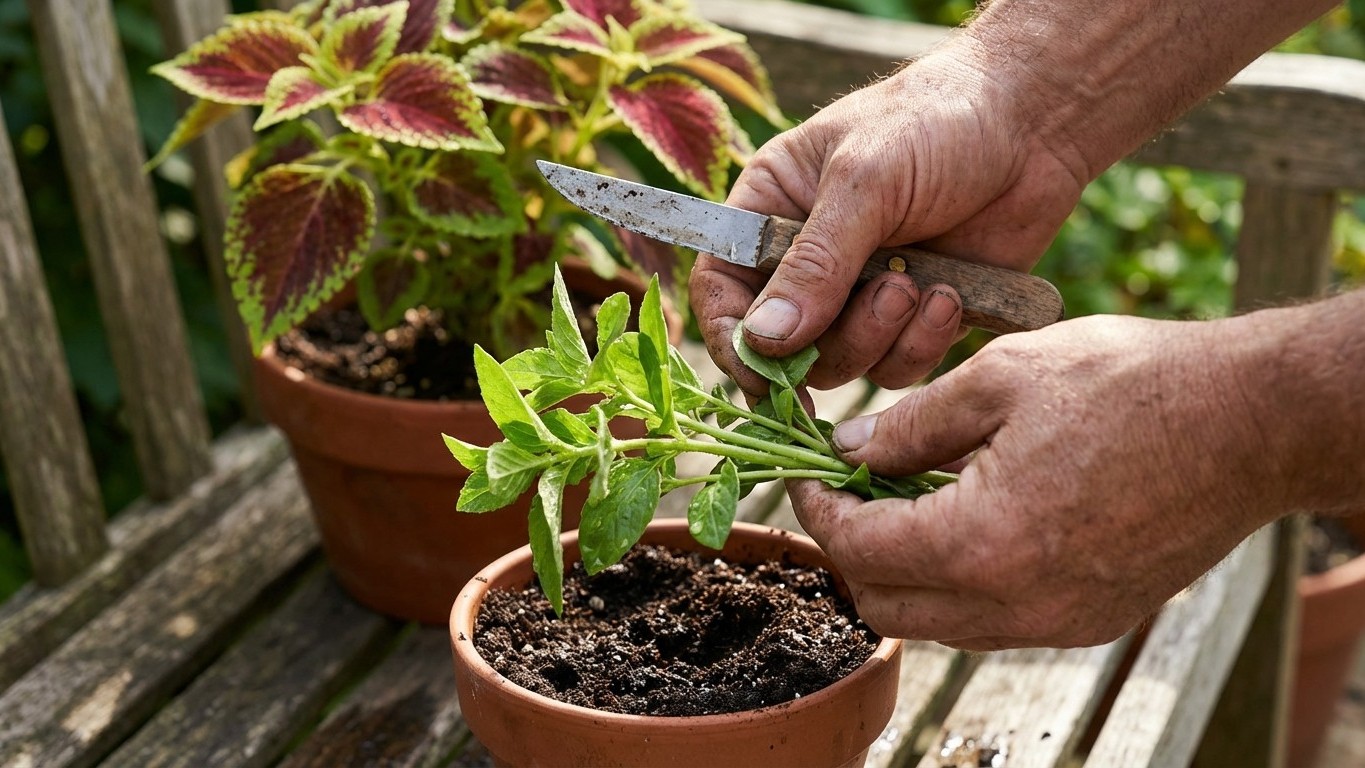
Success begins with selection. Choose healthy shoots from last year’s growth, they should be firm but not woody, about pencil thickness. Morning cuts work best when plants are fully hydrated from overnight moisture.
The cut itself matters more than most realize. Use a sharp, clean blade and slice at a 45-degree angle just below a leaf node. This angle increases surface area for root development while preventing the cutting from sitting flat on soil surface, which invites rot.
Strip lower leaves but leave 2-3 sets at the top. Those remaining leaves will photosynthesize and feed the developing roots, but too many will drain energy faster than roots can supply nutrients. Think of it as botanical life support.
Rooting hormone accelerates the process but isn’t mandatory. Willow bark tea, made by soaking fresh willow twigs overnight, contains natural rooting compounds. Honey works too, providing antimicrobial protection while encouraging root growth.
Beyond Basic Cuttings
Advanced gardeners employ division and layering alongside traditional cutting methods. Division works brilliantly for perennials emerging from winter dormancy. Hostas, daylilies, and ornamental grasses multiply effortlessly when split during March’s cool, moist conditions.
Air layering transforms woody plants into propagation goldmines. Select a flexible branch, wound the bark lightly, wrap with moist sphagnum moss, and cover with plastic. Roots develop while the branch remains attached to the parent plant, essentially creating a new plant with built-in life support.
Ground layering requires even less intervention. Simply bend a low branch to soil level, secure with a brick or wire, and wait. Many shrubs and vines will root naturally at soil contact points.
Water propagation appeals to indoor gardeners. Geraniums, coleus, and impatiens root readily in plain water on a sunny windowsill. Change water every few days to prevent stagnation, and transplant once roots reach an inch long.
The Economics of Multiplication
Numbers tell the compelling story. A packet of impatiens seeds costs $3.99 and might produce twelve plants, if germination goes perfectly. One mature impatiens cutting generates twenty rooted plants within six weeks. The original plant cost $4.99 at the garden center but now provides $100 worth of offspring.
Commercial growers operate on these margins. They purchase mother plants in March, take hundreds of cuttings, and sell rooted offspring by May. Home gardeners can replicate this model on smaller scales, creating neighborhood plant swaps or simply stocking their own gardens abundantly.
Time investment remains minimal. Taking fifty cuttings requires perhaps an hour. Maintaining them demands five minutes daily, watering and checking for root development. Compare this to seed starting, which involves precise timing, supplemental lighting, and temperature control.
March’s magic window closes by mid-April as temperatures rise and plants shift focus to reproduction rather than root development. Miss this timing and you’ll wait until late summer for comparable success rates, assuming your original plants survive summer stress.
The real secret isn’t the technique itself but recognizing opportunity when it presents itself. While others plan elaborate garden expansions with hefty price tags, informed gardeners are quietly building plant empires from what already grows around them. Your garden’s potential isn’t limited by your budget but by your willingness to work with natural cycles rather than against them.