
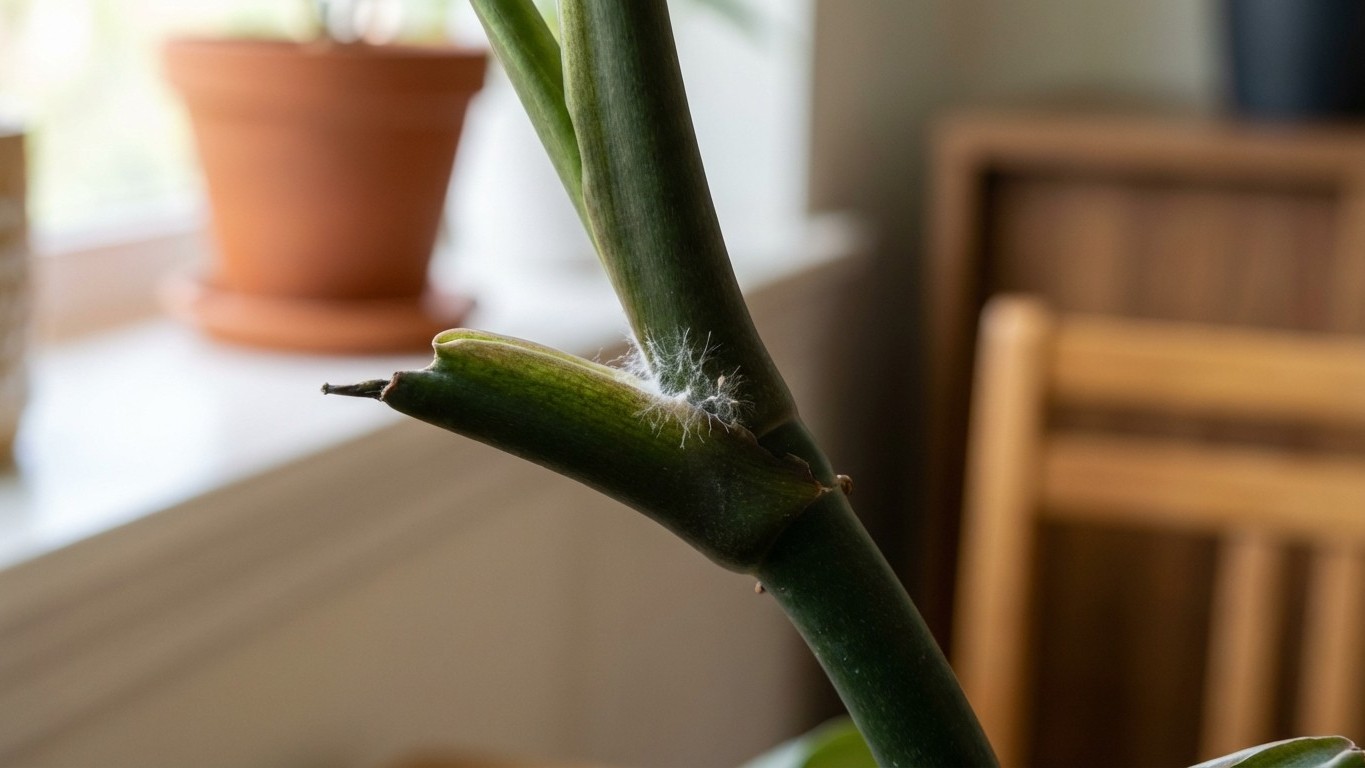
Your misting routine feels nurturing. A few spritzes of water across those glossy leaves, a light cloud drifting over the pothos and the bird of paradise, and you’ve done your good deed for the day. Except there’s a side effect nobody talks about in the YouTube tutorials: that daily white mist is quietly creating one of the most hospitable environments possible for fungal growth and bacterial rot along the stems and soil surface of your tropical plants.
Key takeaways
- The white mist you think is helping may be feeding invisible fungal colonies on your plant stems right now
- Tropical plants need humidity, but not in the way your spray bottle delivers it—and the most misted plants are the most at risk
- There’s a completely different way to create rainforest-level humidity without wetting a single leaf
The moisture trap hiding in plain sight
Tropical plants evolved in humid environments where air movement is constant. A rainforest floor gets soaked, yes, but it also dries quickly thanks to warmth, canopy airflow, and drainage. Your Living Room is a different story. When you mist a plant and set it back on a shelf between two other pots, the water droplets sitting in the crevices where leaves meet stems, or pooling in the dense crown of a calathea, can take hours to evaporate. That stagnant moisture, especially in temperatures between 60 and 80 degrees Fahrenheit, is exactly what powdery mildew, botrytis, and a range of stem rot pathogens need to establish themselves.
Botrytis cinerea, the gray mold responsible for destroying countless houseplants, doesn’t need soil contact to spread. It colonizes damaged or wet tissue on stems and leaves directly. Research from plant pathology programs has documented that it can complete an infection cycle on a leaf surface in under 24 hours when humidity stays above 90 percent and temperatures are moderate. Misting once a day, on a plant that doesn’t dry fast enough, essentially resets that clock every morning.
What’s actually growing on those stems
Take a close look at the base of your monstera’s petioles, or the lower stems of your philodendron. If you see a faint white or gray fuzz that you assumed was just dust or mineral residue, pause. That could be early-stage mycelium, the thread-like body of a fungal colony. It often looks nearly identical to water mineral deposits at first glance, which is why so many plant owners miss it until the stem begins to soften or collapse.
Bacterial stem rot is even sneakier. Erwinia and Pectobacterium species, two bacterial genera commonly found in potting mix, travel in water splash. Every time a mist droplet hits the soil surface and bounces back onto a lower stem, it potentially carries bacterial cells upward. The stem itself may look fine for weeks before the tissue turns translucent, then brown, then mushy from the inside out. By the time you notice something is wrong, the vascular tissue is often already compromised. There’s no recovering a stem once bacterial soft rot has hollowed it.
The plants most at risk are also, ironically, the ones people mist most aggressively. Calatheas, anthuriums, alocasias, and begonias all get targeted because they’re known to prefer humidity. But these species are also particularly susceptible to crown rot when water sits in their growing points. A misting bottle aimed at the leaves often hits the center of the plant more than it hits the surrounding air, concentrating moisture exactly where it’s most dangerous.
Better ways to get your tropicals the humidity they actually need
The good news is that you don’t have to choose between humidity and plant health. You just have to deliver moisture in a way that mimics the rainforest more accurately than a spray bottle does.
A pebble tray filled with water placed beneath the pot raises ambient humidity around the plant through slow evaporation without ever wetting the foliage or stems. The effect is gentler and more consistent than a morning misting session, and it works passively all day. A small room humidifier set a few feet away does even better, creating a diffuse atmospheric humidity that surrounds the plant rather than saturating individual surfaces.
Grouping plants together is another underrated approach. Plants release water vapor through transpiration, so a cluster of five or six pots creates a shared microclimate that can be noticeably more humid than the surrounding room. You get the humidity benefit without any artificial intervention. Think of it as a small, low-maintenance ecosystem rather than a collection of individual patients on a care schedule.
If you genuinely cannot part with the misting bottle, at minimum shift your timing. Misting in the morning, when your home will warm up over the course of the day, gives water a chance to evaporate before evening. Evening misting, which many people do after work, leaves moisture sitting on plant tissue for eight or more cool, dark hours. That’s essentially an invitation written in fungal.
Reading your plant before it’s too late
The earliest signs of trouble are subtle: a slight yellowing at the base of a stem, a soft spot that feels different from the firm tissue above it, or a faint musty smell near the soil. Most people attribute these to overwatering, which isn’t wrong exactly, but it misses the mechanism. Overwatering damages roots and reduces oxygen in the soil. Surface moisture from misting attacks the above-ground parts of the plant through a completely different pathway.
If you catch soft rot early on a succulent stem or a thick-stemmed tropical, cutting several inches above the affected tissue and allowing the cut to callous in open air can sometimes save the plant. With bacterial rot, speed matters more than perfection. A clean cut with sterilized scissors, followed by a dusting of powdered cinnamon (a mild natural antifungal) on the exposed tissue, buys you time.
The deeper question worth sitting with: how many of our plant care habits come from what looks nurturing versus what actually functions well for a living organism? Misting a plant feels satisfying the same way watering a wilting plant feels urgent, even when the wilting is caused by root rot rather than drought. Plants are remarkably good at appearing to need the exact care we’re already giving them. The trick is learning to read what they’re actually saying.