
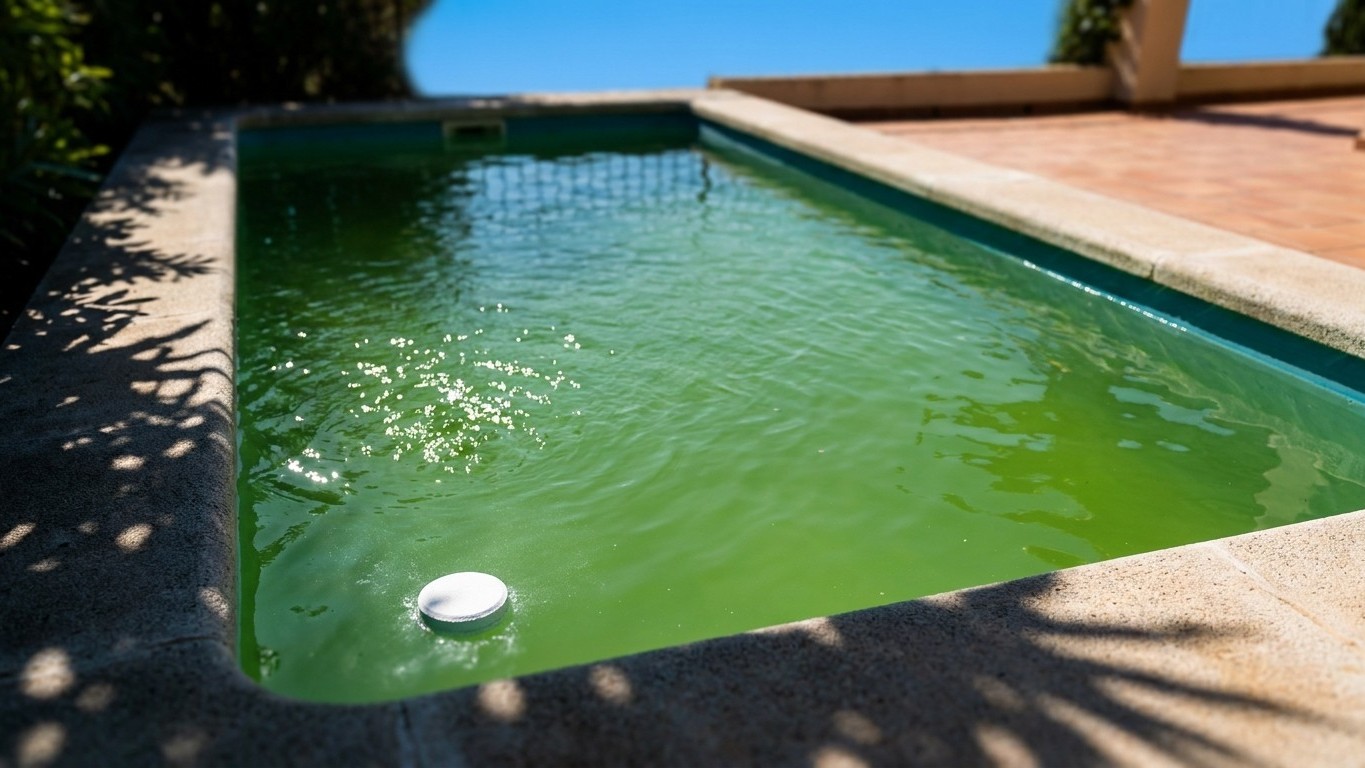
Chlorine tablets dropped in the skimmer every week, water tested “fine,” and yet the pool still turns the color of pond scum by the weekend. The explanation almost never involves a math error at the dosing station. It comes down to physics happening at the water’s surface: ultraviolet light is quietly incinerating the sanitizer before it ever gets a chance to fight algae, and heat above roughly 28°C makes the destruction happen faster and the demand for chlorine climb at the same time.
Key takeaways
- UV rays can destroy up to 90% of your pool’s chlorine in just two hours—without you ever seeing it happen
- Water above 28°C creates a perfect storm: chlorine breaks down faster AND algae demands more chlorine simultaneously
- That green pool with ‘adequate’ chlorine on your test strip might actually have a stabilizer problem, not a dosing problem
The sun burns chlorine, it doesn’t just “use it up”
Most pool owners picture chlorine getting consumed the way soap gets consumed on dirty hands, gradually and proportionally to the dirt. That’s not what sunlight does. Many people believe chlorine just evaporates, but it actually goes through a chemical change called UV degradation. UV radiation gives energy that breaks down hypochlorous acid and hypochlorite ions, turning them into useless compounds like hydrochloric acid and oxygen gas. In plain terms, the active molecules literally get torn apart by photons and vanish into the air. No amount of additional tablets fixes a reaction that’s happening at the molecular level within minutes of exposure.
The speed of that destruction is the part that surprises even experienced pool owners. The ultraviolet rays of the sun can reduce chlorine by up to 90 percent in two hours. Without any protective chemistry in the water, it’s even faster: unstabilized free chlorine has a half-life of less than forty-five minutes under direct Florida sunlight. A morning dose that tests perfectly at 8 a.m. can be functionally gone by lunchtime, hours before the water even looks suspicious.
Why 28°C changes everything
Heat doesn’t just make swimming more pleasant. It attacks chlorine from two directions at once. First, warmer water accelerates the same UV reaction, since chemical reactions generally speed up with temperature. Second, and just as damaging, when water temperatures rise above 27 to 28 degrees Celsius, chlorine becomes less stable and is consumed more quickly, while warm water also encourages faster bacterial growth, which increases chlorine demand. The sanitizer disappears faster and there’s more biological load asking it to work harder, at the exact same moment.
The scale of the extra dosing needed is not trivial. As a general guideline, chlorine input may need to be doubled for every 6-degree increase above 27 degrees Celsius to maintain safe levels. That means a backyard pool sitting at a pleasant 33°C during a July heat wave may need roughly double the chlorine of the same pool at a mild 27°C, just to hold steady, before accounting for swimmers, leaves, or rain. Skip that adjustment and the math simply doesn’t add up: the tablets dissolve, and the sun cancels them out before the water gets sanitized.
The stabilizer nobody thinks about until it’s too late
There is a fix, and it’s chemical rather than behavioral: cyanuric acid, usually called CYA, pool stabilizer or conditioner. It’s an organic molecule that binds to chlorine in water and shields it from UV degradation, though it has no disinfecting power on its own. Think of it as sunscreen for the sanitizer rather than a sanitizer itself. The stabilizer forms a temporary, reversible bond with active chlorine molecules, this bond blocks UV rays from reaching the chlorine, and the chlorine is then gradually released back into the water to continue disinfecting.
Most trichlor and dichlor tablets already contain some CYA, which is why an unstabilized pool suffers so much faster and so much more visibly. Traditional outdoor chlorine pools need 30-50 ppm of CYA to protect the chlorine from breaking down in the sunlight. Get that number right, and chlorine survives the afternoon instead of evaporating by 2 p.m.
But here’s the twist that trips up a lot of pool owners who think they’ve solved the problem by adding stabilizer generously: CYA is a one-way street. Cyanuric acid doesn’t break down quickly or evaporate, and most pools only lose 10 ppm of CYA each month. Every trichlor tablet season after season nudges the number up, and it never comes back down on its own. Push it too far and the same molecule that was protecting chlorine starts smothering it instead. Above 75 ppm, CYA “locks up” your chlorine and renders it nearly inactive, even though a basic test strip still shows a comforting number. That’s the cruel irony behind a pool that stays green despite what looks, on paper, like adequate sanitizer.
What actually works when the thermometer climbs
Testing more often is the first, unglamorous step. During a heat wave, checking chlorine and pH daily instead of weekly catches the drop before algae gets a foothold. Timing the dose matters almost as much as the amount: the most effective strategy involves adding chemicals in the evening, allowing them to establish proper levels overnight before facing the next day’s UV assault. Dumping tablets in at noon, right when UV intensity peaks, wastes a meaningful share of the product before it dissolves.
Running the pump and filter longer during hot spells also helps more than people expect. Circulation system optimization becomes critical during high-demand periods, since extended run times help distribute chemicals evenly and prevent dead spots where algae can establish colonies, and many pool professionals recommend increasing circulation times by 2-4 hours during extreme heat. A pool cover overnight, even a basic solar blanket, cuts UV exposure during the hours the water would otherwise be baking chlorine away for nothing.
None of this means the tablets were dosed wrong, or that a bag of chlorine got bought too cheap. It means the sun and the thermometer are working against the sanitizer in ways a test strip won’t always catch until the water has already turned. Testing CYA levels once at the start of the season and again mid-summer, not just chlorine and pH, is the step most home pool owners skip entirely, right up until they’re standing over a green pool wondering what went wrong.
Sources : dogdayspools.com | barrierreefpoolsperth.com.au