
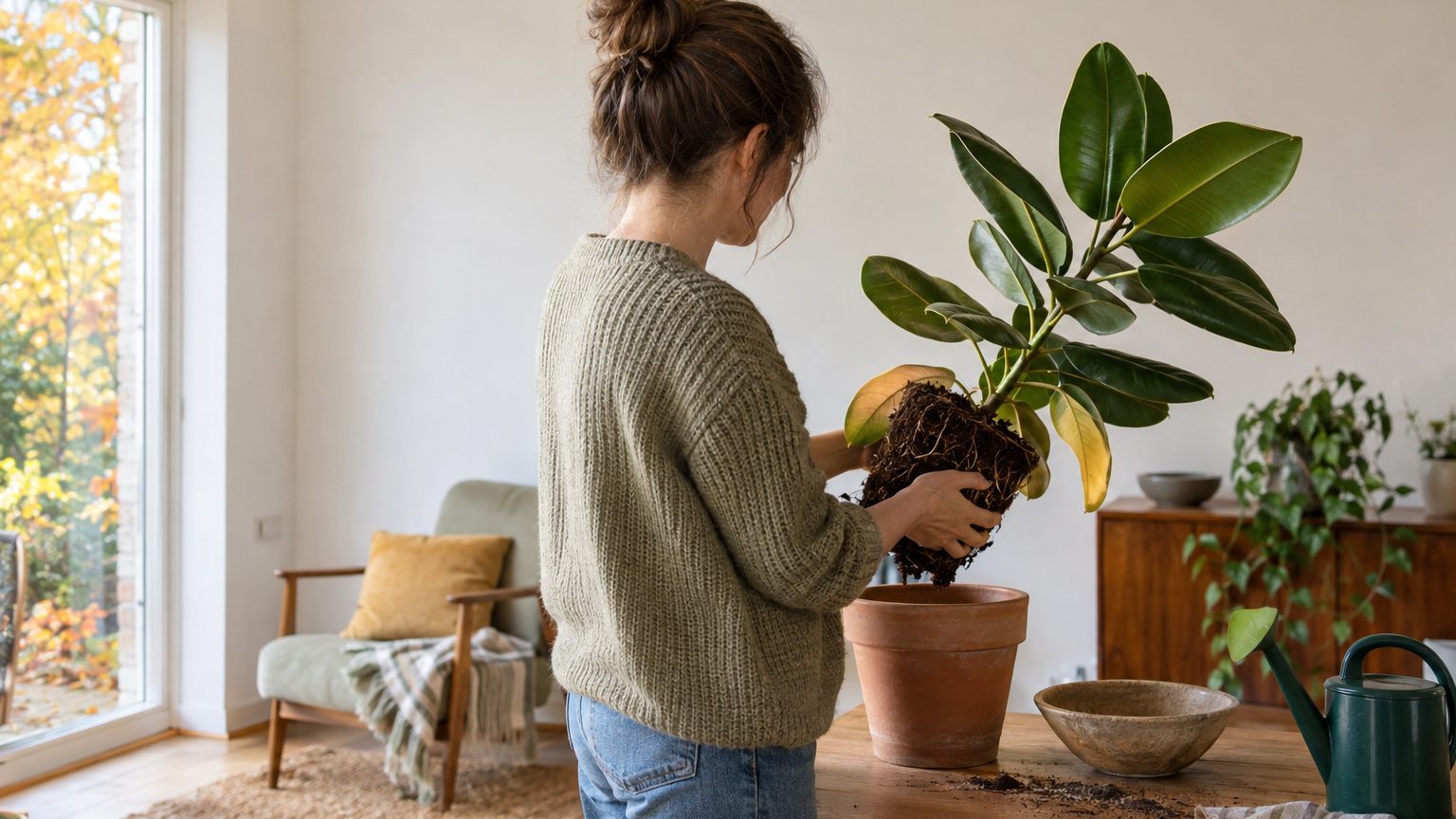
A rubber plant (Ficus elastica) that sheds one or two lower leaves a year is doing what mature plants do. One that loses five in a month, with yellowing first, is telling you something about its roots.
The difference comes down to pattern, speed and what the leaves look like before they fall.
- Each rubber plant leaf lives roughly one to three years before it is shed.
- Overwatering damages roots underground before any leaf symptoms appear.
- Soft, swollen yellow leaves that fall while still pliable signal excess water.
- Healthy roots are firm and pale, while rotten roots are brown or black and slimy.
What normal ageing looks like
Rubber plants are evergreen, but no leaf lives forever. Each one has a working life of roughly one to three years, depending on light and care, after which the plant withdraws the nutrients it can and lets the leaf go. The oldest leaves sit lowest on the stem, so that’s where the loss shows up first.
Healthy ageing is slow and orderly. You’ll see one leaf yellow evenly, over a week or two, then drop with little fuss, while the rest of the plant keeps pushing new growth from the top. The new leaf emerges inside a pinkish-red sheath that unfurls and drops off, a good sign that the plant is actively growing.
Winter adds a wrinkle. Shorter days in the northern hemisphere slow growth, and a rubber plant may shed a few leaves as light levels fall, especially if it was moved in autumn. A relocation alone, from a nursery shelf to your living room, can trigger a mild leaf drop as the plant adjusts.
Count them. Fewer than three leaves over several months, with new growth continuing, is almost always ageing.
The watering mistake you can’t see
Overwatering is the leading cause of rapid lower-leaf loss in Ficus elastica, and the cruel part is that the damage happens Underground. By the time leaves yellow, roots may have been sitting in saturated soil for weeks. Rotting roots can’t take up water, so a plant with wet soil can behave exactly like a thirsty one.
That’s why many owners respond to drooping by watering more, which deepens the problem. A plant that’s drowning and a plant that’s parched can both look limp, so judging by the leaves alone misleads you.
Several clues point to excess water:
- Leaves turn yellow, then brown, and fall while still feeling soft or slightly swollen
- The soil stays damp a week or more after watering
- A sour or swampy smell rises from the pot
- Fungus gnats hover around the surface
- The trunk base feels mushy rather than firm
Underwatering behaves differently. Leaves turn crispy at the edges, curl inward, and drop dry, and the soil pulls away from the pot wall. Dry drop tends to hit older leaves too, but they feel papery, not soft.
Pot design matters more than most people think. A container without drainage holes, or a decorative cachepot that collects runoff in its base, can keep roots in standing water even when you water “reasonably.” Lift the plastic nursery pot out after watering and check whether water pools underneath.
How to check what’s really happening
Skip the calendar. A fixed weekly schedule ignores the fact that a plant in bright summer light may drink twice as fast as the same plant in January.
Push a finger two inches into the soil. If it feels damp, wait. Most rubber plants do best when the top 50 percent of the soil dries out between waterings, which in a typical home means roughly every one to two weeks in the growing season and less in winter. A wooden skewer or a cheap moisture meter works too, and the weight of the pot is a surprisingly good gauge once you’ve learned how light a dry one feels.
If you suspect rot, slide the plant out of its pot. Healthy roots are firm and pale, tan or white. Rotten ones are brown or black, slimy, and often smell of decay.
Found rot? Act the same day. Trim away every soft root with clean, sharp scissors, rinse off the old soil, and repot into fresh, fast-draining mix in a pot with real drainage holes. A blend of standard potting soil with perlite or orchid bark, in roughly a two-to-one ratio, keeps air moving around the roots. Water lightly afterward and then let it dry properly. Recovery takes weeks, and the plant may drop a few more leaves before stabilizing.
Don’t forget light. Rubber plants want bright, indirect light, and a spot several feet from a window can leave them too dim to use the water they get. Low light slows evaporation and growth at once, which quietly turns a normal watering routine into an overwatering one. A plant that thrived near a south-facing window in July may sulk in the same spot’s weaker winter sun.
Other culprits worth ruling out
Cold drafts are a frequent offender. Rubber plants prefer temperatures above about 60°F, and a spot near a frequently opened door or an air-conditioning vent can cause sudden leaf drop, often with dark blotches rather than even yellowing.
Pests deserve a quick look as well. Spider mites and scale tend to settle on leaf undersides and along stems, leaving stippling, sticky residue or small brown bumps. Wipe the leaves with a damp cloth, which also removes dust that blocks light, and you’ll spot trouble early.
Root-bound plants complicate the picture too. If roots circle the pot or poke out of the drainage holes, the soil dries unevenly and the plant struggles to draw nutrients. Repotting into a container one or two inches wider, ideally in spring, usually resolves it.
One final detail that surprises many owners: the milky white sap that bleeds from a snapped leaf is irritating to skin and to pets, so wear gloves when pruning and wipe up any drips from the floor.
A bare lower trunk isn’t a death sentence, either. If you want a fuller plant, cut the top just above a leaf node in spring, and the stem will often branch from below the cut within a couple of months.