
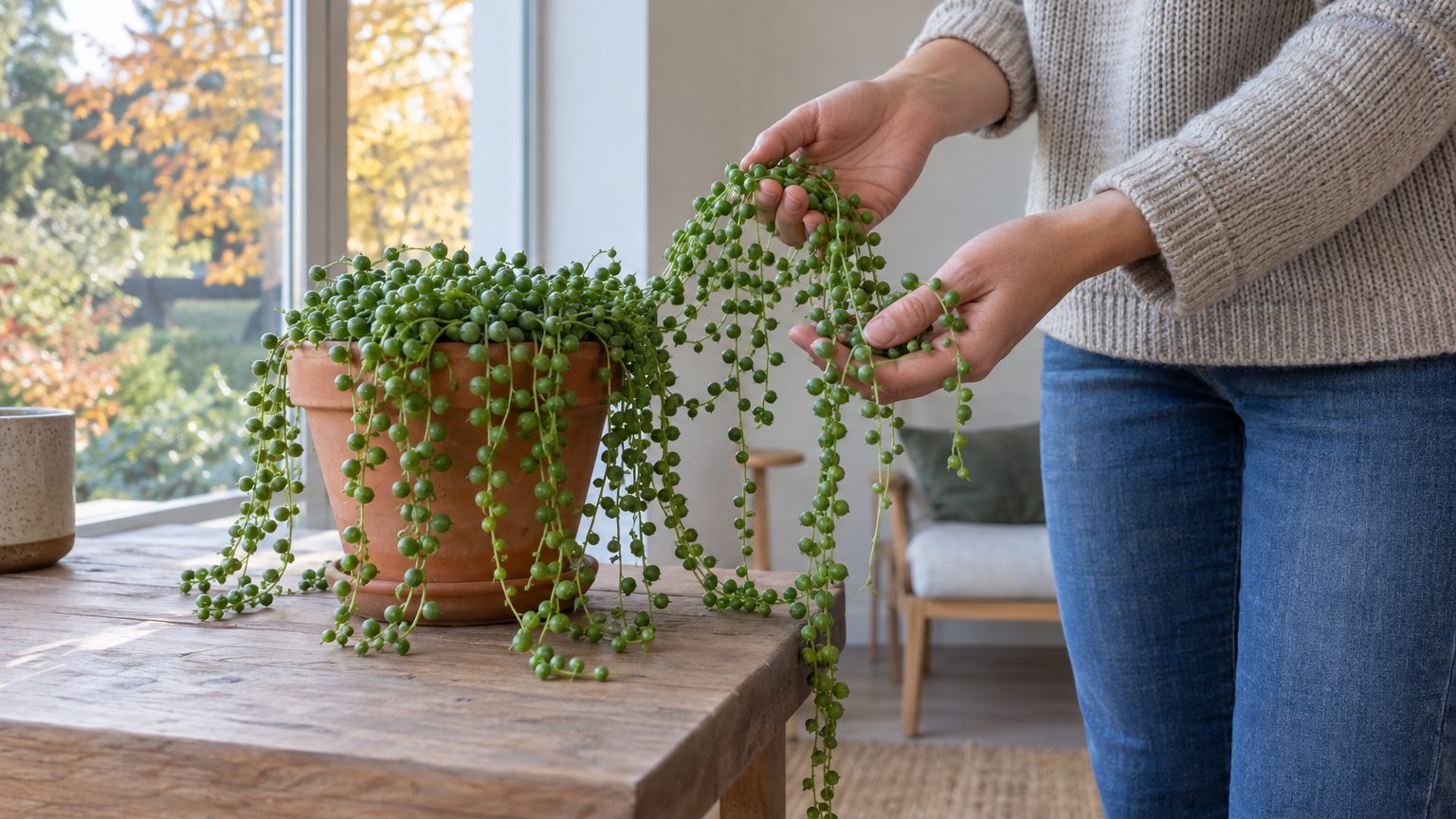
A string of pearls with wrinkled, deflated beads is sending one of two opposite messages. Either the plant is parched, or its roots have rotted and can no longer deliver water to the leaves. The two problems look almost identical from above, and the standard fix for one will kill a plant suffering from the other.
The stem tells you which. Before you reach for the watering can or the scissors, spend thirty seconds with the strand itself.
- Firm, wiry stems with shriveled beads indicate thirst.
- Soft, translucent or blackened stems near the soil indicate rot.
- Dry soil pulling from the pot edge points to thirst; damp, sour-smelling soil points to rot.
The stem check: what to look for and how to do it
Pick up one trailing strand near the pot’s rim and run it gently between your thumb and forefinger. Look at the thread between the beads, not the beads themselves. A thirsty plant keeps a thin, wiry, firm stem, even when the pearls are puckered like raisins.
A rotting plant behaves differently. The stem near the soil line turns soft, translucent, or mushy, and it may look dark brown or black and feel almost slimy. Pinch it lightly and it collapses.
Then try the tug test. Hold a strand close to the soil and pull very gently. Healthy, rooted stems resist. If the strand slides out with little effort, or the base comes away from the crown, the roots have likely failed.
Soil gives a second opinion. Push a finger or a wooden skewer two inches down. Dry, dusty soil that pulls away from the pot’s edge points toward thirst. Damp, cold soil days after your last watering, especially with a sour or swampy smell, points toward rot.
Skip the pearls themselves as evidence. A dehydrated bead and a rot-starved bead both look shriveled, and that is exactly why people misdiagnose this plant.
Why Curio rowleyanus shrivels in the first place
The plant is a succulent native to the dry regions of southwest Africa, and each pearl is a water storage tank. When the soil runs dry, the plant draws on those tanks, and the beads wrinkle as they empty. That is a normal survival response, and the plant recovers fast once water arrives.
Rot is the more common killer. The roots are fine and shallow, sitting in the top inch or two of soil, so they drown quickly in dense potting mix or in a pot without drainage holes. Once they die, the plant can’t absorb anything, and the pearls shrivel while the soil stays wet.
Here is the cruel part.
A struggling, shriveled plant looks thirsty, so well-meaning owners water it more, which finishes the job.
Other causes can mimic both problems. Intense direct sun through a south-facing window in summer can scorch and shrink pearls. Winter dormancy slows water use, so a schedule that worked in July can quietly overwater the plant by December. And pests such as mealybugs, which hide at the nodes between beads, can drain a strand until it puckers.
Rescuing a thirsty plant versus a rotting one
If the stems are firm and the soil is bone dry, soak the pot. Set it in a basin of room-temperature water for 15 to 30 minutes, let it drain completely, and put it back in bright light. Within several days to a week, the pearls should plump back up. If they do, you caught it early.
Avoid the temptation to drench it daily afterward. A thorough soak followed by a full dry-down is the pattern the plant evolved for. In most homes that works out to roughly every two weeks, though it stretches in winter and shortens in a hot, bright room.
Rot calls for surgery. Slide the plant out of its pot and inspect the roots. Healthy roots are pale and slightly firm, while rotted ones are brown or black, soft, and sometimes smell musty. Trim away every dark or mushy section with clean scissors, along with any stem that has gone soft.
Whatever is left becomes cutting material. Take firm, healthy strands, lay them on top of fresh, gritty cactus mix, and press the nodes lightly against the surface. Many growers coil the strands in a circle, and they typically root in a few weeks when kept in bright light with only occasional light watering.
Wait a day or two before watering a repotted plant, letting cut surfaces callus over. Use a pot with drainage and a mix you have amended with perlite or pumice, roughly half and half with cactus soil. Terracotta helps too, since the clay pulls moisture out of the soil.
If every strand is mushy to the crown, the plant is gone. Even then, check the tips of the longest trailing stems, which are often still alive and make decent cuttings.
Preventing the next round
Most losses trace back to three habits: a pot too big, a mix too dense, and a schedule that ignores the season. A string of pearls does best in a snug pot with a shallow profile, wider than it is deep, because its roots stay near the surface. Too much extra soil just holds water the roots will never reach.
Light matters as much as water. Several hours of bright light daily, ideally with a little gentle direct sun from an east window, keeps the plant using water at a healthy pace. In dim corners it sips slowly, and the soil stays wet for weeks.
Check before you water, every time. A skewer or a finger takes five seconds, and no calendar is as reliable as the soil itself.
One last detail from growers: a strand that shrinks only at the tips, with firm beads closer to the pot, is often just old growth shedding naturally, and not a sign of any disease at all.