
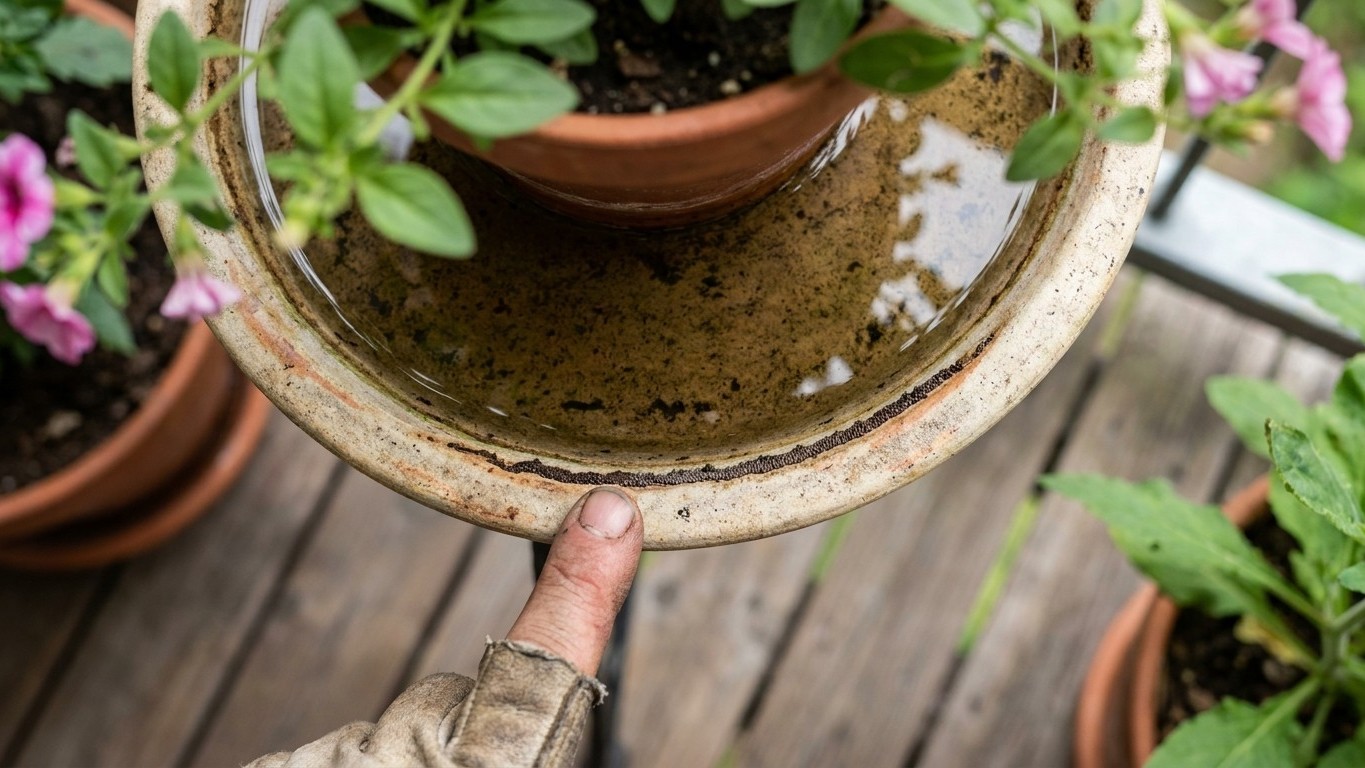
Every few days, you walk out to the balcony, lift the saucer under your favorite planter, and add a splash of water so the soil doesn’t dry out. It feels responsible. It’s also, according to entomologists, the exact habit that keeps tiger mosquitoes cycling through your summer. The fix isn’t complicated, but it’s counterintuitive: instead of topping up that reservoir, you need to dump it completely, wipe the sides, and let it sit dry for a beat before refilling.
Here’s why the half-measure fails. Adult female mosquitoes lay eggs on the inner walls of containers with water, above the waterline, and eggs stick to container walls like glue. That detail matters more than most people realize. When you top up a saucer that’s dropped an inch, you’re not washing away anything, you’re simply raising the water level back up to meet eggs that were laid just above the old waterline. The eggs were waiting there, dry, for exactly this moment.
And they can wait a long time. Eggs can survive drying out for up to 8 months, and can even survive a winter in the southern United States. Once submerged again, the clock resets fast: tiny mosquito larvae emerge from the eggs within 24 to 48 hours almost in unison, and larvae live in water from 4 to 14 days depending on water temperature. In warm weather, that whole cycle from egg to biting adult can wrap up in about a week to ten days, according to the CDC’s own breakdown of the Aedes life cycle.
Key takeaways
- Tiger mosquitoes lay eggs above the waterline in your plant saucers, where they can survive dry for up to 8 months
- Topping up water with the old waterline still present simply re-awakens waiting eggs—the worst thing you can do
- The actual fix takes 20 seconds: empty completely, scrub the sides, refill fresh
The move: empty, scrub, then refill
The actual fix takes maybe twenty extra seconds. Instead of pouring more water into a saucer that’s low, tip it out entirely over the edge of the balcony (away from downstairs neighbors, obviously), then run a finger or an old toothbrush around the inside rim before putting any water back. Pest control professionals frame this as breeding-site elimination rather than breeding-site management, and the logic tracks: Aedes mosquitoes lay desiccation-resistant eggs on surfaces above the waterline that can survive dry conditions for months and hatch when water returns, so scrubbing container walls is also recommended. Skip the scrubbing and you’re just running the same population through another generation on autopilot.
Timing helps too. Health departments generally agree that water allowed to “stand” for five days or more can become a potential mosquito-breeding site. That’s a useful mental calendar: if your balcony reservoir has been holding the same water for the better part of a week, treat it as already colonized, not just cloudy.
Small amounts of water do plenty of damage
What makes balcony planters such a reliable nursery is how little water tiger mosquitoes actually need. Asian tiger mosquitoes breed in small amounts of standing water: as little as a bottle cap’s worth. A saucer holding a quarter-inch after a light watering session is, from the mosquito’s perspective, a perfectly good pond. Other researchers put the threshold even lower, noting that mosquitoes can breed in as little as one tablespoon of water, with bottle caps, upturned leaves, and tiny depressions in outdoor furniture all holding enough to support development.
This is also why the species does so well on balconies specifically. Unlike mosquitoes that need marshland or ditches, tiger mosquitoes evolved breeding in tree holes and bamboo stalks, tight little pockets of water, which is precisely what a plant saucer mimics. And they don’t need to travel far to find you again: tigers have a short flight range, about 100 to 200 yards, so if you feel them biting you, then they are breeding nearby. The mosquito irritating your morning coffee on the balcony almost certainly hatched a few feet from where you’re sitting, not from some marsh across town.
Backup options if you’d rather not scrub weekly
Scrubbing every time you water isn’t realistic for everyone, so a few adjustments make the underlying container less hospitable without demanding constant attention. One option county extension offices recommend is changing the material itself: using unfinished, unpainted terra cotta means the material will naturally soak up the water over time and shouldn’t hold standing water for 7 days. That’s long enough to break the egg-to-adult cycle on its own, since the container simply can’t stay wet long enough for larvae to mature.
Another approach ditches the standing water entirely. Filling saucers with fine gravel or sand can make it more difficult for mosquitoes to lay their eggs, while still letting excess irrigation water drain away from the roots. If neither appeals and you’d rather keep a classic plastic or ceramic saucer, a small dose of biological larvicide covers the gap: containers that may be too large to empty can be treated with a biological pesticide such as Bti, which is probably the safest method for controlling mosquito larvae and is highly specific and toxic only to mosquitoes and a few related flies, without harming people, pets, wildlife, or fish. Mosquito dunks sold at most garden centers contain exactly this bacterium, and a quarter of one lasts weeks in a small saucer.
One thing worth knowing before you declare victory: clearing every saucer on the balcony won’t make the mosquitoes vanish overnight. Even after eliminating all breeding grounds, you’ll still have mosquitoes for up to two more weeks because they have a lifespan of about two weeks, so the effect of scrubbing that reservoir shows up gradually, not the same afternoon. Patience is part of the method here, not a sign it isn’t working.
Sources : us.biogents.com | smartsolutionspestcontrol.com