
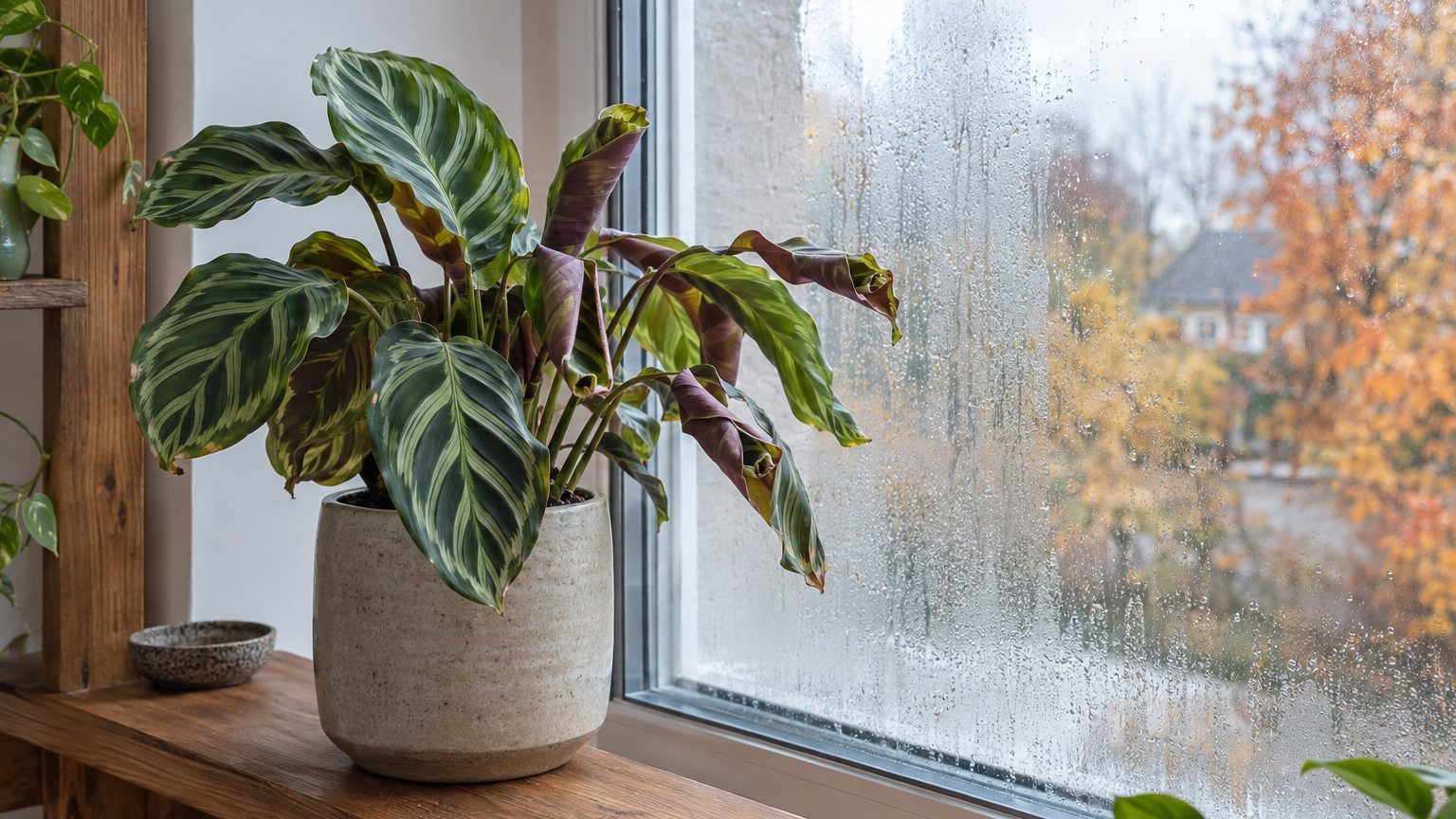
A calathea curling its leaves in January is almost always reacting to one of three things: air dried out by the furnace, a chill radiating from a window pane, or soil that has quietly run dry. Each leaves its own fingerprint. Telling them apart takes about five minutes, a finger, and ideally a cheap hygrometer.
First, check the clock.
Calatheas belong to the prayer plant family, so they raise and fold their leaves at dusk and lower them again at dawn. A plant that looks tight and upright at 9 p.m. is simply following its schedule. Judge the leaves in mid-morning, when they should be flat and open. If they are still rolled then, something is wrong.
- Dry air from furnaces causes gradual, two-to-three-week leaf curling with crisp brown edges while soil stays damp.
- Cold window glass damages only leaves touching or facing the pane within one to two days, leaving them limp and grayish.
- Underwatering creates fast curling across the whole plant within days, with papery leaves and a noticeably light pot.
Dry heating air: the slow curl
Most calatheas evolved on the floor of tropical forests in Central and South America, where humid air is the default. A heated American home in midwinter can fall to 20 or 30 percent relative humidity, a gap the plant never evolved to handle. Thin, broad leaves lose water fast in that air.
Curling is the leaf’s defense. Rolled lengthwise, it exposes less surface and sheds less moisture through its pores.
The signature is gradual. Over two or three weeks, several leaves tighten at once, usually with crisp brown tips or edges, while the soil stays reliably damp. The worst damage tends to appear on leaves closest to a heating vent, radiator, or fireplace. A hygrometer reading below 40 percent next to the plant is close to a confession.
Dry air builds slowly, so the damage always looks sudden.
Cold glass: the one-sided problem
On a freezing night, the inside surface of a single-pane or older double-pane window can sit far below room temperature. Calatheas start to sulk below roughly 60°F, and leaves touching or hovering near that glass get the worst of it. The room may read a comfortable 68°F while the plant’s immediate neighborhood is 15 degrees colder.
Look for asymmetry. Only the leaves facing the window curl, often with dull, grayish patches or a slightly water-soaked look, and they feel limp rather than papery. Press the back of your hand to the glass after dark, then slip a thermometer into the gap between the pane and the foliage. Door drafts and the blast from a cold hallway can do the same job.
Cold damage shows up within a day or two, not weeks.
Moving the pot 8 to 12 inches back from the window usually solves it. Sheer curtains help too, though a curtain trapped between plant and glass can create a pocket of even colder air.
Thirst: the fast curl
Calatheas want soil that stays evenly moist, never soggy and never bone dry. Winter tricks owners into underwatering because growth slows and they cut back, yet a forced-air system can dry a pot nearly as quickly as in July. The top inch or two of soil is the place to check.
Thirst is the quickest of the three. The whole plant curls within days, the leaves feel thin and papery, and the pot is noticeably light when lifted. Sometimes the soil shrinks away from the pot’s edge, which lets water race down the gap without soaking in. If that happens, set the pot in a few inches of room-temperature water for 20 minutes, then let it drain fully.
Leaves often relax within a day of a proper drink.
Overwatering can mimic all of this. Curling accompanied by yellowing, soggy soil, and a sour smell points toward root trouble, and cold, wet roots in a dim winter room are a risky combination.
Running the five-minute triage
Start with the soil, since it takes ten seconds. Push a finger two inches down; dry means thirst, wet means look elsewhere. Next, test the glass and check which leaves are affected: one side only suggests cold, the whole plant suggests water or air. Last, read the hygrometer.
Two culprits often overlap.
For dry air, a humidifier running within a few feet of the plant works better than any trick. Pebble trays, popular for years, raise humidity only in the inches directly above the water, so their effect is minor. Grouping plants helps a little, and keeping the pot at least three feet from a heat source helps more.
Water quality matters too. Calatheas are famously sensitive to the minerals and fluoride in some tap water, and crisped brown edges can come from that rather than from humidity. Filtered water or collected rainwater, left to reach room temperature, is a cheap experiment that often pays off.
Leaves already curled and browned will not fully recover, and the damaged edges can be trimmed along the natural leaf shape. Watch the new growth instead: if fresh leaves unfurl flat and green by early spring, the diagnosis was right.