
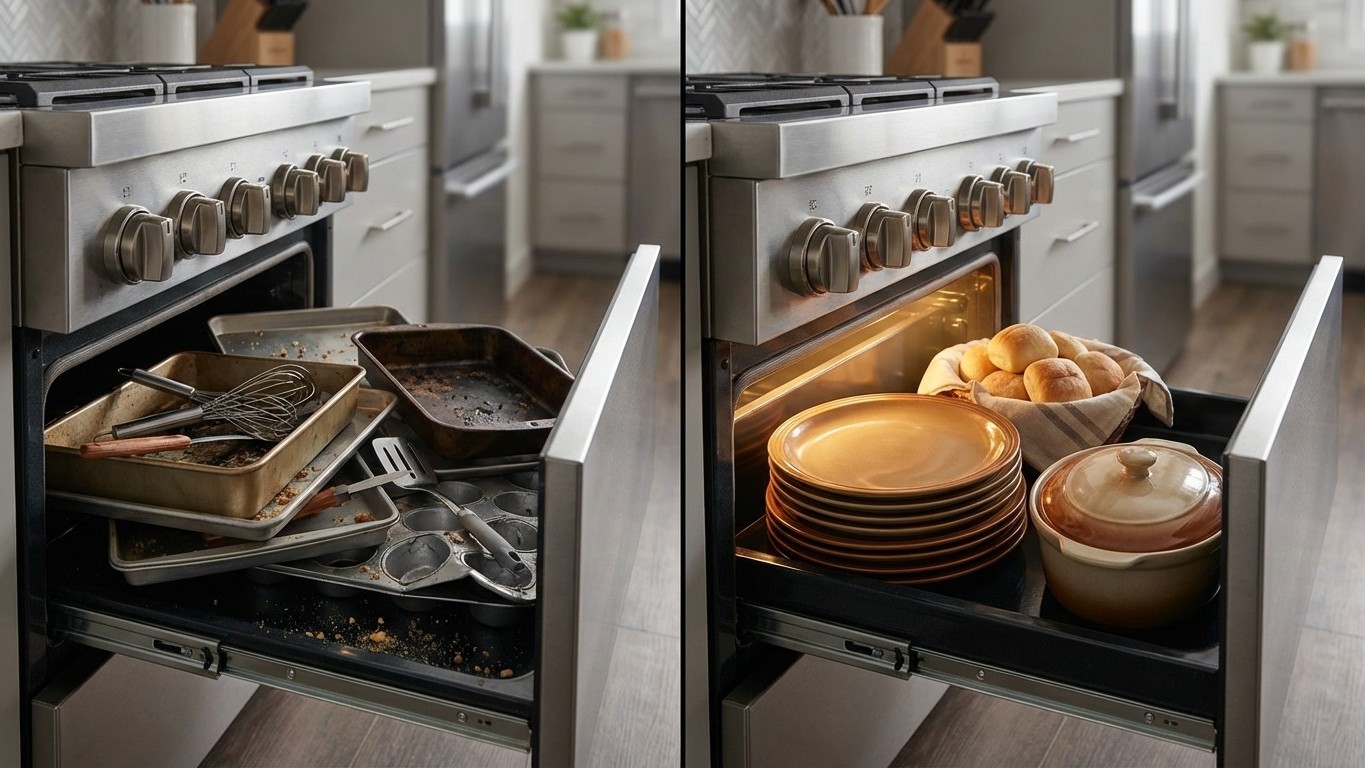
That drawer beneath your oven? You’ve probably been shoving pots, pans, and random kitchen gadgets into it for years. Join the club — millions of home cooks have turned this space into a chaotic storage unit without ever questioning its true purpose.
Plot twist: that’s not what it’s designed for.
The drawer underneath most ovens serves a specific function that could revolutionize how you cook. Understanding its actual purpose might explain why your dinner rolls sometimes come out lukewarm or why that casserole never stays quite warm enough for second helpings.
Key takeaways
- Your oven drawer has a secret function that’s completely different from what most people think
- Professional kitchens have exploited this drawer’s hidden talent for years—but home cooks are just catching on
- Using it the wrong way could actually be dangerous, and you might be damaging items right now
The Warming Drawer Revolution
Professional chefs have known this secret for decades. That bottom drawer? It’s a warming drawer — designed to keep cooked food at the perfect serving temperature without continuing to cook it.
Think about Thanksgiving dinner. You’ve got the turkey resting, the sides finishing up, and guests arriving in waves. Your oven drawer becomes mission control for temperature management. Dinner rolls stay bakery-fresh warm. The green bean casserole maintains that just-out-of-the-oven appeal while you finish the gravy.
The temperature range typically hovers between 170°F and 200°F — hot enough to prevent bacterial growth but gentle enough to avoid overcooking. No more juggling multiple dishes or watching helplessly as your carefully prepared sides turn cold and unappetizing.
Restaurant kitchens rely on warming drawers to maintain food quality during busy service periods. Your home version operates on the same principle, just scaled down for family meals rather than feeding hundreds of customers.
Beyond Simple Storage
But warming isn’t the drawer’s only talent. Many home bakers have discovered its prowess as a proofing chamber for bread dough.
Yeast thrives in warm, consistent environments — something your kitchen counter can’t always provide, especially during winter months. The drawer creates an ideal microclimate for dough development. Set it to its lowest temperature setting, place your covered bowl inside, and watch as your bread dough doubles in record time.
Professional bakeries use specialized proofing cabinets that cost thousands of dollars. Your oven drawer delivers similar results for the price of running a small appliance.
Some adventurous cooks use the space for slow-cooking projects that benefit from gentle, sustained heat. Think compound butter that needs to stay spreadable, chocolate that requires careful melting, or delicate custards that demand precise temperature control.
The key lies in understanding that this drawer operates independently from your main oven. You can bake cookies upstairs while keeping soup warm downstairs — two cooking zones in one appliance.
The Storage Trap
Why did so many of us get this wrong? Blame a combination of factors: unclear manufacturer instructions, cramped kitchens desperate for storage, and the simple fact that the drawer looks perfect for stashing cookware.
Plus, not all oven drawers function the same way. Some older models or basic ranges genuinely serve as storage compartments. The difference lies in whether your drawer has its own heating element and temperature controls.
Check for telltale signs: does your drawer have a separate dial or digital controls? Can you feel warmth emanating from it when the oven runs? If yes, you’ve got a warming drawer masquerading as a junk collector.
Using it for storage isn’t just wasteful — it can be dangerous. Plastic containers melt. Paper products become fire hazards. Even metal pans can warp under sustained heat exposure.
One home cook discovered this lesson the hard way when her plastic cutting boards transformed into abstract art after accidentally activating the warming function with storage items inside.
Making the Switch
Transitioning from storage to proper use requires some kitchen reorganization, but the payoff justifies the effort.
Start by clearing everything out — really everything. Give the drawer a thorough cleaning to remove any residual food particles or grease that accumulated during its storage phase.
Invest in oven-safe dishes that fit your drawer’s dimensions. Shallow casserole dishes, serving platters, and bread baskets work beautifully. Avoid anything with plastic handles or decorative elements that might not withstand sustained heat.
Plan your cooking timeline differently. Instead of frantically juggling multiple dishes at serving time, prepare components earlier and let the warming drawer handle the temperature maintenance.
Your dinner parties will never be the same. No more apologizing for lukewarm food or rushing through explanations while dishes cool on the counter. Everything arrives at the table at optimal serving temperature.
What other kitchen “storage solutions” might be hiding their true potential in plain sight? That mysterious button on your microwave, the various settings on your dishwasher, or the extra compartment in your refrigerator — perhaps it’s time to read those manuals gathering dust in your junk drawer.