
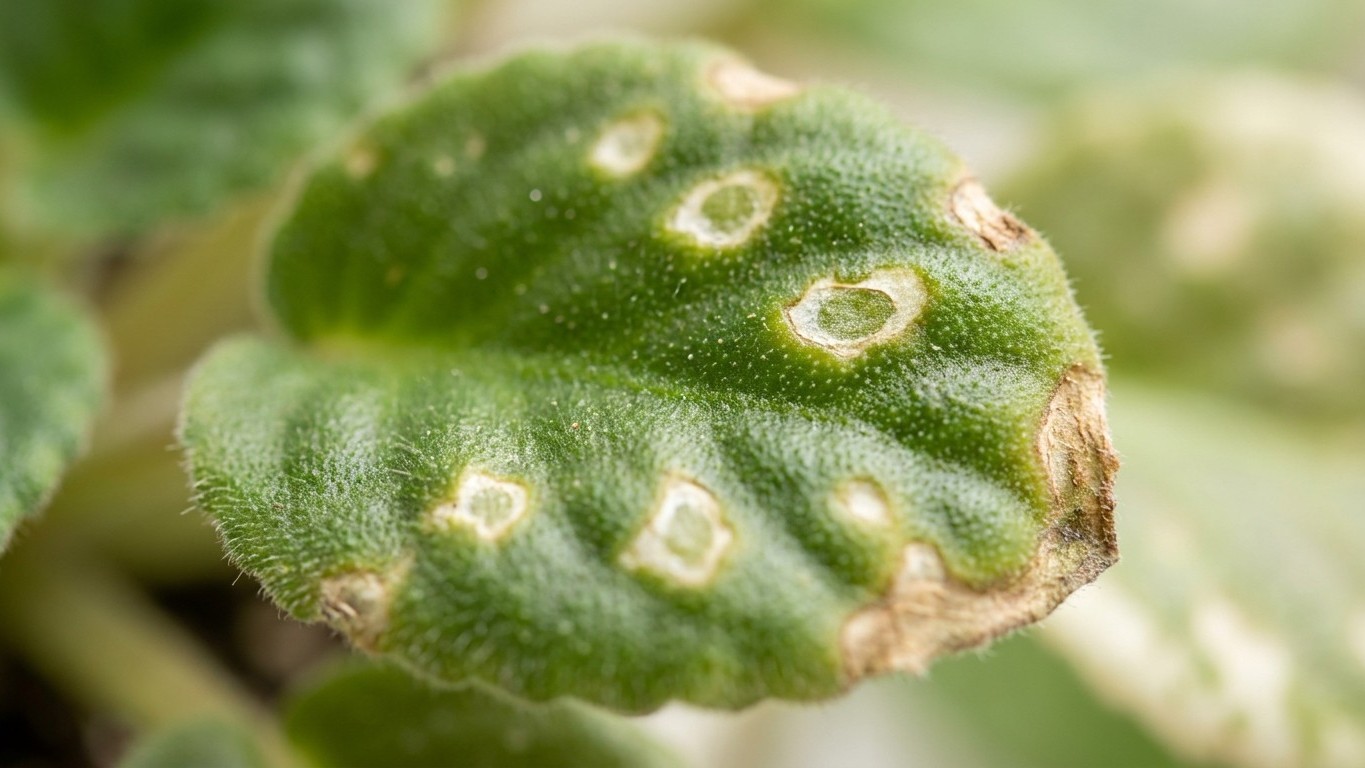
Leaf spotting on African violets has a single most common cause, and it’s not pests, not disease, not overwatering. It’s the well-meaning gardener reaching for a spray bottle. Cold or room-temperature water landing on those fuzzy leaves creates white or yellow rings that never fade, the tissue is dead, the damage irreversible. The plant keeps growing around those spots, but the marks stay.
That’s the part nobody warns you about upfront. Misting feels intuitive. You see a plant, you want to refresh it, you mist. African violets (Saintpaulia) look like they belong in a humid jungle, and technically their ancestors do, the Usambara Mountains of Tanzania, where mist rolls through naturally. But “naturally” is the operative word. In those environments, the moisture is airborne and roughly the same temperature as the leaves. A spray bottle of tap water at 65°F hitting a leaf that’s been sitting in a warm room is a thermal shock, essentially burning the surface cells.
Key takeaways
- That intuitive spray bottle is actually burning your African violet’s leaves at the cellular level
- The fuzzy leaf texture that makes the plant look tropical is the exact reason misting backfires
- Months of accumulated damage can happen before you notice a single visible spot
Why the Fuzz Makes Everything Worse
Those tiny hairs covering African violet leaves, botanically called trichomes, are not just decorative. They trap moisture against the leaf surface far longer than a smooth leaf would allow. On a rubber plant or a pothos, a water droplet rolls off in minutes. On an African violet, it sits. And as it evaporates, the temperature drop it causes is concentrated exactly where the droplet touched, leaving that characteristic pale ring.
The same trichomes that cause this problem also serve the plant’s defense system, deterring insects and reducing water loss through transpiration. Damaging them repeatedly weakens the plant’s ability to manage its own environment. After months of misting, you’re not just dealing with cosmetic spots, you’ve been gradually compromising the leaf’s function. The outer leaves, which are oldest, tend to show the worst damage first, which is why many growers mistake the problem for natural aging and keep misting the newer growth.
What Actually Happened Over Those Months
The timeline of misting damage is slow enough to be deceptive. One session won’t ruin a plant. Ten sessions across a few weeks won’t either, at least not visibly. But the damage accumulates underneath before it becomes obvious on the surface. By the time you notice the white rings or the bronze discoloration spreading across multiple leaves, you’ve already been misting through the warning signs you couldn’t yet see.
This is not a hypothetical worst case. African violet growers on forums like the African Violet Society of America regularly post photos of plants that have been misted for a season before the owner realized what was happening. The rings are described as “water stains” by beginners, but the accurate term is leaf scorch — and unlike a regular stain, it cannot be wiped off because the discoloration is within the leaf tissue, not on top of it.
Temperature differential is the direct cause, but mineral content in tap water adds another layer. Hard water leaves calcium and magnesium deposits on those leaf hairs, creating a gritty residue that further blocks light absorption over time. Some growers switch to distilled water and notice slightly less spotting, but the temperature problem remains regardless of water quality.
The Right Way to Water African Violets
Bottom watering is the method the plant itself seems designed for. Set the pot in a tray or shallow dish of water at room temperature, let the soil wick moisture upward through the drainage holes for 20 to 30 minutes, then remove it. The leaves never get wet. The roots get exactly what they need. It’s slower than top watering, but the trade-off is a plant that looks clean and undamaged for years.
Humidity is a separate concern from watering, and it requires a separate solution. African violets thrive between 50% and 60% relative humidity, higher than most American homes in winter. A small pebble tray filled with water placed near (not under) the pot raises local humidity as the water evaporates. A humidifier in the room works even better. Neither method puts moisture directly on the leaves, which is the only rule that matters.
Top watering is possible if you’re careful. Use a narrow-spouted watering can, aim directly at the soil, and keep the stream away from the crown and leaves entirely. Room-temperature water only, water that’s been sitting in a watering can overnight is ideal, which also allows some of the chlorine to off-gas. If you do get water on the leaves, blotting gently with a soft cloth and moving the plant out of direct light while it dries reduces (but doesn’t eliminate) the risk of spotting.
The Leaves With Spots Won’t Recover : But the Plant Can
Damaged leaves are damaged permanently. No treatment, no fertilizer, no change in care will restore the tissue. The practical move is to remove the worst leaves cleanly at the stem : African violets regenerate foliage readily, and removing a damaged outer leaf often encourages the plant to push new growth from the center. Left on the plant, heavily spotted leaves still photosynthesize at reduced capacity, so it’s a judgment call based on how severe the damage is.
New growth from a plant that’s no longer being misted will come in clean. That contrast, healthy new leaves emerging alongside the spotted old ones, is actually a useful diagnostic: it confirms the care change is working and that the problem was environmental, not genetic or disease-related. African violet crowns can look surprisingly fresh within six to eight weeks of correcting the watering method, even on a plant that looked rough before.
One detail worth knowing: the spots don’t make the plant toxic or diseased, so there’s no urgency to discard it. The African Violet Society of America notes that even heavily spotted specimens often bloom normally, because the flowers draw on the whole plant’s energy, not just individual leaf health. A scarred plant can still be a flowering one.