
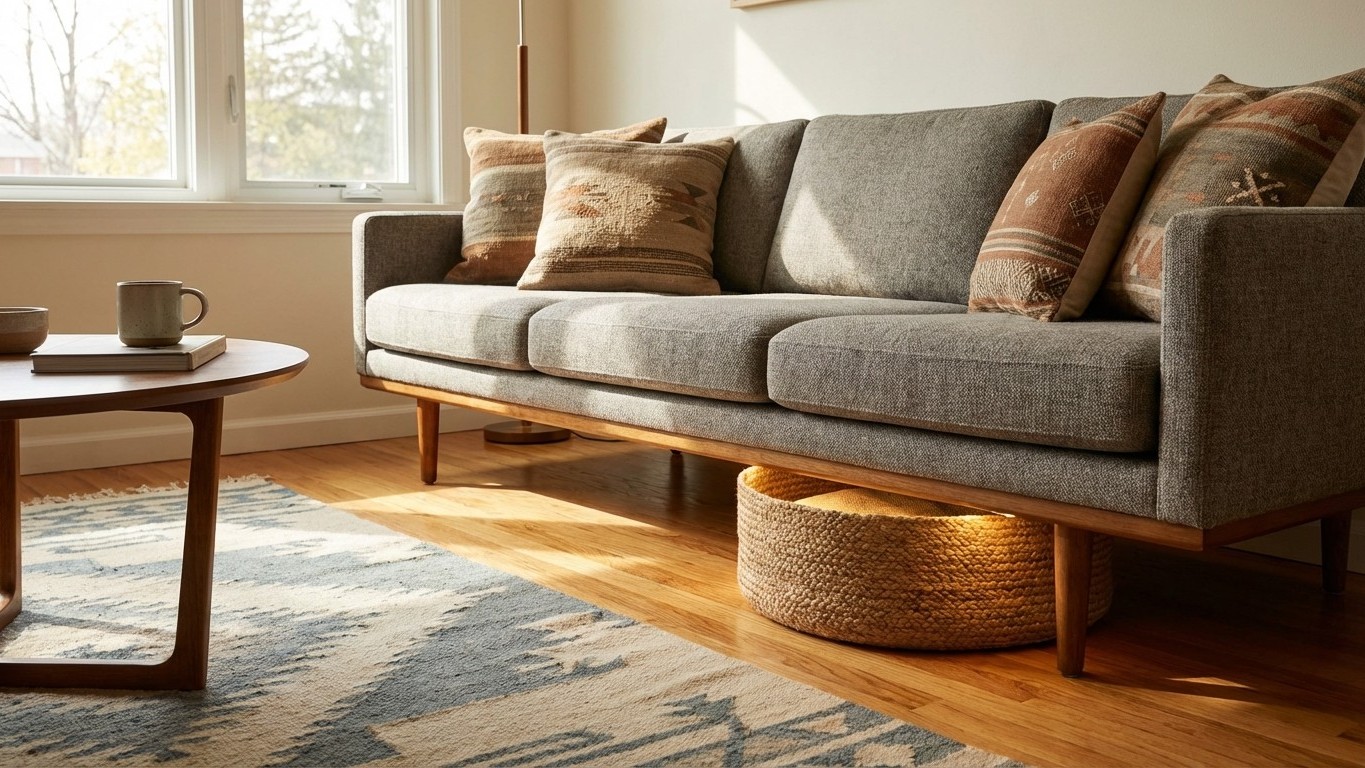
Every Saturday morning for months, I found myself squinting at my living room, mug in hand, mentally listing the suspects: clashing throw pillows, a lopsided gallery wall, rug too small by a hair. Yet something deeper nagged, a sense the space just wouldn’t settle. The sofa, hulking and inviting, commanded the room. But beneath it? Dead air and dust bunnies. I’d ignored it for years.
One rainy afternoon, out of curiosity more than hope, I tried slipping a woven basket under the sofa, a leftover from last year’s closet purge. Instantly, the room felt cohesive, anchored. The difference wasn’t dramatic in a before-and-after-photo way. It was subtle, like the satisfying click of a puzzle piece. Suddenly, I understood what Designers mean when they talk about “visual weight.” The overlooked gap under the sofa wasn’t just empty; it left the room feeling unfinished.
Key takeaways
- Why does the space under your sofa affect your whole room’s vibe?
- How designers use hidden zones to create flawless interiors.
- The surprising impact of a small storage basket beyond clutter hiding.
The Invisible Zone: Why Under-Sofa Spaces Matter
Fifty-nine percent of U.S. homes built in the last decade feature open-concept living areas, according to the National Association of Home Builders. In these sprawling spaces, every detail is exposed, especially those you’d rather ignore. The sections just below our line of sight, including the “toe-kick” spaces under cabinets and, yes, the area beneath the sofa, catch the light in ways that can subtly make or break a room’s polish. When left barren, these zones become voids that cheapen even the most curated arrangement.
Think about hotel lobbies. Do you ever see naked under-sofa spaces there? Never. Designers employ baskets, low ottomans, or neatly stacked books to humanize pristine seating areas, banishing the neglected look. At home, that same technique can Transform a room from default to deliberate. Real estate professionals have long known this trick. Before showings, many stagers purposefully add accents in overlooked places, under coffee tables, beside armchairs, and especially under sofas—to coax that elusive “move-in ready” feeling.
Function Marries Style: Beyond Hiding Clutter
The practical benefits are obvious. Yes, an under-sofa basket is perfect for stashing throw blankets, magazines, remote controls, or the elusive TV guide that keeps vanishing. But the real pivot comes when utility sneaks handsomely into the picture. A box made of seagrass or felt not only hides odds and ends, but introduces texture, an ingredient often missing in big-box-furnished spaces dominated by smooth fabrics and flat surfaces.
On a whim, my friend once stuffed a pair of old travel trunks underneath her mid-century couch. The result: functional storage for out-of-season shoes, and an unexpected conversation piece. It’s a minor tweak, but it yields a domino effect. Tidy up the underbelly, and suddenly even wayward toys or charger cords seem less noticeable. It’s about managing chaos, sure, but also about projecting an image of intentional living, even if your real life feels less organized than your Instagram grid.
Troubleshooting the Details: What Actually Works?
No single rule applies to every living room, of course. Some sofas hover a mere two inches off the ground, a non-starter for most baskets. Others balance on skinny legs with six inches to spare. Measure your sofa’s clearance before starting the hunt. The sweet spot? Most designers suggest maintaining a two- to four-inch gap between basket top and sofa base for airflow and ease of access.
If storage isn’t the goal, try using a decorative object instead. A large ceramic bowl with smooth curves, a stack of vintage books, or even a folded quilt in a color that echoes a piece of art on the wall, these inject personality and avoid the trap of sterile minimalism. For pet owners, a low-profile pet bed can slot neatly beneath the couch, trading clutter for coziness. One ingenious parent I know even stores board game boxes under her sectional, within arm’s reach but out of casual sight. It’s a minor act of domestic choreography.
Lighting changes everything. Position a small, battery-powered lamp or LED strip along the back wall under the sofa, and the shadow transforms from dead space to ambient glow, like a subtle, private theater. I stumbled across this trick in a boutique hotel in Lisbon; at home, I mimic it using an inexpensive clip-on light. The effect: guests notice the room feels warmer, even if they can’t pinpoint why. That’s the secret sauce of interior design—shaping sensation as much as appearance.
What Gets Overlooked : And Why It Matters
We live surrounded by images of “perfect homes,” yet the reality is most of us look past the liminal spaces. They’re too easy to ignore when we don’t know what to do with them. One survey, conducted by a leading home organization brand in 2025, found that fewer than 10% of Americans proactively style the spaces below major furniture. The result: living rooms that feel perpetually incomplete, no matter how artfully styled above eye level.
The irony? Fixing this micro-detail costs less than a new throw pillow and demands zero DIY prowess. Most solutions don’t even require shopping; a repurposed crate, a storage box from the closet, or even a deep decorative tray can work. The only requirement: intention. That’s what sets apart living rooms you linger in from those you just pass through. A home should feel resolved at every level, including the shadows.
Is it possible for a minor tweak, just a basket under the sofa, to rewrite the whole vibe of a room? I think yes, though it’s rarely acknowledged in glossy magazines or home improvement shows. We spend hundreds updating wall colors or swapping out furniture, but the spaces beneath our feet, quite literally, hold the power to ground us. Next time your living room feels “off,” scan lower. There’s likely a clue waiting where you least expect it.
What if the secret to your most inviting space isn’t something new, but rethinking the places you’ve been trained to ignore? The answer, it turns out, may be just under your nose. Or, more accurately, under your sofa.