
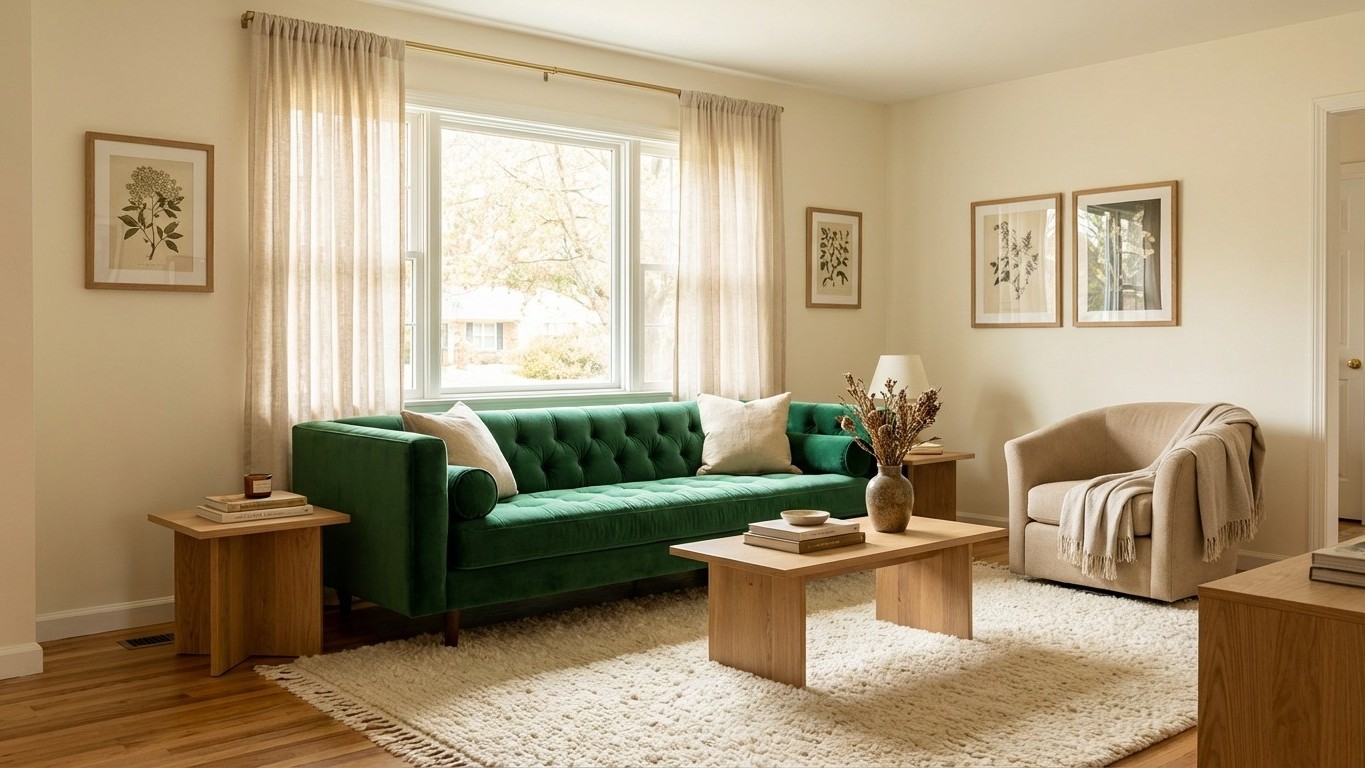
No one warns you how a house can echo. Not just with sound, but with the blare of mismatched furniture, the empty stares of bare walls, the cold geometry of a room that looks like it’s trying too hard, or, worse, not trying at all. I lived in that echo for years, mistaking “filled” for “finished,” certain that more was more. The result? A living room more suited to a waiting area than a retreat. Scattered noise, zero personality. Then a designer handed me a rule so simple I couldn’t believe I’d missed it: start with one significant piece, just one, and build everything out from there.
Key takeaways
- Why more furniture often leads to louder, less cozy spaces.
- The secret rule designers use to bring calm and cohesion to any room.
- How anchoring with a single piece changes the look and feel of your home.
The Rule: Anchor, Then Layer
Imagine standing in a bare living room. The ceiling’s too high, the windows too wide. You want warmth, but every shopping trip adds another unrelated lamp or side table. Interiors can quickly read like a catalog’s “everything must go” page, restless and loud. Enter the anchor rule. “Let one item set the tone,” my designer friend explained as she glanced at my anxious collection of furniture. A sofa, a rug, an artwork—choose what speaks, then let the rest play backup.
It sounds obvious. Yet, most of us do it backward. We accumulate, scattershot. A coffee table here, two chairs there, plus the sale rug that sort of matches. Think of a poorly rehearsed orchestra: a flurry of sound, no melody. The anchor rule rewrites your space as a clear composition. When you pick your anchor—a bold velvet sofa in emerald, say, or a massive abstract on canvas, everything else becomes accompaniment. Patterns, textures, and supporting colors echo, rather than compete.
I chose my anchor by feel, a rug large enough to claim the room and quiet enough to balance its chaos. Cream, deeply textured, breaking up the floor’s monochrome. Suddenly, everything else made sense; sofas and throws conspired quietly, bookshelves became less intrusive, and, miraculously, the room’s persistent “noise” softened. One strong voice—then a careful chorus.
Loudness Isn’t Just About Volume
Noise in a room isn’t always audible. Visual cacophony, the sense of a space that’s “alive” but never welcoming, can be just as exhausting. Consider a bedroom overrun with accent pillows, a dining room with mismatched chairs, or the modern curse: endless decorative “stuff” that accumulates on open shelving. A well-anchored room, on the other hand, settles your nerves before you even notice it.
There’s hard science here. Researchers have found that visual clutter raises stress hormones and even spikes your heart rate. An endless scroll of things for the eye to process and categorize. The anchor rule, by contrast, gifts you visual rest. Pick the rug, or the oak dining table, or the wall-spanning window seat, and decide that everything else will serve that vision. The result isn’t sterile. It’s intentional.
During a visit to an architect’s apartment, I saw this rule in action, one exposed brick wall, lit perfectly, everything else supporting its texture and warmth. No distractions, just a rhythm. The discipline was palpable, and, frankly, oddly soothing. Like background music you barely notice until it’s turned off. That’s the difference between design that shouts and design that listens.
Making it Personal (Without the Noise)
Somewhere between “catalog perfect” and “lived-in chaos,” most of us struggle to find our style. Anchoring, though, is a cheat code, because it doesn’t mean stripping personality away. Quite the opposite: when the anchor is right, your favorite objects become highlights instead of clutter.
Take books, shelved carefully under an oversized artwork, they tell a story in vignettes, not in heaps. Or houseplants, which echo the shapes and colors picked up from your centerpiece rug or sofa. Even quirky finds, a neon lamp, souvenir ceramics, become intentional with an anchor in place. It’s the difference between a potluck and a beautifully curated meal: just enough, never too much.
I paused before buying anything new after learning this. Sometimes months at a stretch, waiting for the right chair, the right light. The patience pays off. A friend, an artist, once said she lives by the “one great thing at a time” mantra. Her living room, anchored by a painting she made, looks like a home, not a magazine. Everything else finds meaning in relation to that first bold choice.
Small Space, Big Impact
Apartment-dwellers, take heart. Anchoring isn’t about square footage. Sometimes it matters even more where every inch counts. A bed with a distinctive linen headboard, a round table that truly fits the kitchen nook, a vintage mirror in the entryway. Anchors lend small places the kind of personality and coherence that can’t be bought off the shelf.
One Manhattan studio springs to mind. Only 500 square feet, barely the size of two hotel rooms, but the owner (a designer herself) used an enormous black-and-white photograph above the sofa as her anchor. Everything else sat quietly: a low, pale couch, discreet lighting, texture from nubby throws and woven baskets, but all tuned to that photograph’s drama. Walking in, you felt instantly welcomed, not overwhelmed. A miracle, considering the city outside never stops.
All this might sound like minimalism in disguise. It isn’t. The anchor rule doesn’t demand empty space or endless restraint. Just clarity. Like an old radio tuned to a single clear station rather than static. Sometimes, that’s all a room needs.
So, what happens when you bring this rule home? Rooms that feel quieter, softer, more like you, even when you’re not quite sure what “your style” is yet. Maybe the real trick isn’t filling up on objects, but listening for that one thing that wants to take center stage. After all, every home deserves a little harmony. The next time you feel that echo, too bright, too cold, too anonymous, pause. What stands out? That’s your anchor. Everything else is just support.