
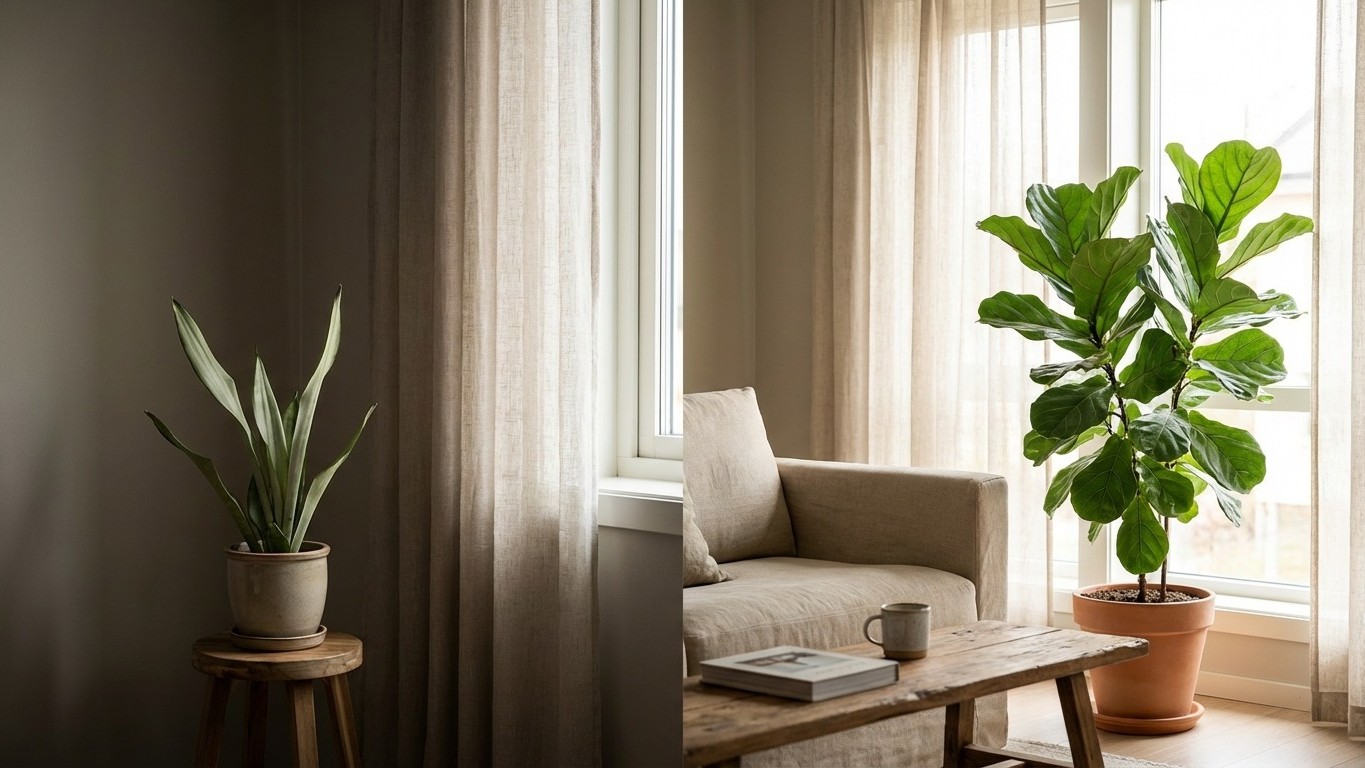
Introduction: Light decides more than you think
A plant can survive your missed watering. It can even forgive a dry heater week. Light is less negotiable.
Indoors, the problem isn’t “no light”. It’s misread light. Your eyes adapt so well that a dim corner can feel “bright enough”, while the plant is running on a tight energy budget, day after day. Result? Slow growth, stretched stems, pale leaves, and the quiet feeling that you “don’t have a green thumb”.
This page breaks down the practical difference between low light and bright indirect light, with visual cues you can use at home, window-by-window, season-by-season. The goal is simple: find the best light for indoor plants (low light vs bright indirect), without guessing.
Understanding indoor light types
What “low light” Actually means
Low light is not darkness. It’s usable light that is too weak for many species to grow well, even if they don’t die.
Horticulture guides often define low indoor light around roughly 25 to 100 foot-candles at mid-day in the spot where the plant sits, a range typically found far from windows or in rooms where overhead lighting is the main source. Some extension resources broaden “low light” into ranges like 50 to 250 foot-candles for plants marketed as tolerant, but the core idea stays the same: low light is a survival setting, not a Thriving setting.
In everyday Apartment terms, low light looks like this:
- A few meters into a room, even if the window feels bright.
- A north-facing window set back from the glass.
- Behind heavy curtains, tinted film, deep balconies, or dense outdoor trees.
- Hallways, bathrooms, or bedrooms that rely on Ceiling fixtures.
Low-light plants can maintain leaves there. Many won’t actively grow much. Think of it like putting your phone in low-power mode.
What “bright indirect light” actually means
Bright indirect light is strong light that does not hit the leaves as a direct sunbeam. No sharp rectangle of sunlight moving across the pot. No hot glass magnifier effect. Just a bright patch of room illuminated by the sky, often near a window.
Measured at the plant’s leaf level, bright indirect light commonly lands in the “medium to high” indoor range, often several hundred foot-candles or more in the right spot. Placement matters more than the label. Two steps closer to the window can be the difference between a plant that holds steady and a plant that grows.
Bright indirect light tends to exist:
- Right beside an east or west window where direct sun is limited in duration.
- Near a south-facing window but pulled back so sun rays don’t strike the foliage.
- At a bright window softened by a sheer curtain, outdoor shade, or filtered light through foliage.
It’s the indoor equivalent of wearing sunscreen at the beach: plenty of light, less scorch.
How light changes indoor plant growth
Photosynthesis is the plant’s income. Light is the currency.
Chlorophyll absorbs light and helps convert it into chemical energy. When light intensity is too low, the plant has fewer resources to spend on new leaves, thicker stems, flowers, and strong roots. Growth slows. Internodes stretch. Leaves may become smaller, thinner, or simply fewer.
When light is strong enough, plants build sturdier tissue and maintain color better. Variegated plants are the clearest example in daily life: the pale sections carry less chlorophyll, so they generally need brighter conditions to keep patterns crisp. In a dim room, variegation often fades first, like a photo left in a sunny car window.
One more reality check: indoor light is seasonal. In February 2026, if you live in much of the United States, days are still relatively short compared with late spring and summer. The same window that feels “fine” in June can slide into low-light territory in winter, even before you notice a difference.
Low light vs bright indirect: the differences that matter at home
The fundamental difference is not a poetic one. It’s physics: intensity, distance, and time.
Three practical contrasts you can use immediately:
- Intensity: bright indirect delivers far more usable energy than low light, even if both feel “comfortable” to your eyes.
- Distance to the window: moving a plant from 6 feet to 2 feet from a window can change results more than switching to a “hardier” species.
- Consistency across seasons: low-light spots swing hard in winter; bright indirect spots usually remain workable year-round, though still weaker in the cold season.
This is why choosing placement is part of plant selection. If you want the broader framework beyond light, you’ll find it in indoor plant care, where the basics of light, watering, humidity, and temperature come together.
Plant types that suit low light (meaning “tolerate shade”)
Low light is the realm of “tough leaves, slow expectations”. These plants evolved under canopies or in understory habitats, where sunlight is scattered and brief.
Examples that are widely treated as shade-tolerant houseplants:
- Snake plant (Dracaena trifasciata, often sold as Sansevieria): holds structure in dim corners, grows faster with more light.
- ZZ plant (Zamioculcas zamiifolia): thick, waxy foliage, steady in lower light, slower by design.
- Cast iron plant (Aspidistra elatior): famous for patience and endurance.
- Peace lily (Spathiphyllum): survives in lower light, tends to flower better with brighter conditions.
- Pothos (Epipremnum aureum): tolerates lower light, becomes fuller and more compact with brighter indirect light.
A useful mental model: “tolerant” does not mean “optimized”. A pothos in low light can live. A pothos in bright indirect can look like you hired a stylist.
Plants that want bright indirect light (and show it quickly)
Some houseplants react to low light with unmistakable body language. They lean. They stretch. They drop older leaves to fund new growth. The plant isn’t being dramatic; it’s reallocating.
Common houseplants that generally perform best in bright indirect light include:
- Monstera and many philodendrons: larger leaves and sturdier stems with stronger indirect light.
- Fiddle-leaf fig (Ficus lyrata): tends to thin out and become sparse when light is modest.
- Croton (Codiaeum variegatum): color is closely tied to intensity, often loses vibrancy in dim rooms.
- Many orchids and flowering houseplants: “alive” isn’t the goal, blooms are, and blooms are energy-intensive.
If you’re building a home jungle, this is where your best windows should go. Bright indirect light is prime real estate.
How to recognize and measure light in your home
You don’t need to turn your living room into a lab. You do need a repeatable method.
Simple methods to evaluate light (shadow test, apps, tools)
The shadow test is the fastest beginner tool. Place your hand between the light source and the surface where the plant sits:
- Sharp, crisp shadow: light is strong, often direct or near-direct, handle with care for sensitive leaves.
- Soft-edged shadow: moderate to bright indirect, typically a safe “growth zone” for many houseplants.
- Barely visible shadow: low light, expect slow growth and choose tolerant plants.
Phone apps can give a rough lux estimate using your camera sensor. They’re not Perfect, but they’re consistent enough to compare two spots in the same home. Consistency beats precision when your question is “corner A or shelf B?”
A lux meter (or a meter that reads foot-candles) gives the clearest answer. Measure at leaf height, with the plant in place, around mid-day, and repeat on a cloudy day if your climate is frequently overcast. Numbers will vary, the pattern is what matters.
Quick conversion, if you’re mixing sources: 1 foot-candle is about 10.764 lux. That means 100 foot-candles is roughly 1,076 lux, and 500 foot-candles is roughly 5,382 lux.
Match plant placement to plant needs
Window direction is your map. Distance is your dial.
General indoor patterns, with plenty of local exceptions (trees, buildings, awnings, balcony depth):
- North-facing windows: typically the gentlest light, often indirect most of the day. Great for many shade-tolerant foliage plants.
- East-facing windows: morning sun, then softer light. A sweet spot for many “bright indirect” plants if you pull them slightly back.
- West-facing windows: stronger afternoon light, sometimes harsher. Filter it if leaves scorch.
- South-facing windows (in the Northern Hemisphere): brightest overall, highest risk of direct-sun burn indoors, also the best place to create bright indirect by stepping back from the glass.
Then comes the practical move: start with the plant’s label, but trust its behavior more. If stems stretch and leaves shrink, it’s asking for more light. If leaves bleach or crisp on edges soon after a move, you gave it too much sun too fast.
Placement interacts with watering, too. A plant in bright indirect dries faster than the same plant in low light. That’s why “how often to water houseplants” is never a single number; light and season set the pace.
Tips to maximize natural light indoors
Light management is often home management. The plant is just the one complaining.
- Clean the glass: dust and film reduce transmission more than people expect, especially in winter when every bit counts.
- Use sheer curtains: they turn harsh direct sun into filtered light, which many tropical foliage plants prefer.
- Paint and surfaces matter: pale walls and ceilings bounce light deeper into a room; dark matte finishes absorb it.
- Mirrors can help: placed thoughtfully, they redirect daylight toward plant Shelves, without changing your layout.
- Raise the plant: a stand can lift foliage into a brighter layer of the room, away from shade cast by furniture.
Humidity enters the conversation here. Bright windows can be drafty or dry in winter, especially with heating. If you push plants closer to glass for light, keep an eye on leaf edges and indoor humidity, and cross-check with ideal humidity for houseplants if symptoms show up.
When natural light isn’t enough: grow lights and design tricks
Some homes are dim by architecture: deep floorplans, small windows, dense urban shade. You can still grow plants. You just switch from “window gardening” to “lighting design”.
Two key concepts help avoid disappointment:
- Intensity at the leaf matters more than wattage on a box. Distance and beam spread decide what reaches the plant.
- Duration matters. A weaker light run longer can outperform a stronger light run briefly, within reason.
Many indoor growers talk in PPFD (photosynthetic photon flux density) and DLI (daily light integral). Beginners don’t need to memorize formulas, but the idea is useful: plants need a daily “dose” of usable light. A grow light placed too far away delivers a tiny dose, even if it looks bright to you.
Practical setup guidance that stays safe and realistic:
- Choose a purpose-built horticultural LED grow light from a reputable brand, with clear specs and a return policy.
- Measure light at leaf height with a lux meter or app, and keep notes for two weeks.
- Start conservative, then adjust. Light stress is harder to reverse than slow growth.
Can you grow plants in a room with no window using only artificial light? Yes, for many foliage houseplants, if the light is strong enough and runs long enough each day. Expect more constraints for flowering plants and anything marketed as “full sun”. Also expect maintenance: dusting fixtures, replacing failed drivers, and rebalancing placement as plants grow.
One design trick that works in real apartments: group plants by light category, not by aesthetic. Put “bright indirect” plants together under one strong light zone, and “low light tolerant” plants in the softer spillover. It looks intentional, and it prevents the common mistake of spreading one weak grow light across too many pots.
FAQ: indoor plant light, answered plainly
What is the best light for indoor plants in a dark apartment?
A bright window zone is still your best asset, even if the apartment feels dim overall. Start by identifying the brightest spot at mid-day, then place your most light-hungry plants there in bright indirect conditions, usually close to the window but out of direct sun rays.
For corners that stay low light all day, choose plants known for shade tolerance, and accept slower growth. If you want a broader plant-selection guide that connects light to species and care styles, look at indoor plants care varieties houseplants.
What’s the difference between direct, indirect, and low light?
- Direct light: sunbeams hit the plant. You can often see the bright patch move across the floor.
- Indirect light: the area is bright, but the sun does not strike the leaves directly.
- Low light: indirect light that is too weak for many plants to grow well, common farther from windows.
Direct light indoors can be surprisingly intense and can scorch leaves that are adapted to shade. Indirect light is the “most wanted” category for many common houseplants. Low light is where tough plants endure.
How can I measure how much light a plant receives?
Use a lux meter or a light meter that reads foot-candles, and measure at leaf height where the plant sits. Repeat at different times of day, and ideally compare a sunny and a cloudy day.
If you prefer a simpler route, use the shadow test to classify the spot, then confirm by watching plant response over the next month. Plants are slow reporters, but they are honest ones.
Can I grow indoor plants without a window using only grow lights?
Yes, especially foliage plants that don’t demand full sun. Use a real grow light, keep it close enough to deliver useful intensity at the leaves, and run it long enough each day to mimic daylight duration.
Be ready to adjust watering and fertilizing, because once light goes up, growth and water use typically go up too. Plant care is a system, not a single switch, and indoor plant care helps keep that system balanced.
Choosing the right light: a simple decision path
Picture your home as three zones: window-edge brightness, comfortable room light, and background dimness. Most frustration comes from treating them as equal.
- If you can read comfortably all day without turning on a lamp, you may have bright indirect potential nearby, depending on distance to the window.
- If the spot looks fine to you but casts almost no shadow, treat it as low light and choose accordingly.
- If sun hits the floor in a bright patch, assume direct light and manage it with distance, sheers, or different plants.
Then decide what you want: survival, steady growth, or visible progress. Low light delivers survival and patience. Bright indirect delivers momentum. Your living room shouldn’t force your plants into a slow-motion life unless you actually want that pace.
Next step: take one afternoon this week, map your windows by direction, do the shadow test in three spots, and move just one plant to a better place. Which one changes first, the plant’s growth, or the way you see your home’s light?