
For the longest time, I thought hanging mirrors was simple—just find a wall and put them up high enough to see myself. Wrong. After years of living with mirrors that felt awkwardly positioned, making rooms appear smaller and less welcoming, I discovered what professional interior designers have known all along: there’s a precise science to mirror placement that can make or break a room’s entire aesthetic.
The revelation came during a consultation with a seasoned interior designer who walked into my living room and immediately pointed to my large decorative mirror. “That’s your problem right there,” she said, gesturing upward. “You’ve hung it for giraffes, not humans.” She was right. My mirror, like so many others I’d seen in homes, was floating somewhere near the ceiling, creating a disconnected, top-heavy feeling that threw off the room’s balance.
The 60-Inch Rule That Changes Everything
Professional decorators follow what’s known as the “center at 60 inches” rule, and once you understand it, you’ll never hang a mirror the same way again. This guideline states that the center of any mirror should be positioned 60 inches from the floor—not the bottom, not the top, but the exact center. This height corresponds to the average eye level of most adults and creates the most natural, comfortable viewing experience.
But this rule goes far beyond mere functionality. When mirrors are hung at the correct height, they become powerful tools for enhancing a room’s proportions and light distribution. A properly positioned mirror reflects light more effectively throughout the space, bouncing illumination at angles that brighten areas where people actually spend time, rather than casting light uselessly toward the ceiling.
The psychological impact is equally significant. Mirrors hung too high create a subconscious sense of disconnection—they feel like decorative afterthoughts rather than integral design elements. When positioned correctly, mirrors establish a visual anchor that grounds the room and creates a more intimate, human-scaled environment.
Why Most People Get It Wrong
The tendency to hang mirrors too high stems from several common misconceptions. Many people assume that higher placement makes ceilings appear taller, but the opposite is often true. When mirrors are positioned too high, they create a visual gap between the mirror and the furniture below, actually emphasizing the vertical space in an unflattering way.
Another factor is the installation process itself. When hanging mirrors, people often hold them up while standing directly in front of the wall, which naturally leads to positioning them at their own eye level while standing close. However, mirrors are typically viewed from several feet away, where the perspective changes dramatically. What looks right up close often appears too high when experienced from normal viewing distances.
The fear of hanging mirrors too low also plays a role. Nobody wants a mirror that feels squat or gets in the way of furniture, so there’s a tendency to err on the high side. Professional designers, however, understand that the relationship between mirrors and surrounding elements is crucial, and they’re not afraid to bring mirrors down to human scale.
Adapting the Rule to Real-Life Situations
While the 60-inch center rule serves as an excellent baseline, professional decorators know when and how to modify it based on specific circumstances. In dining rooms, where mirrors often hang above sideboards or buffets, the mirror should typically be positioned 6-8 inches above the furniture piece, which might adjust the center height slightly. The key is maintaining visual connection between the mirror and the furniture below while still keeping the center reasonably close to the 60-inch mark.
In bedrooms, mirrors over dressers follow similar principles, with the bottom of the mirror positioned just above the dresser top. For bathroom mirrors, functionality trumps the rule—the mirror should be positioned to serve all household members effectively, though starting with the 60-inch center and adjusting as needed usually works well.
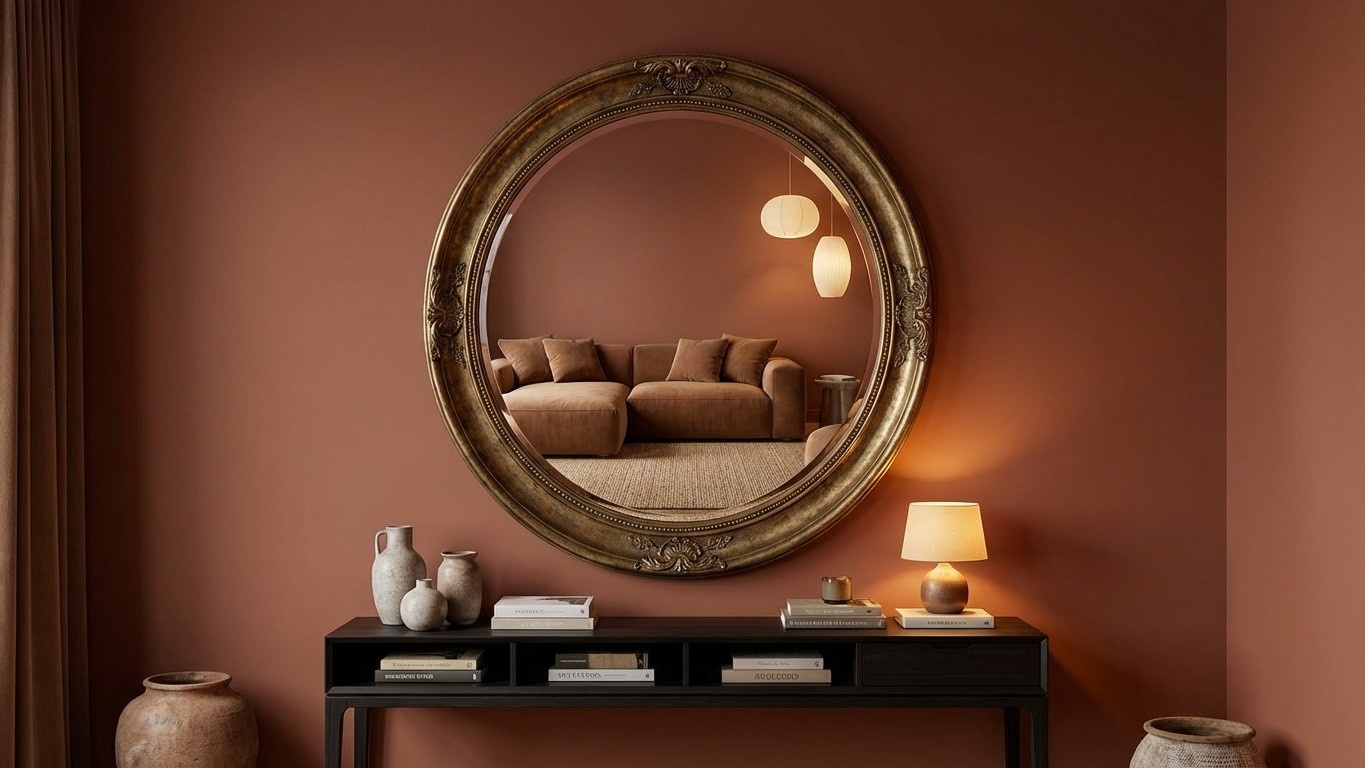
Large statement mirrors in living rooms or entryways can be particularly tricky. These substantial pieces often tempt homeowners to hang them higher to “fill the wall,” but this usually backfires. Instead, professional designers position these mirrors to create relationship with nearby seating or console tables, maintaining the human-scale connection that makes spaces feel welcoming and intentional.
The Transformation Effect
Repositioning mirrors according to professional standards creates immediate, dramatic improvements in how spaces feel and function. Rooms suddenly appear more proportioned and thoughtfully designed. Light distribution becomes more even and flattering. The mirrors themselves seem to “belong” in the space rather than floating awkwardly above it.
The change is particularly noticeable in smaller spaces, where properly positioned mirrors can create the illusion of expanded square footage more effectively than mirrors hung too high. When mirrors reflect more of the actual living space rather than empty wall and ceiling areas, they fulfill their space-enhancing potential.
After implementing this simple rule throughout my home, the difference was striking. Rooms that had felt slightly “off” suddenly clicked into place. The mirrors became functional design elements rather than decorative afterthoughts, proving that sometimes the smallest adjustments create the most significant improvements. Professional decorators understand that good design is often about these subtle but crucial details that separate amateur arrangements from spaces that feel truly polished and intentional.