
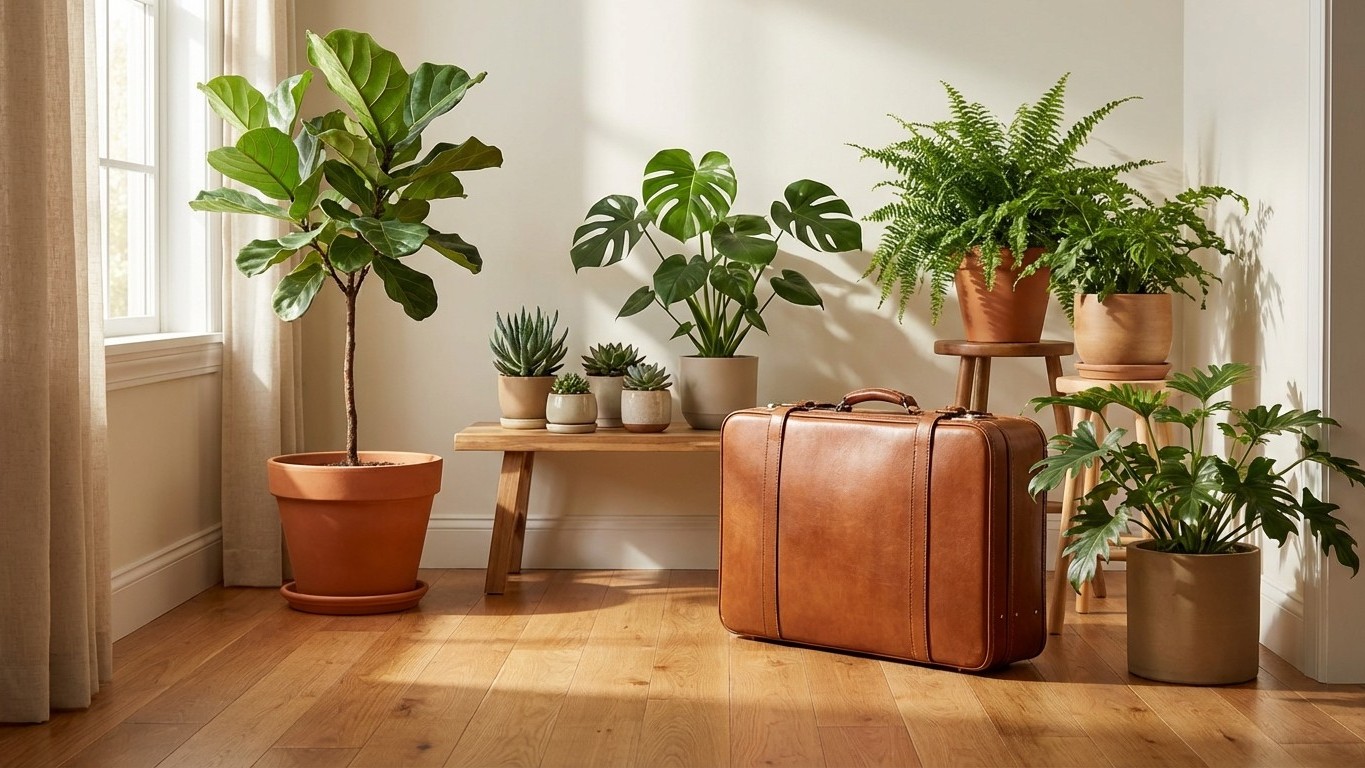
A suitcase in the hallway, a ride to the airport, and then that tiny sting of doubt: “Did I water the plants?” It sounds trivial until you come home to limp leaves and crispy soil. Keeping indoor plants alive while you’re away isn’t about one miracle gadget. It’s about matching the solution to your absence length and to the type of plant you own. That’s the whole logic behind how to keep houseplants alive while on vacation.
Think of it like meal-prepping for a busy week. A salad won’t survive three days on the counter, but a jar of pickles will. Plants work the same way: succulents store “reserves,” tropicals burn through water fast, and small pots dry out like espresso grounds.
Why prepare your plants before leaving on vacation?
Leaving without preparation is gambling with biology. Water loss continues even when you’re gone: evaporation from soil, transpiration through leaves, and the hidden wildcard, heat from a sunny window or an HVAC vent.
The trap is overcompensation. Many people “drown” their plants right before leaving, thinking more water equals more safety. Result? Roots sit in soggy soil, oxygen drops, and rot can start while you’re sipping something cold elsewhere. University-style guidance tends to repeat the same point: healthy plants, well-draining soil, and moderated light beat panic-watering every time.
Preparation also reduces pests. A plant already stressed by spider mites or fungus gnats tends to crash faster when conditions change. Your pre-trip job is simple: stabilize, don’t Transform.
Assess your absence length: how it changes what plants need
Duration is the real decision tree. Three days asks for smart timing. Ten days asks for a controlled water source. Two weeks and beyond asks for delegation or a system you’ve tested before.
Also, don’t treat your collection like one organism. A ZZ plant and a calathea live on different planets. For an indoor baseline across plant types, keep a reference guide handy, like the cluster pillar page on indoor plants care varieties houseplants.
Short absence (3 to 4 days): simple moves that prevent drama
Three or four days is often survivable with almost no gear, especially in February or in a mild indoor climate. Many houseplants can coast if you reduce demand and start with evenly moist soil.
- Water 12 to 24 hours before you leave, not five minutes before. That gives excess water time to drain so roots aren’t left soaking.
- Skip fertilizer the week you leave. Fertilizer can push new growth, and new growth needs water.
- Move plants out of direct sun into bright, indirect light. Less light means lower water use, and plants can tolerate this for a couple of weeks if needed.
- Do a fast pest check: look under leaves, along stems, and at the soil surface.
Plant-type nuance matters. Succulents and cacti usually prefer being left alone. Tropical plants with thin leaves (peace lily, calathea types) are the ones that sulk fastest.
One practical rule: if a plant is in a tiny pot and normally dries in two days, treat it like a “medium absence” plant even if your trip is short. Pot size changes the whole equation.
Medium absence (5 to 10 days): watering systems that match indoor reality
A week away is where DIY gets serious. You need a water source that releases slowly, and you need to avoid the two classic failures: too much flow (rot) or no flow (bone dry).
Start with the least fussy options, the ones that tolerate imperfect setup.
- Capillary wick system: cotton cord from a water reservoir into the potting mix. It’s cheap, scalable, and easy to test in advance.
- Capillary mat: a mat stays damp from a tray of water, and pots with drainage holes pull moisture up from below. Great when you can group plants together.
- Watering spikes (terracotta or ceramic): a bottle feeds water through porous clay into soil. These can work well for moderate moisture lovers, but you still need to test the flow rate.
Testing is not optional. Two days before your trip, run the system on one “medium-thirst” plant. Check the soil after 24 hours. If it’s soggy, reduce the wick thickness, lower the reservoir, or shorten the wick depth. If it’s dry, add a second wick or increase contact.
A quick reality check on the popular “inverted bottle” trick (a bottle with tiny holes): it can work, but it often fails because soil compacts around the holes, or because air can’t enter the bottle, slowing the flow unpredictably. If you use it, treat it as a backup, not your only lifeline.
Best method for watering houseplants during absence? For most homes, a wick setup wins because it’s adjustable, and it doesn’t rely on pressurized flow or electronics.
Long absence (more than 10 days): advanced solutions and delegation
More than ten days changes the mindset. You’re no longer “Holding moisture.” You’re creating a stable micro-environment and, ideally, adding a human checkpoint.
Can houseplants survive two weeks without watering? Some can. Snake plants, many succulents, and thick-leaved plants often handle two weeks if watered properly beforehand and moved into lower light. Many tropical plants will not be happy, especially in small pots or warm rooms.
For long absences, stack strategies.
- Delegate: a friend, neighbor, or house-sitter who checks once, halfway through. Give written instructions per plant group, not per plant, to keep it realistic.
- Self-watering planters or reservoir pots: useful, but only if you already use them. Switching containers right before travel is risky.
- Bathtub or tray method for groups: place plants on towels or pebbles with a shallow water layer beneath, so pots absorb moisture without sitting directly in water. This is often suggested by extension-style gardening resources for stretching watering intervals.
- Humidity tent for select tropicals: clear bag or plastic cover that reduces transpiration. This is powerful, but it must be used carefully to avoid fungal issues, and it’s not suitable for succulents.
One opinion, from too many plant rescues: if you’re leaving for 14 to 21 days and you own calatheas, ferns, or thin-leaved tropicals, ask a human for help. A simple check-in beats a complicated contraption that fails on day three.
Adjust the environment before you leave (light, temperature, humidity)
Water is only half the story. Most vacation plant losses come from a mismatch: too much light and heat for the available soil moisture, or too little humidity for a tropical leaf surface.
If your trip happens in winter conditions or your home gets less natural light seasonally, you’ll also want the broader context from how to care for houseplants in winter (less light). Lower light often reduces thirst, but it changes growth patterns and soil drying speed.
Group and move plants to build a favorable microclimate
Grouping plants works the way a crowd warms a room. Leaves transpire, the local humidity rises, and the cluster dries out more slowly than isolated pots scattered around the house.
Place thirstier plants together: tropical foliage, small pots, and plants with lots of leaf area. Keep drought-tolerant plants separate so you don’t accidentally water them “like the others.” Succulents don’t want a humid party.
A practical layout: one bright, indirect corner near a window, plants grouped on a waterproof tray. One zone. One logic.
Manage light: reduce drying, keep photosynthesis running
Direct sun is a dehydration accelerator. Move plants a little farther from the glass, or use a sheer curtain. Many extension-style recommendations explicitly suggest shifting plants away from warm windows and into indirect light for vacation periods, because plants can tolerate lower light for a couple of weeks and will use less water.
Don’t send everything into darkness, though. A plant sitting in a dark room may stop using water, but it can also weaken, drop leaves, or become more vulnerable to pests when you return.
Target: bright shade. Think “reading light,” not “sunbeam.”
Increase ambient humidity with low-effort tools
Humidity is the silent helper for tropical houseplants. You don’t need a lab-grade humidifier to make a difference over a week.
- Pebble tray: a tray with pebbles and water under the pot, the pot sits on the pebbles, not in the water. It modestly boosts local humidity.
- Multiple open water containers: bowls of water near grouped plants can raise humidity slightly.
- Bathroom placement: if it has a window, it’s often more humid and stable than a living room corner.
Skip the idea of “vaporizing everything right before leaving.” Spraying leaves gives a short-lived effect and can encourage spotting on some foliage. Humidity works when it’s steady.
Prepare the potting mix and drainage to lower risk
Watering systems fail fastest in the wrong soil. If your mix is compacted or your pot has poor drainage, a slow-release setup can quietly create root rot.
Two checks matter more than any gadget:
- Drainage holes: if a pot has no hole, treat it as a decorative cachepot and keep the real plant in a nursery pot inside it.
- Soil structure: if water pools on top and drains slowly, your mix may be too dense. Don’t repot the day before leaving, but do consider improving the mix weeks ahead of a long trip.
What about water-retaining gels or hydrogel crystals? They exist, and they can hold water and release it gradually. The catch is dosage and expectations. They won’t replace a watering schedule for high-demand plants, and they can make a soil mix stay wet longer, which is good or bad depending on the plant. Use them conservatively, and only if you’ve already seen how your plant reacts in your home conditions.
A safer alternative for many people: increase pot size only if the plant is ready, months before travel. Bigger soil volume equals a bigger moisture buffer.
Pre-departure checklist and common mistakes to avoid
Lists sound boring until you’re locking the door. This one is built for speed, not perfection.
- Water appropriately 12 to 24 hours before leaving, then empty saucers that keep roots sitting in water (unless you’re intentionally using a controlled reservoir method).
- Move to bright, indirect light, away from heating/cooling vents.
- Group plants by thirst level and pot size.
- Set up your chosen system (wick, mat, spikes, reservoir tray), then test at least once.
- Remove dead leaves and obvious debris from the soil surface.
- Check for pests quickly, especially under leaves.
- If a plant sitter is involved: label groups, pre-fill a watering can to the right amount, and leave a note that says “less is better” for most plants.
Frequent mistakes show up again and again:
- Overwatering in panic and leaving pots waterlogged.
- Closing all curtains and creating low-light stress for weeks.
- Trying a new product for the first time the day you leave.
- Asking a neighbor to “water when it looks dry” without explaining what “dry” means for that plant.
If you want to connect vacation care to the bigger rhythm of plant life, including pruning and propagation after stress periods, bookmark winter care for indoor plants as a broader “exception routines” hub.
What to do when you return: triage, recovery, and getting back on track
Walking back into your home after travel, you’ll see plants like a headline: droop, yellowing, crispy edges. Don’t rush to fix everything in ten minutes.
Start with a simple inspection:
- Check soil moisture with a finger 1 to 2 inches deep. Topsoil can be dry while the root zone is still wet.
- Look at stems: if they’re firm and green, the plant is usually recoverable even after leaf loss.
- Scan for pests that may have taken advantage of stress.
If soil is bone dry and the pot feels light, a slow rehydration can help. Bottom-watering, placing the pot in a basin so it can absorb water through drainage holes, often re-wets hydrophobic dry mix better than pouring from the top. Then let it drain completely.
Resist the urge to fertilize immediately. New nutrients won’t “heal” drought stress, and they can push growth before roots are ready.
Leaves that are fully dead won’t come back. That’s where pruning becomes a recovery tool, not a cosmetic one. Trim crispy leaves and dead stems to reduce the burden on the plant and to reduce rot risk. For a clean approach on where to cut and what to do with stems, use how to prune indoor plants.
Propagation can also turn a partial failure into a restart, especially for pothos, philodendrons, tradescantia, and other easy stem-rooters. When a plant comes back leggy after low light or loses a few stems, taking cuttings is sometimes the most practical “repair.”
Vacation plant care FAQ (based on common “People Also Ask” questions)
How do you care for indoor plants when on vacation?
Match care to the absence length, reduce water demand by moving plants into bright indirect light, group humidity-loving plants, and use a tested slow-watering method (wicking, capillary mat, spikes) for trips longer than about five days.
What is the best method for watering houseplants during absence?
For many homes, a capillary wick setup is the most reliable blend of cost, control, and scalability, especially if you test it before leaving. For large collections or long trips, a plant sitter check-in often beats any DIY system.
Can houseplants survive two weeks without watering?
Some can, especially drought-tolerant species and larger pots in lower light. Many tropical plants in small pots will struggle. Two weeks is a borderline duration where environment adjustments and at least one mid-trip watering can make the difference between “fine” and “rehab project.”
If you want one action that pays off every time, it’s this: do a mini “vacation drill” on a normal weekend. Set up your wick or reservoir, move plants to indirect light, and see what happens over 48 hours. Your future self, jet-lagged and craving a calm home, will notice the difference. Next trip, are you going to trust hope, or a system you’ve actually watched work?