
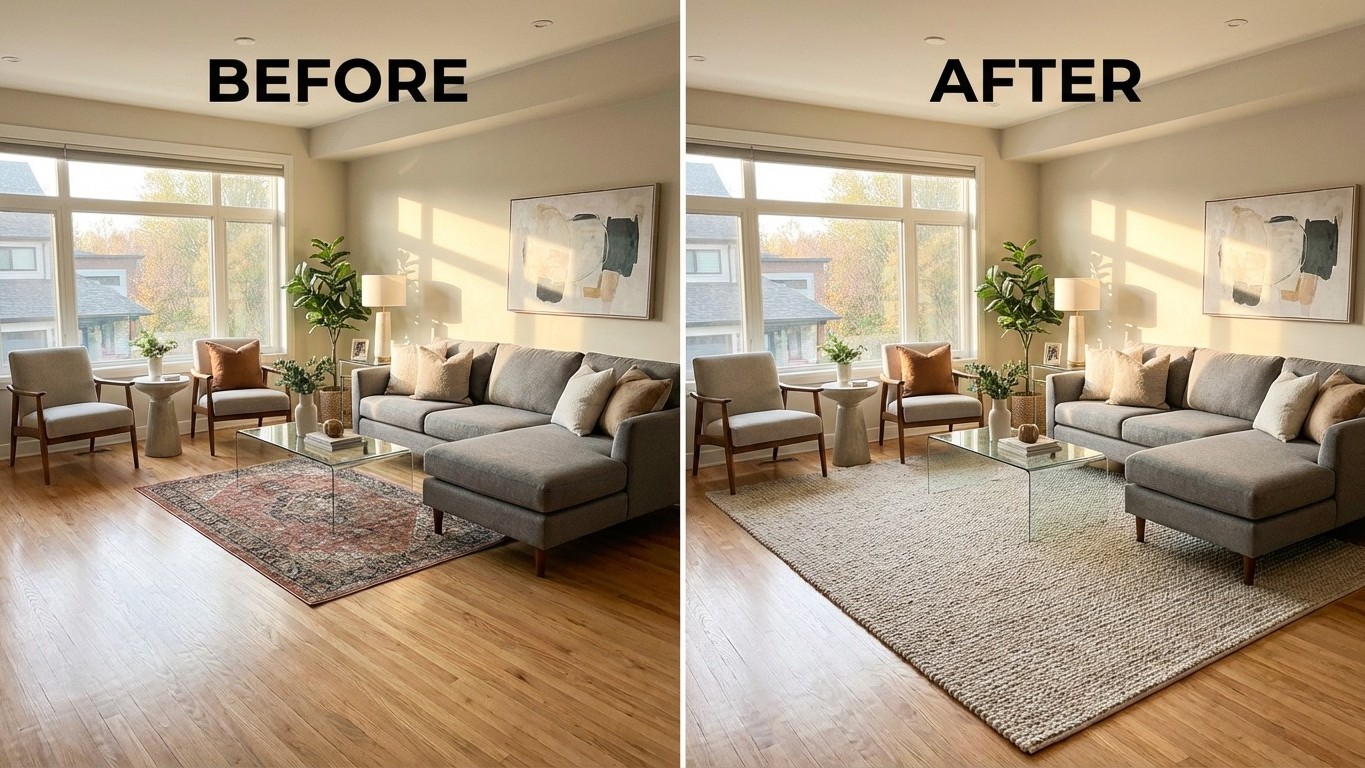
Standing in my living room five years ago, staring at yet another rug that looked comically small beneath my coffee table, I finally understood why my spaces never felt quite right. Despite measuring carefully and consulting online guides, every rug purchase left me with that nagging feeling that something was off. It wasn’t until a seasoned interior decorator visited my home that I learned the truth: I’d been approaching rug sizing completely backwards.
The revelation came when she pulled out her measuring tape and said something that changed my entire perspective on room design. “Most people measure their furniture and buy rugs to fit underneath,” she explained, “but the magic happens when you think about the room’s proportions first.” What she showed me next was so simple, yet so transformative, that I’ve never made a rug sizing mistake since.
The Two-Thirds Rule That Changes Everything
The secret lies in what designers call the two-thirds rule. Instead of measuring individual pieces of furniture, you measure the entire seating area of your room and choose a rug that covers approximately two-thirds of that space. This creates what decorators call “visual anchoring” – the rug becomes the foundation that pulls all elements together rather than an afterthought squeezed between chair legs.
When my decorator demonstrated this principle, she had me look at my seating arrangement as a single unit rather than separate pieces. In my living room, this meant considering the span from the back of my sofa to the front edge of my coffee table, plus the walking space around the chairs. The total area measured roughly 12 by 15 feet, which meant I needed a rug around 8 by 10 feet – significantly larger than the 6 by 9 foot rug I’d been stubbornly trying to make work.
The difference was immediately apparent. Where before my furniture seemed to float awkwardly in the space, the properly sized rug created clear boundaries and made the entire seating area feel intentional and cohesive. The room suddenly had weight and presence that had been missing for years.
Beyond the Living Room: Adapting the Ratio
This principle extends far beyond living spaces, though the application varies by room function. In dining rooms, the two-thirds rule translates to ensuring your rug extends at least 24 inches beyond the table on all sides when chairs are pulled out. This prevents the awkward situation where chair legs catch on the rug’s edge during meals. For bedrooms, the rug should extend well beyond the bed frame, creating a soft landing for bare feet and visually expanding the sleeping area.
The decorator explained that many people get trapped in the mindset of buying the largest rug their budget allows, regardless of their room’s actual proportions. This often results in rugs that are too small for the space they’re meant to define. Conversely, some homeowners go too large, overwhelming the room and making it feel cramped despite having adequate square footage.
Kitchen and hallway applications require different considerations entirely. In these transitional spaces, the rug serves more as a pathway definer than an anchoring element. Here, the two-thirds rule applies to the width of the walkway rather than the total floor space, ensuring comfortable passage while adding warmth and texture underfoot.
The Psychology of Proper Proportions
Understanding why this ratio works reveals fascinating insights about how we perceive space. Our brains naturally seek visual balance and clear boundaries within rooms. When a rug is too small, it creates what designers call “floating furniture syndrome” – pieces appear disconnected and the eye struggles to understand the room’s organization. Too large, and the rug dominates the space, making walls feel closer and reducing the sense of openness.
The two-thirds coverage creates what psychologists call the “Goldilocks effect” in interior design. It provides enough coverage to unify the space without overwhelming it, leaving just enough bare floor visible around the edges to maintain the room’s proportional integrity. This remaining floor space acts as a visual frame, much like matting around artwork, giving the entire arrangement breathing room.
My decorator also pointed out that this principle helps with practical considerations I’d never considered. Properly sized rugs are easier to vacuum around, create cleaner sight lines for foot traffic, and actually make rooms appear larger by clearly defining functional zones rather than cluttering them with undersized accent pieces.
Implementing the Rule in Real Spaces
Putting this knowledge into practice requires shifting your measuring approach entirely. Start by identifying your room’s primary function zone – the conversation area in a living room, the dining space in an open-plan kitchen, or the sleeping area in a bedroom. Measure this zone’s perimeter, including reasonable walking space around furniture. Your ideal rug should cover roughly two-thirds of this measured area.
This might mean buying a larger rug than you initially planned, but the investment pays dividends in visual impact. A properly proportioned rug transforms not just the look of a room but how it feels to spend time there. Conversations flow more naturally when seating feels connected by a shared foundation. Dining becomes more comfortable when chairs glide smoothly across consistent surfaces. Even simple activities like reading or watching television feel more intentional in properly anchored spaces.
The beauty of this approach lies in its simplicity and universal application. Whether you’re furnishing your first apartment or redesigning a longtime home, the two-thirds rule provides a reliable foundation for creating spaces that feel both Professional and personal. It’s the difference between rooms that look accidentally assembled and those that feel purposefully designed – all achieved through one simple ratio that most of us never learned but wish we had discovered years sooner.