
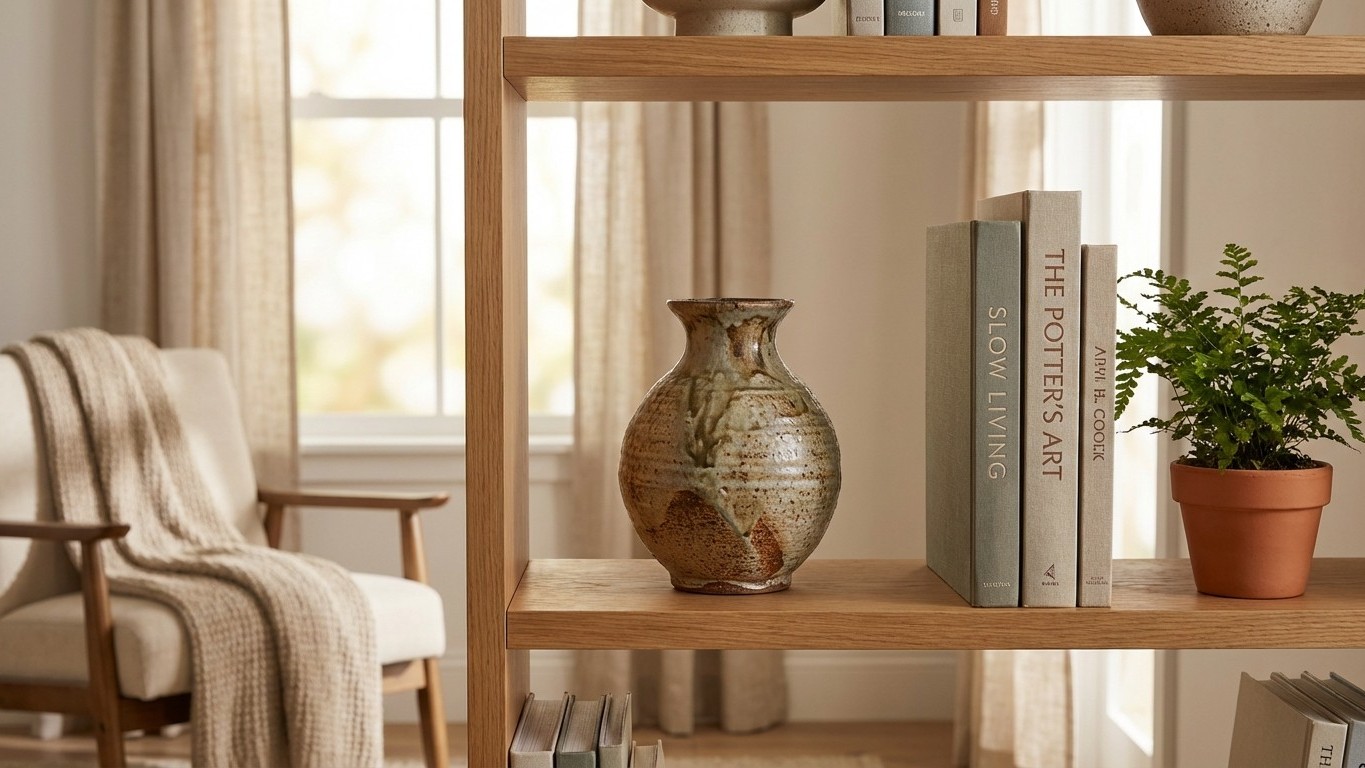
The chaos went unnoticed at first. Books squeezed next to mismatched vases, family photos nudging against half-burnt candles, an orphaned mug at the very edge. Maybe you know the drill: when a new object enters your home, you simply find the nearest flat surface and, voilà, another layer gets added to the growing display. It all felt personal, eclectic even, until one day the room’s energy felt off. Crowded. Uneasy. That’s when I heard about the “one in, one out” rule, half-accidentally, while doomscrolling interior design accounts late one night.
This was no minimalist prophecy. No daring KonMari sweep of the shelves, but something far simpler, and much more effective for most homes who live firmly in the real, messy world. Here’s the gist: each time you add something to your shelves, take something away. A rotation, not a purge. Small, regular edits instead of drastic upheaval. The impact goes far beyond aesthetics; it’s spatial therapy for both room and mind.
Key takeaways
- From messy shelves to meaningful displays—one unexpected change made all the difference.
- Discover the surprising mental benefits of decluttering your living space piece by piece.
- The secret isn’t minimalism, but thoughtful rotation that keeps your décor fresh and personal.
The Psychology of Too-Muchness
Look at a busy urban skyline. Every inch of airspace has a purpose, but the atmosphere is hectic, no surprise that too-cluttered interiors have a similar mental impact. Research in environmental psychology backs it up: visual clutter is quietly stressful, even if you think you’re immune. At UCLA’s Center on Everyday Lives of Families, scientists found that women in homes crammed with stuff had consistently higher stress hormone levels compared to those in tidier spaces. That feeling when you’re restless but can’t put your finger on why? Sometimes, it’s the clutter talking.
But shelf styling isn’t purely about stripping back. The balance sits somewhere between sterile minimalism and maximalist chaos, a place where your possessions feel intentional, your stories are visible, and your brain breathes easy whenever you glance over.
“One In, One Out”: The Art of Shelf Rotation
I’ll admit, I scoffed first. One item removed for every new object seemed too simple to matter. After all, a single figurine doesn’t make much difference, right? And yet, from the first swap, the transformation was immediate. A favorite travel souvenir took the prime spot, while a dusty candle retired to the donation box. My bookshelf’s top went from catch-all to conversation starter. Suddenly, every item had earned its place, no more freeloaders on the shelf.
This rule accomplishes three things at once. First, it enforces a gentle, ongoing decluttering, avoiding the moment when you finally realize, after years, that you never actually liked that chipped bowl. Second, it makes your décor dynamic. Holidays, new hobbies, the latest flea market find—all can have their season Without your home freezing in time. Most surprising of all, it changes the way guests see the room. A neighbor noticed, unprompted, that the whole space felt “lighter” even though Nothing fundamental had changed. A compliment felt all the sweeter because I hadn’t done anything dramatic.
Personal Collections: Curate, Don’t Crowd
Everyone collects something. For some, it’s vintage cameras; for others, souvenir plates from road trips, or endless plant Cuttings. The urge to display these tokens is natural but, unchecked, they pile into visual noise. The rotation method shifts collecting from accretion to curation. Instead of every item demanding attention, the best pieces shine, at least for a while, before being swapped for something else you love just as much.
A friend became a convert after a single test. She curated her crowded art book shelf by cycling in fresh covers every three weeks. Barely five books were displayed, but suddenly, visitors reached for them, paging through, asking questions. The objects on display became active participants in conversation, not inert background texture. Almost like having a rotating mini-exhibit at home, one that evolves with your mood and interests. Who wouldn’t want their living room to feel that alive?
Maintaining the Magic: Practical Shelf Wisdom
Of course, rules don’t enforce themselves. It’s easy to slip back into the old habit, especially after a successful thrift spree or a housewarming gift lands in your lap. Discipline is less about depriving yourself and more about routine. Every season, I make a ritual of shelf-editing: old postcards out, new arrangements in, a photograph replaced with another shot from the archives. The act takes fifteen minutes; the aftereffects last for weeks.
This gentle periodic refresh also fosters creativity. Forced to pick what stays, you become a better curator of your own things. Sometimes that means mixing up heights, embracing negative space, or reimagining a shelf as a series of visual “moments”, a sculptural lamp opposite a stack of favorite novels, a trailing pothos filling the empty space between artifacts. Design blogs are full of advice about “groups of three” or “vary your textures” but none of those tips matter if you’re not seeing your items, only your accumulation.
It feels almost mathematical: every shelf can only hold so much joy. Corners, like bank accounts, need room to breathe. Neglect the balance and the beauty vanishes into background noise.
The “one in, one out” rule doesn’t exile personality from your shelves, it sharpens it. Like editing a great story, what you decide to leave in says more than what you cut. The shelves become snapshots of who you are today, not just who you used to be or the sum of every impulse buy.
So, the next time you hold a new ceramic vase or a thrifted book, pause for a second. What story does your shelf want to tell this month? And what might happen if fewer things meant you Actually see, and love, each one?