
Introduction
A potted plant can look perfectly healthy on the surface, glossy leaves, fresh growth, no pests in sight, and still be slowly drowning below. It happens in silence: water fills the tiny air pockets in the potting mix, roots lose oxygen, and what should have been “care” turns into stress.
If you searched for how to improve drainage for potted plants, you’re probably trying to solve one of two problems: soggy soil that never dries, or a plant that keeps declining even though you “don’t water that much.” The good news is that drainage is not a mysterious talent. It’s a set of physical rules you can control with the pot, the mix, and the way you water.
Why is drainage critical for potted plants?
In a pot, water has one job: move through the substrate, then leave. When it can’t, the root zone becomes a low-oxygen environment. Roots don’t just drink water, they also breathe, and in containers the margin for error is thin.
Effects of poor drainage (root rot, suffocated roots, slow decline)
Root rot is the headline, but it’s rarely the first symptom you notice. Leaves yellow, growth stalls, stems soften, fungus gnats appear, and the soil smells “swampy.” The pattern is consistent: water sits too long, microbes that thrive in wet conditions take over, and roots turn dark and mushy. Once the plant loses a functioning root system, even perfect light and fertilizer won’t help.
One everyday comparison makes it click: imagine wearing wet socks for days. You might not “see” the damage immediately, but comfort and function drop fast. Roots react the same way when the pore spaces stay waterlogged.
What are the main factors that influence drainage?
Drainage isn’t one product you buy. It’s the interaction between container design, substrate structure, and watering behavior. Change one, and the whole system shifts.
Pot type (material, shape, size, drainage holes)
Drainage holes matter more than any layer of pebbles. Without an exit point, water can only leave by evaporation and plant uptake, both slow indoors.
Material changes the rhythm:
- Terracotta is porous, so the pot wall helps moisture escape. That can be a lifesaver for heavy-handed watering, but it can also dry fast in bright, warm rooms.
- Plastic and glazed ceramic hold moisture longer because they don’t “breathe.” Great for plants that like steadier moisture, risky for those that hate wet feet.
Shape and size count too. Tall pots often drain and dry differently than shallow bowls, because the water column and airflow change. Oversized pots are a classic trap: too much mix stays wet for too long, especially if the plant’s root ball is still small.
Substrate nature: potting soil, sand, perlite, vermiculite, clay pebbles
A draining mix is not simply “light.” It has structure: particles large enough to create macropores (air channels), plus enough fine material to hold moisture and nutrients without turning into sludge.
- Standard potting soil can be fine for many houseplants, but it compacts over time, especially if it’s peat-heavy and repeatedly saturated.
- Perlite increases aeration and drainage because it creates open space in the mix and holds relatively little water compared to more absorbent amendments. Multiple gardening references agree it’s the go-to for improving drainage in containers.
- Vermiculite holds significantly more water, more like a sponge, so it’s better when you need moisture retention rather than faster drainage.
- “Sand” is tricky: very fine sand can worsen compaction; coarse horticultural sand behaves differently. For indoor pots, perlite, pumice, orchid bark, or similar chunky components are usually more predictable than random sand.
- Clay pebbles (billes d’argile) are useful, but often misused. More on that below.
Clay pebbles (billes d’argile): useful, and when to use them
Clay pebbles became a default “drainage fix” in many households, partly because they look tidy and feel intuitive. Put rocks at the bottom, water runs away, right? The science is less comforting.
Putting clay pebbles at the bottom of the pot
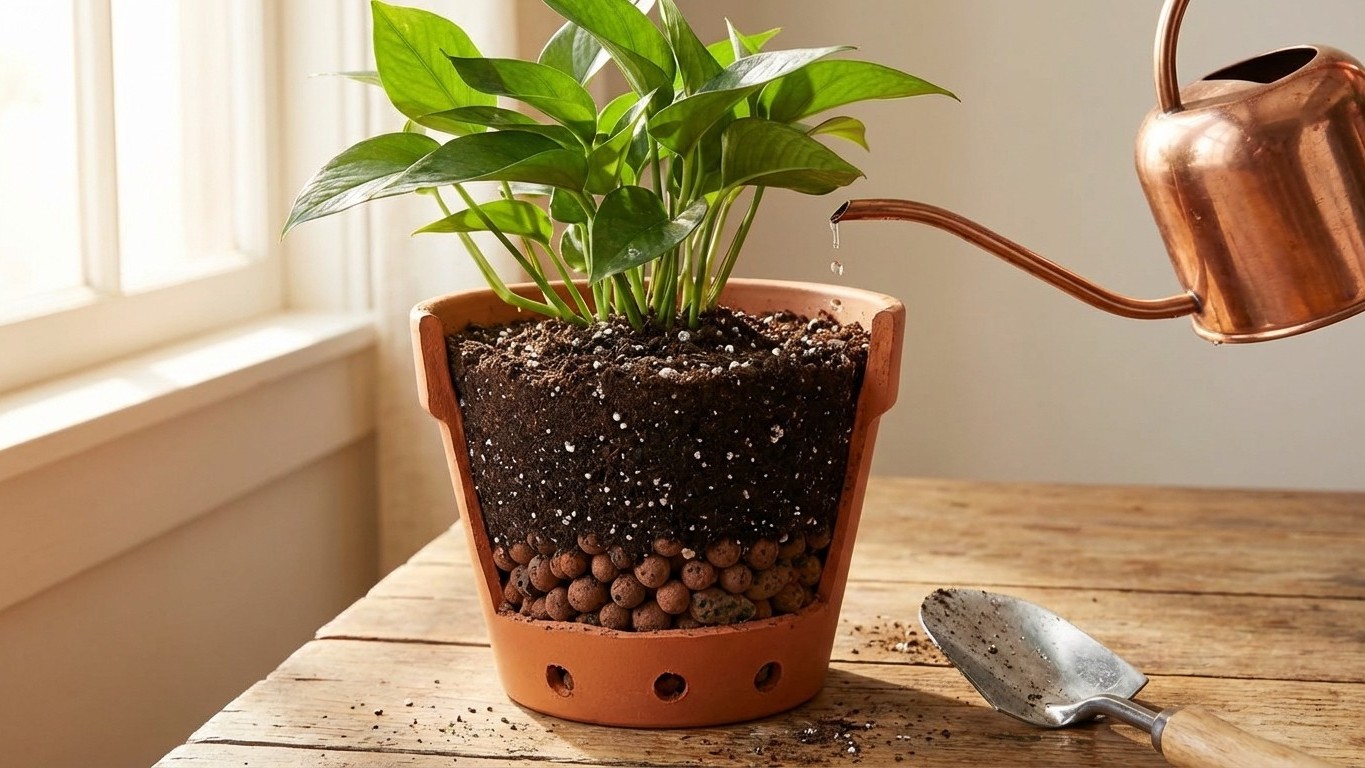
A bottom layer of coarse material, gravel, rocks, or clay pebbles, does not automatically improve drainage inside the root zone. University Extension educators have explained why: water does not move easily from a fine-textured layer (potting mix) into a coarser layer (rocks) until the fine layer is saturated. That creates a wetter zone above the rock layer, the opposite of what people want.
Result? You lose usable root space and keep a perched, soggy layer closer to the roots. If your goal is to prevent waterlogging, a better-draining mix throughout the pot is typically more effective than a “false bottom.”
Alternative or complement: smarter ways to use clay pebbles
Clay pebbles still have a place when used with intention:
- As a thin top dressing to reduce fungus gnat breeding and splashing soil, though it can also slow surface drying in some setups.
- In cachepot systems: keep the plant in a nursery pot with holes, set it inside a decorative pot, and use clay pebbles to lift the inner pot so it never sits in runoff water.
- For semi-hydro setups, where clay pebbles are the main medium and watering is managed differently (this is a separate method, not a quick add-on).
If you love the look of billes d’argile, keep them, but let them serve airflow and separation from standing water, not as a magic drainage layer.
Create and adjust a draining mix for your plants
Think in percentages, not recipes carved in stone. Your room humidity, light level, and watering habits matter as much as the plant species. Still, a few practical “starting mixes” cover most indoor scenarios.
Simple mixes by plant family (succulents, tropicals, moisture lovers)
For succulents and cacti (fast drying, high air):
- Start with a cactus/succulent mix, then increase aeration if it stays wet.
- Add a chunky amendment like perlite or pumice. Many growers aim for a visibly gritty texture rather than a smooth, peat-like feel.
For common tropical foliage (pothos, philodendron, monstera types):
- Use a quality indoor potting mix as the base.
- Add structure: perlite for aeration and drainage; orchid bark for chunk and airflow around roots.
For moisture-loving plants (some ferns, peace lily-type preferences):
- Drainage still matters, but you don’t want the pot to dry in a day.
- Use less perlite than you would for succulents, and be cautious with very fast-draining mixes that force you into constant watering.
Where vermiculite fits: it tends to increase water holding more than it increases drainage. Multiple horticulture resources describe vermiculite as more water-retentive than perlite, so it’s not the first choice if your core problem is “soil stays wet too long.”
How to test drainage in your mix (fast, visual, repeatable)
You don’t need lab equipment. Try this:
- The pour-through check: pot up a small amount of mix in a container with holes, water slowly, and watch. If water pools on top for a long time before soaking in, the mix may be too fine or hydrophobic.
- The squeeze test: wet a handful of mix, then squeeze. A good indoor mix should hold shape briefly but crumble when tapped, not ooze water like a sponge.
- The 24-hour reality test: after watering thoroughly, the surface can look dry while the core stays wet. Check deeper moisture before deciding the mix “drains fine.”
Configure drainage holes: should you drill your pot?
If you want to improve drainage quickly, nothing beats a pot with an actual exit for water. Everything else is a workaround.
Number and size of holes by pot type
Rules of thumb that work in real homes:
- Small pots benefit from at least one adequate central hole plus a couple of smaller ones if the design allows.
- Wide pots do better with multiple holes, because water spreads out and can sit in “dead zones” otherwise.
- Very large containers should not rely on one tiny hole. Water will find the lowest point and ignore the rest.
Don’t block holes with shards or thick mesh. A simple piece of screen or a light filter can prevent soil loss without sealing the drainage path.
Solutions if your pot has no drainage hole
This is the question people ask when they’ve already bought the beautiful ceramic pot. Three options, from safest to riskiest:
- Use a nursery pot inside it. Water at the sink, let it drain fully, then return it to the decorative pot. This solves 80% of “no hole” problems with zero drilling.
- Drill a hole. Many ceramics and some plastics can be drilled with the right bit and patience, but the feasibility depends on the material and glaze. If you’re not sure, test on a similar cheap pot first.
- Direct potting with strict watering control. It can work, but it demands discipline: smaller watering volumes, strong light, and a mix that won’t compact. For beginners, it’s the path to accidental root rot.
If you must keep a no-hole pot, treat watering like dosing, not like rainfall. A few measured pours can be safer than a full soak.
Watering management to optimize drainage
Even with a perfect mix, you can still overwater. Not by frequency alone, but by watering again while the core remains wet.
Watering techniques (top watering, soaking, adapted frequency)
Top watering is the standard: water slowly until excess exits the drainage holes, then discard runoff. The “slowly” part matters because dry, peat-heavy mixes can repel water, sending it down the sides without truly wetting the root ball.
Bottom watering (soaking) can be useful for plants that resist wetting from above, but it’s easy to overdo. If you bottom-water, limit soak time and let the pot drain well afterward. No plant benefits from standing in water for hours indoors.
Frequency should follow conditions, not calendars. In March 2026, many US homes still run heating at least part of the day, and that can dry the top layer while the lower mix stays cold and wet. The surface lies. Your fingers and your pot weight tell the truth.
Avoid overwatering and detect excess water early
Use simple indicators that match real life:
- Lift the pot after watering, then lift it again a few days later. Weight changes are more reliable than leaf drama.
- Check moisture deeper than the surface. The common “finger test” exists for a reason: it bypasses the deceptive dry crust on top.
- Never let a pot sit in a saucer of runoff. Standing water turns “good drainage” into a closed loop.
Signs of poor drainage: spot them and act fast
Some warning signs are obvious, others look like nutrient issues at first glance.
- Soil stays wet for many days, especially in average indoor light.
- Leaves yellow and drop while the soil is still damp.
- Mold on the soil surface, algae film, or persistent fungus gnats.
- A sour smell when you get close to the pot.
- Wilting that doesn’t improve after watering, a classic sign roots are damaged and can’t uptake water properly.
Quick triage helps: stop watering, increase light if possible, improve airflow, and consider repotting into a better-draining mix if the plant continues to decline.
FAQ: common mistakes and fast fixes
How can I improve drainage in potted plants without drainage holes?
Best fix: place the plant in a plastic nursery pot with holes, then slip it into the decorative pot. Water it at a sink, let it drain completely, and only then return it. If you insist on planting directly, use a chunkier mix and water in small measured amounts, never until water pools at the bottom.
What is the best soil mix to ensure proper drainage for indoor plants?
No single mix wins for every plant, but the principle is stable: combine a quality indoor potting mix with an aeration component like perlite, plus optional chunky material like orchid bark for many tropicals. If your plant prefers drier conditions, increase the proportion of gritty components. If it prefers consistent moisture, use a lighter touch with drainage amendments and focus more on pot choice and watering control.
For deeper substrate guidance across pot types and indoor conditions, see: best soil for indoor plants.
Are clay pebbles (billes d’argile) really necessary to improve drainage?
Usually, no. A bottom layer of coarse material can even keep the root zone wetter, because of how water behaves between different particle sizes in layered materials, a concept often explained as a perched water table. Clay pebbles are more useful to keep an inner pot elevated in a cachepot, or as part of specific growing systems, than as a universal “drainage layer.”
I repotted and now the plant looks worse. Is it drainage?
Sometimes it’s transplant stress, sometimes it’s a mix that stayed too wet, and sometimes roots were already compromised. If the pot has holes and the new mix is airy, give the plant stable light and time. If the soil remains soggy for a week, drainage and watering strategy need a reset. Step-by-step repotting help here: how to repot a houseplant.
When should I repot to fix drainage problems?
Repot when the mix has compacted, when water runs straight through without wetting evenly, when the plant stays wet too long, or when roots circle densely and block flow. Timing matters too, especially indoors where growth slows in low light. A seasonal and symptom-based guide is here: when to repot indoor plants.
Resources to consult and related guides
Drainage is part of a bigger indoor ecosystem: light, pot size, plant type, and your home’s humidity all interact. If you’re building a consistent routine across multiple plants, this broader hub helps you connect the dots: indoor plants care varieties houseplants.
- Cross-topic reading idea: white crusts on pots often connect to watering habits, mineral buildup, and drainage patterns, especially when runoff is never allowed to flush through.
- If you’re troubleshooting “I keep overwatering,” focus on pot-with-holes systems and a substrate that drains evenly, not on adding layers at the bottom.
Conclusion
Pick one plant in your home and run a small experiment this week: lift the pot right after watering, then again every day until it’s time to water again. Pair that with one change, a pot with proper holes, or a chunkier mix, or a switch to nursery-pot-in-cachepot. Small shifts, clear feedback.
Once you see drainage as physics and habit, not luck, the question changes. You stop asking “Why is this plant so hard?” and start asking something more useful: what would happen to your watering routine if every pot in your home drained freely, every time?