
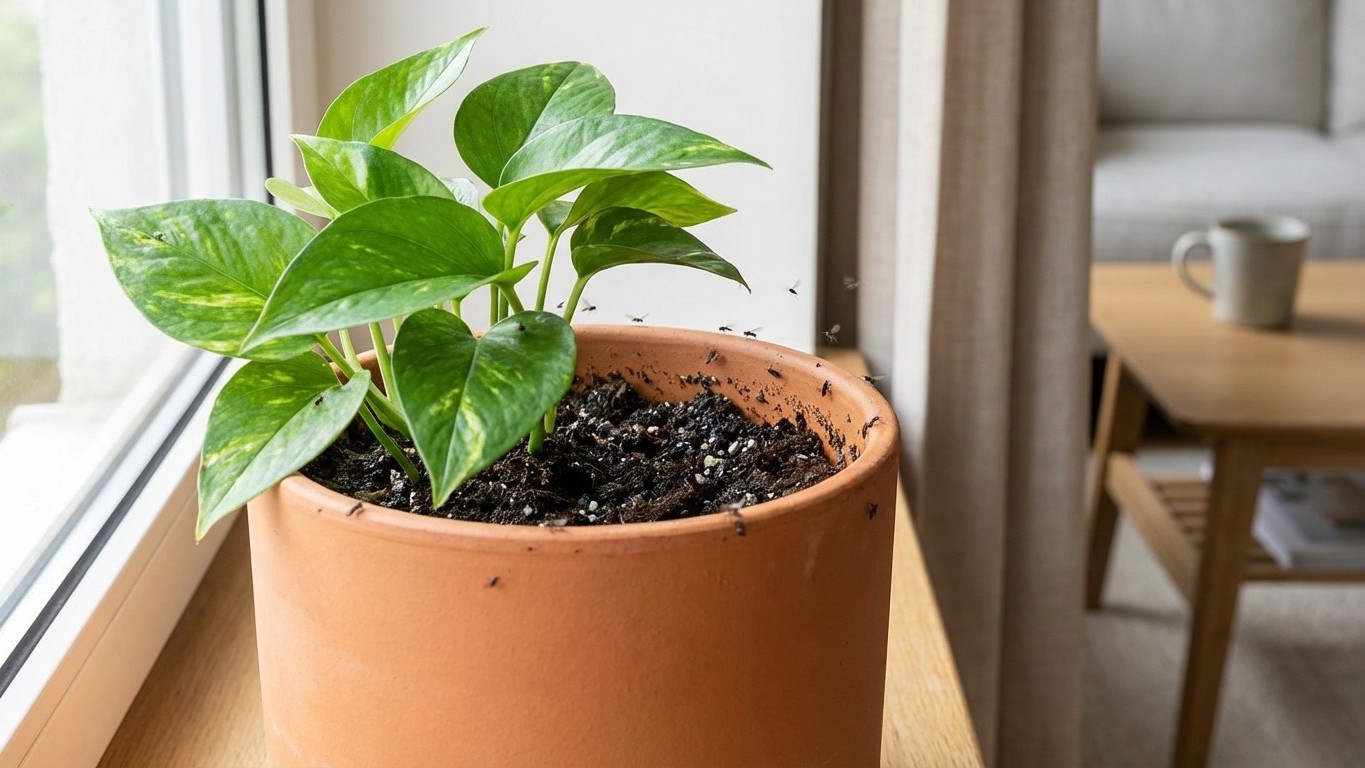
A few tiny black flies orbiting your favorite pothos, then suddenly they’re everywhere: on the rim of the pot, on the window, sometimes in your morning coffee. Fungus gnats feel like a cleanliness problem. Most of the time, they’re actually an irrigation problem that happens to have wings.
This guide focuses on how to get rid of fungus gnats in houseplants in a way that holds up in real life, not just for two days. The key is simple to say and easy to miss: trap the adults, kill the larvae, then change what made the pot a nursery in the first place. Miss one step, and the cycle restarts.
Understand fungus gnats (sciarid flies)
What is a fungus gnat?
They’re attracted to damp, organic potting mixes where fungi and decaying material are available. That detail matters because larvae mainly feed on fungi and decomposing organic matter, and only sometimes on living roots. Still, “sometimes” becomes “often” when populations explode or plants are already stressed.
Life cycle and what triggers an outbreak
Fungus gnats go through four stages: egg, larva, pupa, adult. Indoors, generations can overlap, so you can have all stages in one pot at the same time. Eggs are laid in crevices on the surface of moist potting soil. They hatch quickly, larvae develop over roughly one to two weeks, pupate near the surface, then adults emerge and repeat the cycle. In warm indoor conditions, the full cycle can be around 3 to 4 weeks.
What pushes a normal, occasional gnat into an “infestation”? Three patterns show up again and again.
- Constant moisture in the top layer of the substrate. The upper centimeters never dry, so eggs and larvae thrive.
- Rich, organic mixes that hold water and provide food, especially if they compact over time.
- New introductions: a new plant, a bag of potting mix stored damp, or reused soil from a previous problem pot.
One more trigger that surprises people: “helpful” habits. Misting the surface, keeping saucers full, watering on a fixed schedule instead of by soil dryness. Kind intentions, perfect nursery.
Risks for plants and humans
Adult fungus gnats don’t bite people, don’t sting, and don’t chew leaves. They are mostly a nuisance: they fly into your face, hover around lights, and make the room feel messy.
Plants are a different story. Larvae usually feed on fungi and organic matter, but in high numbers they can damage fine root hairs and even tunnel into tender roots or lower stems. Seedlings, cuttings, and already-stressed houseplants are the ones that pay the price first. Symptoms can resemble classic care issues: yellowing, wilting that doesn’t improve after watering, slow growth, and leaf drop. If you’ve been Googling houseplant problems, fungus gnats often sit in the background as the cause you didn’t suspect.
How to spot a fungus gnat infestation
Visible signs on plants and around pots
The clearest sign is adult activity: tiny dark flies lifting off from the soil when you water, or collecting near a window. They often appear in the evening when the room is calmer, then vanish when you move around. That “now you see them, now you don’t” pattern is typical.
On the plant itself, symptoms are indirect. You might notice:
- Leaves turning pale or yellow, especially on plants that are otherwise in decent light and getting fertilizer. If you’re sorting through causes, compare with why are my houseplant leaves turning yellow, because overwatering and root stress can look identical.
- A plant that droops even though the soil feels damp.
- New growth that stalls, or a cutting that refuses to root.
Want proof of larvae without digging up the plant? Place a slice of raw potato on the soil surface for a few days. Larvae often come up to feed, and you may see tiny, translucent “worms” with darker heads on the underside of the slice.
Tell sciarids apart from other small insects
Indoor plant pests love being confused with each other. Fungus gnats are commonly mixed up with fruit flies and drain flies.
- Fruit flies tend to hover near fruit bowls, trash, or recycling. They’re often more tan or brown and care about fermentation, not potting soil.
- Drain flies look fuzzier, almost moth-like, and gather around sinks, showers, or floor drains.
- Shore flies (more common in greenhouses) are sturdier flyers and can look “stockier.”
Here’s a practical filter: if the cloud rises from the pot when you water, assume fungus gnats until proven otherwise. If they’re mostly in the kitchen and never around pots, look elsewhere.
Effective methods to eliminate fungus gnats
One tactic rarely fixes the problem long-term. Adults are easy to catch, larvae are the engine, and the soil conditions are the fuel. A working plan hits all three, on purpose.
Physical traps and home techniques (sticky traps, “vinegar traps,” soap, sand)
Yellow sticky traps are the most consistent tool for adults. Place them close to the soil line, not just near the leaves. They don’t eliminate an infestation alone, but they cut breeding pressure and tell you whether your plan is working. If the trap count drops each week, you’re breaking the cycle.
Vinegar traps are popular online, but they’re hit-or-miss for fungus gnats because gnats aren’t as drawn to vinegar as fruit flies are. They can catch some adults in a mixed-insect situation, but don’t rely on them as your main monitoring tool.
Soapy water can help as a contact killer for adults on surfaces, but it doesn’t solve the soil stage. Think of it like wiping up crumbs while ignoring the open cereal box.
Top-dressing barriers can reduce egg-laying and adult emergence. A layer of coarse sand can help keep the surface drier, but it must stay dry to work. If you keep watering frequently, the sand becomes wet sand, and wet sand does not discourage gnats.
A better “physical” move is often the least glamorous: stop leaving water in saucers. Waterlogging at the bottom keeps the entire pot humid for longer than your finger test suggests.
Biological treatments: nematodes, BTI, essential oils
Biological control is where things get interesting, because it targets larvae directly while keeping indoor use reasonable.
BTI (Bacillus thuringiensis israelensis) is widely used as a biological larvicide. It works when larvae ingest it, which means it targets the feeding larval stage, not adults, and not eggs or pupae. Practically, that translates into repetition: you apply it on a schedule long enough to catch newly hatched larvae before they become new adults.
Beneficial nematodes, especially Steinernema feltiae, actively seek out larvae in moist media and infect them. They can work very well in a houseplant context if applied correctly, with attention to moisture and temperature, and if you follow the product label rates. People fail with nematodes for predictable reasons: the soil dries too much right after application, the product was stored poorly before use, or they treat only one pot while the whole shelf is infested.
Essential oils sit in the “maybe, with caution” category. Some scents can repel insects, but oils also risk phytotoxicity and do not reliably control larvae deep in the substrate. If you use them at all, treat them as a minor add-on, never the core of your plan.
Insecticides: when and how to use them
Indoor growers often jump straight to “spray something.” That usually hits adults you can see, while larvae continue breeding out of sight.
If you choose an insecticide route, keep two principles in mind:
- Match the product to the life stage. Adults and larvae are different problems. Adult sprays can reduce annoyance quickly, but larval control is what changes the trajectory.
- Use the lightest effective option. Indoor spaces have less ventilation, and houseplants are often in living rooms, bedrooms, or near pets.
In practice, insecticides make the most sense in two scenarios: (1) a heavy infestation where you need fast adult knockdown while you treat soil, or (2) a plant collection where you cannot dry pots down and need a stronger integrated approach. Always follow label instructions for indoor use, and treat all affected pots at the same time. Half-measures create the illusion of progress, then the gnats return.
How to kill larvae in the potting soil
This is the part that determines whether you’re dealing with gnats for a week or for two months.
Start with moisture management. Let the top layer dry more than you’re used to, within the tolerance of the plant. Many common houseplants handle a deeper dry-down than their owners expect. Overwatering symptoms, including indoor plant leaves curling causes, can overlap with root damage, so adjust thoughtfully and observe the response.
Then pick a larval control method that fits your routine:
- BTI soil drenches on a repeat schedule can steadily collapse populations, especially when paired with sticky traps.
- Nematodes can be highly effective when you can keep the soil evenly moist for a period after application (moist, not saturated).
- Repotting is the “reset button” when the substrate is old, compacted, or chronically wet. It’s also the fastest way to remove a high larval load, if you can handle the stress repotting causes to the plant.
A useful mental model: adults are the smoke, larvae are the fire, and wet organic soil is the oxygen. Remove oxygen, and the fire shrinks. Remove larvae, and the next “smoke” never appears.
Prevent fungus gnats from coming back
Adjust watering and indoor humidity
Most “permanent” solutions are boring. Watering is the big one.
Shift from schedule watering to observation-based watering. Check the pot by weight, not just surface feel. Use a chopstick as a dipstick, or a moisture meter if it helps you learn. Water thoroughly, then let the top portion dry before watering again. For plants that dislike drying (some ferns, for example), use larval biocontrol instead of trying to force a desert routine.
Humidity in the room matters less than moisture in the soil, but it can influence how quickly the top layer dries. If you run a humidifier in winter, it’s worth compensating by improving airflow and drainage, rather than watering less and stressing the plant.
Substrate choices and repotting strategy
Potting mix is not a neutral medium. It’s an environment.
Choose mixes that drain well and don’t stay wet for days. Over time, many organic mixes break down and compact, reducing oxygen around roots and staying wetter longer. That’s when gnats find a stable home.
When you repot, keep it clean: wash pots, remove decaying plant matter, and don’t reuse old infested mix. If you keep a potting soil bag open in a damp basement or garage, you’re basically offering housing. Store it sealed and dry.
Control what enters your collection (new plants, soil, tools)
Fungus gnats often arrive quietly. A new plant from a shop, a gifted cutting potted in someone else’s mix, even a bag of soil that sat in a warm greenhouse.
Quarantine isn’t just for rare collectors. Put new plants in a separate area for a couple of weeks. Add a sticky trap immediately. If gnats show up, treat early while the population is still small. Your future self will thank you.
Also: clean tools and trays. Organic debris in catch trays is a hidden feeding zone for larvae, even when the pot surface looks neat.
FAQ about fungus gnats in houseplants
How do you permanently get rid of fungus gnats in houseplants?
Expect to work across at least one full life cycle. If you stop when you see fewer adults, you often stop too early, because pupae and eggs are still waiting in the soil.
Can fungus gnats harm my houseplants or are they just annoying?
Adults are mostly annoying. Larvae can harm plants when numbers are high, especially seedlings, cuttings, and stressed plants. The damage tends to show as weak growth, yellowing, or a plant that looks thirsty even when the soil is wet. Those symptoms overlap with classic care mistakes, which is why gnats can quietly keep a plant “mysteriously” declining.
What household products are effective against fungus gnats in soil?
Household options have limits, but a few can support a plan. Sticky traps are straightforward and effective for adults. A potato slice is a simple larval detector. Soap solutions can kill adults on contact, but won’t solve the soil stage. Vinegar traps may catch some, but they’re not dependable for fungus gnats specifically.
If you want a truly soil-targeted approach, biological controls like BTI and nematodes tend to outperform improvised kitchen remedies, while keeping indoor use reasonable.
When should you act, and how long does treatment take?
Act as soon as you see consistent adult activity around pots, or when sticky traps start collecting multiple gnats per week. Waiting is what turns a mild nuisance into a full-room problem.
Timeline expectations help keep you consistent. Adult numbers can drop quickly with traps, but full control often takes several weeks because you’re interrupting a repeating cycle. If you treat larvae only once, the next wave is already scheduled.
Summary: the keys to a gnat-free home and healthier pots
Fungus gnats are one of those indoor plant issues that teach you how your pots really work. Water moves, air disappears, organic mixes break down, roots struggle, then the insects arrive to take advantage. Learn that chain once, and it improves everything from growth to leaf color, the kind of baseline care covered in indoor plants care varieties houseplants.
If you’re dealing with gnats right now, pick a date on your calendar and commit to a full-cycle plan: traps today, larval treatment this week, watering changes starting immediately. Then watch the traps like you’d watch a budget. The numbers don’t lie. What would your plant corner look like in a month if every pot stopped being a nursery?