
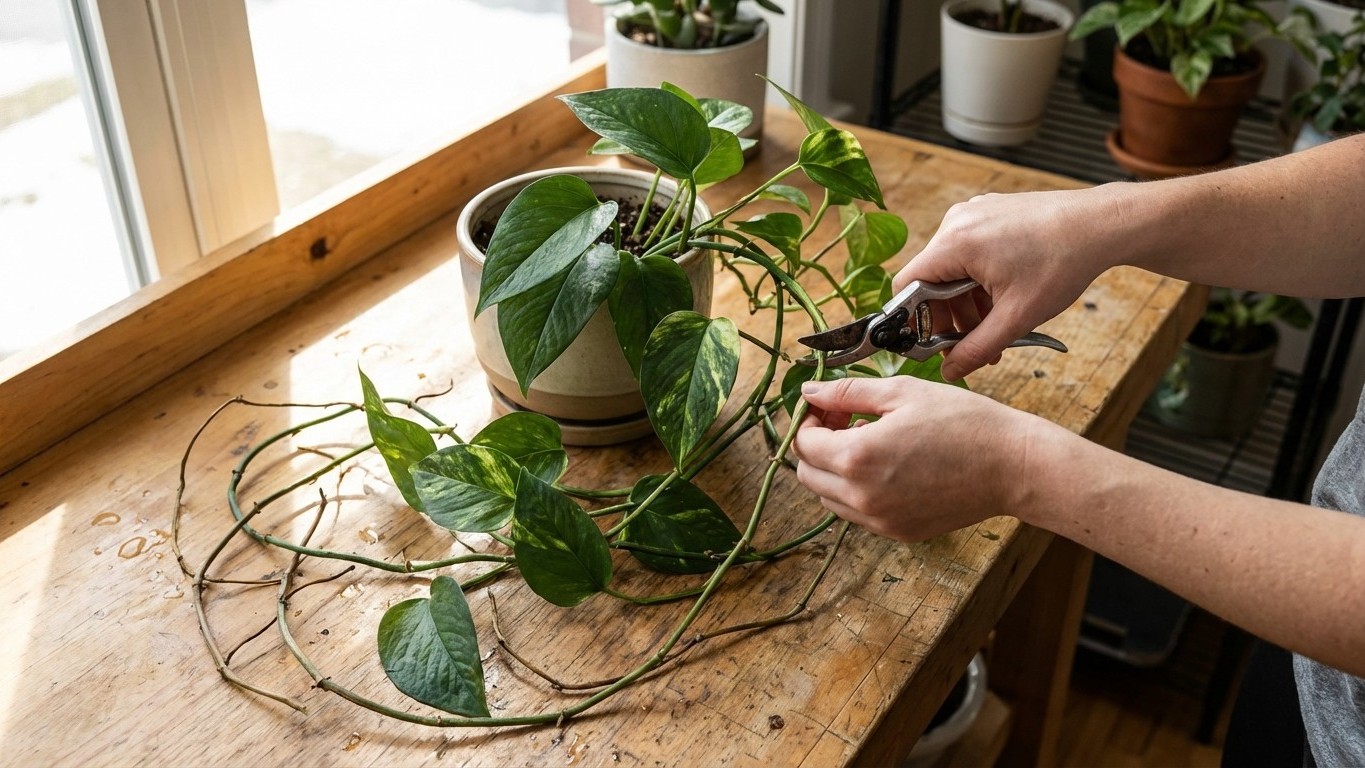
Your pothos has been trailing along the shelf for eighteen months now, and you watch it grow with a mix of pride and mild concern. The vines are getting long. Some sections have lost their leaves, leaving bare stems that wind aimlessly around the pot. You wonder: should I cut it? Where, exactly? And what happens to those cuttings once they’re off?
Pruning indoor plants remains one of the most misunderstood aspects of houseplant care. Many plant owners hesitate, fearing they’ll harm their green companions. Many new plant owners hesitate to cut their plants, fearing they’ll damage them, but the truth is, most indoor plants benefit greatly from regular pruning. The hesitation makes sense: you’ve nurtured these leaves, watched them unfurl, and now you’re supposed to snip them off?
This guide breaks down when and where to prune houseplants, walks through the techniques that match different plant types, and shows you what to do with those cuttings so nothing goes to waste.
Pourquoi tailler ses plantes d’intérieur ? Avantages et bénéfices
Pruning encourages fresh growth, improves airflow, prevents legginess, and helps shape the plant into a fuller, healthier version of itself. Unlike their outdoor cousins, houseplants don’t experience natural wear from wind, weather, or seasonal changes. Over time, their growth can become uneven or unbalanced.
When you prune a stem, the plant redirects energy into side shoots. This leads to more branches, creating a fuller, bushier plant that looks better and grows stronger. The mechanism works through dormant buds located at nodes along the stem. Cut above a node, and the plant activates those buds to produce new growth.
Removing yellowed, brown or dead leaves and stems is necessary for most houseplants. Plants use their energy on all their leaves, even the dying ones. If you prune these away, the healthy leaves get all the energy they need.
Beyond aesthetics, pruning serves a health function. It helps keep pests and disease away, it prevents your plants from getting too sparse, and it allows your plants to retain a shape and size suitable for indoor spaces. A plant with good airflow between its leaves is far less likely to develop fungal problems or harbor pests in dense, hidden canopies.
Quand tailler les plantes d’intérieur ? Moment idéal selon la saison et la plante
Indoor plants are less affected by the seasons than their outdoor cousins. You can lightly prune houseplants at any time of year, including in winter. However, if you’re thinking about a more substantial re-shaping, the best time to tackle it is late winter or early spring, when spring’s longer daylight hours will give the plant the boost it needs to recover.
It’s best to get any large amounts of pruning done during the spring or summer, when your plants are getting more sunlight and are actively growing. Trimming off a large amount of leaves, branches, or anything that will cut back a sizable amount of your plant, is best done during this time. In general, you don’t want to remove any more than 1/4 of the overall foliage of the plant.
Hold back on any major pruning during the fall and winter, your plants won’t be growing as quickly, and it could take a longer time for them to put out new growth. However, there are tasks that can easily be accomplished during any time of the year. Pulling off yellowing or brown leaves, trimming away a few stems or vines, or other smaller items, can all be done daily or as needed throughout the year.
For flowering plants, you may want to prune right after a cycle of flowering if you choose to prune. This way you will be sure not to prune off any future unopened buds. Timing matters here: cut a Peace Lily before it blooms, and you’ve just removed the very buds that would have opened into flowers.
In March 2026, with spring approaching in the Northern Hemisphere, now is the optimal window for more significant reshaping work. Your plants are waking from their slower winter phase and have the energy reserves to respond with vigorous new growth. For guidance on winter care for indoor plants, including seasonal pruning routines, check our dedicated article.
Comment préparer ses outils et son espace avant la taille
Always use high quality pruning tools, and maintain them with a sharp edge. Blunt blades can crush or tear stems, leaving the plant vulnerable to disease. A clean cut is much healthier for the plant.
Tool sterilization prevents disease transmission between plants. One of the easiest ways to sanitize pruning equipment is to use ethanol or isopropyl alcohol. To sanitize with alcohol, wipe or dip the tool into the alcohol. No prolonged soak is needed. Rubbing alcohol (70% isopropyl alcohol) is readily available at most drug stores and can be used directly from the container with no dilution required.
The best and cheapest sterilization method is probably rubbing alcohol. You can dip the tool in a small cup of it or wipe the blade with a cotton ball or cloth dipped in it. It cleans and sterilizes, yet is in no way corrosive.
Before you begin, be sure to put down an old sheet or a drop cloth, especially if it’s a large plant or tree. You may want to wear gloves as well. Some plants may bleed a sticky sap that can damage your floor and irritate skin. Ficus varieties, for instance, produce a milky latex sap that can be a nuisance during pruning sessions.
Gather everything before you start: sharp bypass pruners or scissors, rubbing alcohol in a spray bottle, clean cloth, gloves, a container for cuttings you want to keep, and a bin for diseased material you’ll discard.
Où couper ? Principes de base de la coupe sur différentes espèces
Identifier les zones à couper : tiges, feuilles, bourgeons
Remember the four Xs: the first things to remove from your plant are dead, damaged, diseased and crossing. This simple rule applies across nearly all houseplant types. Dead leaves drain energy. Damaged stems invite infection. Diseased material spreads problems. Crossing branches restrict growth and create dense tangles.
Dormant buds await where the leaf meets the stem. They are ready to grow and send out new branches when the stem is cut just above the bud. Whether you are pruning just to shape the plant or to rejuvenate an overgrown monster, make your cuts just above a leaf node.
When cutting back an over-long stem, make your cut above a leaf node, where new growth will appear. If you’re removing large stems entirely, cut as close to the main stem as possible, or right at the base of the plant, if that’s how your plant grows.
When a leaf is yellowing, let the leaf fully turn yellow before pulling it off. When a leaf is on its way out, the plant absorbs any leftover nutrients from the yellowing leaf. The leaf should be able to be pulled off easily without any kind of resistance.
Organisation de la taille : techniques pour plantes à port dressé, retombant, arbustif
Upright trees like Ficus and Dracaena require a specific approach. Indoor trees tend to grow vertically, but it is possible to encourage branching by trimming off the topmost point of growth. Doing this will force your plant to branch out from the sides of where you cut.
When an existing branch is pruned, new branches will sprout from beneath the area where the cut was made. This principle lets you shape a single-stemmed ficus into a bushier specimen over time. Cut the leader, and multiple side shoots emerge below.
When it comes to weeping figs grown indoors, it’s best to keep your pruning to a minimum and not cut away too much living material at once. Pruning should focus on removing dead or dying branches so they don’t clog up the interior of the tree. Cutting out any criss-crossing branches so that the tree grows outwards is important too.
Trailing vines like Pothos, Philodendron, and Tradescantia follow different rules. If you snip a vine right next to a node, it will send out new growth, usually in the form of multiple branches. You can do this to any branch of any length.
To prune, use a sharp, clean pair of scissors or secateurs to make a cut just below a node. If your goal is to encourage bushy growth, prune close to the crown to create lots of shorter stems from which new leaves will emerge. If you want to shorten up a long vine, snip it off wherever you prefer.
Soft-stemmed bushy plants respond well to pinching. Polka dot plant and young pothos, philodendron and coleus are easy to prune with your thumb and forefinger nails. Pinch off the growing tips of such plants, and they will grow bushy, rather than lanky.
Plants that should not be pruned: Most palms and tree ferns never form branches, so the top areas of growth shouldn’t be cut off, otherwise it will effectively kill the plant. Most varieties of orchids don’t like being pruned. Remove dead leaves only.
Étapes pas à pas pour tailler ses plantes d’appartement (exemples concrets)
Let’s walk through pruning a pothos that has grown leggy over time:
-
The first step is observation. Take a moment and look at your plant. If it’s grown too big or stretching out too much, ask yourself: “What’s the perfect size for it?” As you look, you might notice areas where the plant has grown long and thin. Also, keep an eye out for any leaves or stems that look off-colour, damaged, or just plain dead. Identifying these areas is the key to knowing where to make your cuts.
-
Sterilize your tools by wiping the blades with rubbing alcohol.
-
To prune your pothos, pick out a vine and figure out where you’d like to make the cut. Once you’ve picked a spot, you want to cut about a quarter-inch above a leaf, or growth node. You’ll make the cut a quarter-inch above the growth node of what, after the cut, will be the first leaf on the vine.
-
Repeat the process on each vine you want to cut for however much you want to take off. If there are any vines without leaves or with bare spots, you may want to consider pruning those off to allow your pothos room and energy to grow newer, healthier vines.
-
If you’re pruning to alter the shape of your plant, proceed slowly. Keep taking a step back, and turn the plant to view it from all angles before deciding to cut. If a stem is lost which gives symmetry, fullness or balance, it will be a long time before a replacement will appear.
Healthy plants usually have no trouble recovering from pruning and are found to have new growth within a few weeks. This can vary from plant to plant, so don’t panic if it’s been a month and your plant still hasn’t grown much post-pruning. Some plants may droop a bit in the few days following pruning due to shock, but as long as you don’t overprune, your plant should bounce back.
For detailed guidance on indoor plants care varieties houseplants, our complete guide covers species-specific requirements.
Quoi faire des tiges coupées ? Valoriser les déchets de taille
Recyclage, compost, bouturage : solutions pour chaque type de tige
Disposing of your leaves: If you’re removing sick or damaged pieces of the plant, throw them in the garbage. Do NOT compost them, or you risk spreading infection to other plants. If you’re removing healthy growth, you might want to hang onto them for propagation.
Healthy cuttings become new plants through propagation. We recommend water if this is your first time propagating a plant. The big benefit of rooting in water is that it’s easier to observe progress as roots develop. For advanced plant propagators, rooting directly into potting soil avoids the transplant shock of transitioning the cutting from water to soil.
One of the most popular indoor plant families that propagate really well in water are Aroids, that’s plants like your Monstera, Pothos, Philodendron, Epipremnum and Scindapsus, making them a great place to start your propagating journey.
For the best success rate when water propagating, roots should be at least two to four inches long before transferring to soil. Patience pays off here. Be patient, this can take anywhere from 2-6 weeks or in some cases, months!
If you’d like to make more plants, try rooting your cuttings. Remove the flowers and strip off some of the lower leaves. Then simply place in a glass of water to root. These pothos cuttings will form roots in no time and can be potted up for friends. This is one plant that will happily grow in water.
What about the less glamorous scraps? Healthy green material goes to the compost pile. Woody stems from larger plants can be chopped into mulch. Some plant parents get creative, pressing leaves or arranging small cuttings in decorative vases as temporary botanical art.
Erreurs fréquentes et signaux d’alerte à surveiller après la taille
Don’t give your indoor plants a buzz cut! Remove no more than 20 percent of the plant overall when you are pruning. If you really need to cut back more, do it in stages.
Using blunt or wrong tools can result in jagged cuts that are difficult for the plant to heal properly. Pruning too close to the trunk or stem can damage the plant and create an entry point for pests and diseases.
Pruning at the wrong time, especially during a plant’s dormant period, can hinder its growth or bloom potential. This mistake shows up most often with flowering houseplants, where an ill-timed trim removes developing buds.
A word of caution: If your plant has any health issues or doesn’t have a strong root system, the shock of losing all its leaves could kill it! Please take the health of your plant into consideration before you start chopping.
After pruning, watch for these warning signs:
- Excessive wilting that lasts more than a few days
- Cuts that turn brown or black, indicating infection
- Sap that continues oozing for extended periods
- No new growth after 4-6 weeks during growing season
If you’re traveling soon after pruning, check our guide on how to keep houseplants alive while on vacation to ensure your freshly pruned plants stay healthy while you’re away.
FAQ taille des plantes d’intérieur : vos questions les plus fréquentes
How do you know when to prune indoor plants?
If a houseplant becomes unwieldy or unbalanced, it’s probably time to give it a pruning. Pinching and pruning make your indoor garden more attractive and can correct structural problems while encouraging new growth. The key to pruning houseplants is to do so before they become too leggy or unbalanced.
Where should I cut my houseplant when pruning?
Shorten leggy stems and branches, cutting back to just before a leaf node, which is the bump on the branch or stem where new growth will appear. When removing large stems completely, cut as close to the main stem as possible or all the way to the base of the plant.
What should I do with indoor plant cuttings after pruning?
Healthy cuttings can be propagated in water or soil to create new plants. Diseased or damaged material should be discarded in the trash, never composted. Healthy green scraps can go to compost.
Can I prune houseplants in winter?
You can lightly prune houseplants at any time of year, including in winter. However, major reshaping should wait for late winter or early spring. For more on winter plant care, see our article on how to care for houseplants in winter (less light).
Which houseplants should never be pruned?
Palm trees and Norfolk Island pines grow from a central dominant bud and do not lay down secondary buds. Destroying this bud could cause the plant to die. Most orchids also require minimal intervention beyond removing spent flower spikes.
Liens utiles pour aller plus loin (bouturage, entretien saisonnier…)
Pruning connects to every other aspect of houseplant care. The cuttings you take become propagation projects. The timing aligns with seasonal rhythms. The recovery period requires adjusted watering and light conditions.
A few weeks from now, your pruned pothos will look different. Where you made those cuts, new growth points will emerge. The plant will be bushier, more balanced. And those cuttings sitting in a jar of water on your windowsill? Tiny white roots will be forming, ready to become plants of their own.
The question isn’t whether to prune, but whether you’re ready to see your plants transform.