
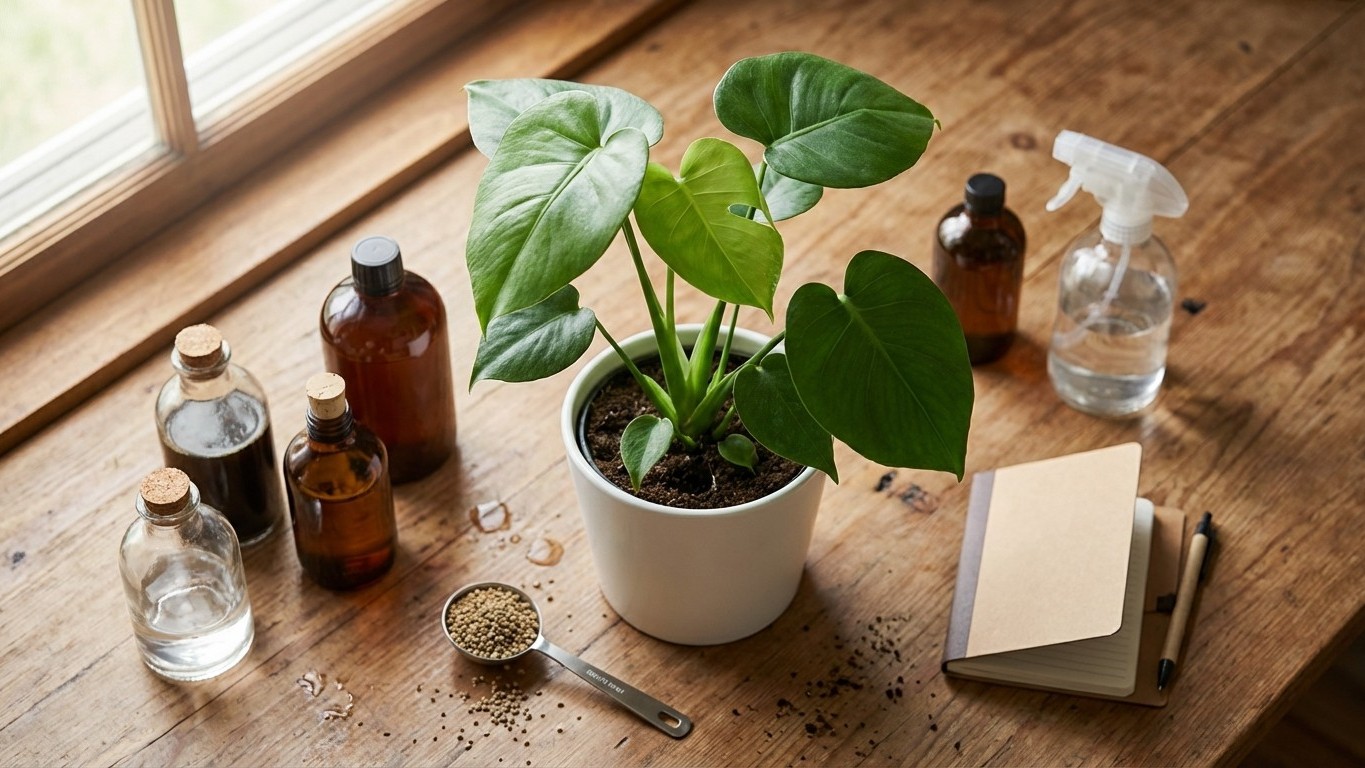
Your Monstera is pushing out a new leaf every three weeks. Your peace lily is blooming on schedule. Your pothos trails across the shelf in long, confident vines. Then you skip fertilizing for two months, and suddenly everything stalls. Growth slows, leaves pale, and you find yourself wondering if your plants are sick or just hungry. Nine times out of ten, it’s the latter.
Fertilizing houseplants sounds deceptively simple, but getting the timing, the formula, and the dosage right is where most plant owners trip up. Too little, and your plants plateau. Too much, and you risk something far worse than slow growth. This guide walks you through building a solid indoor plant fertilizer schedule, understanding what your plants actually need, and reading the signals they send when something’s off.
Why Fertilizing Indoor Plants Is Non-Negotiable
The role of nutrients in growth and flowering
Fertilizing indoor plants is essential for maintaining healthy growth, vibrant leaves, and strong roots. Unlike outdoor plants, indoor plants rely entirely on the nutrients provided in their soil or fertilizer since they don’t have access to natural replenishment from rain and decomposing organic matter.
a potted plant’s soil is a closed system. Every watering leaches a little more out. Without refilling that nutrient bank, your plant is essentially living off savings that eventually run dry.
In the gardening world, nitrogen, phosphorous, and potassium (N-P-K) are known as primary or macronutrients, because they are required in larger quantities than other elements for plant growth and survival. As a result, these nutrients are usually depleted from the growing media first.
Each plays a distinct role:
nitrogen is the leaf-maker, behind that vibrant green and pushing plants to grow tall and bushy; phosphorus is the root and bloom booster, helping plants dig deep and flower; potassium is the all-around protector, strengthening plants against drought, disease, and cold.
What happens when you miss the balance
If plants do not receive sufficient nitrogen, they will grow slowly and become pale. Too much nitrogen causes plants to put their efforts into green growth and lose their blooms and fruit.
The same logic applies to every other nutrient. Deficiency and excess both produce visible damage, just in different ways and at different speeds.
Plants in low light will require less fertilizing than those with brighter light.
That’s the part of the equation most guides skip: fertilizer requirements aren’t fixed, they flex with your indoor environment. A Monstera sitting in a south-facing window in summer needs more feeding than the same plant parked in a dim hallway in December.
Understanding Fertilizer Types and NPK Labels
Liquid, slow-release, organic, and synthetic
The format of the fertilizer determines how quickly nutrients reach your plant, and how much margin for error you have.
Liquid fertilizers should usually be applied every two weeks. Always water plants with plain water before applying liquid fertilizer. Granular fertilizers are usually applied once a month. Slow-release fertilizers are usually applied once every four months.
Liquid formulas give you the most control but demand more consistency. Slow-release pellets are forgiving but harder to adjust once applied.
On the organic versus synthetic debate, there’s a practical distinction worth knowing.
Organic fertilizers are created from organic compounds in things like seaweed, compost, or worm castings. Synthetic fertilizers are often created from inorganic compounds. These products deliver nutrients, but that’s where the benefits end. Organic products give your plants and soil a boost by adding organic matter that helps repair nutrient-depleted soil, along with beneficial microbes that contribute to healthier soil over time.
Reading the NPK label without getting lost
If a fertilizer has an N-P-K ratio of 2-2-4, then it contains 2% nitrate, 2% phosphate, and 4% potash. The N-P-K ratio represents the availability of nitrogen, phosphorous, and potassium, by weight, contained in a plant fertilizer.
The numbers on the packaging aren’t arbitrary marketing; they directly dictate what the fertilizer will and won’t do for your plant.
For most indoor plants, an N-P-K ratio of 4-1-3, 6-1-4, or 5-5-5 is ideal. For flowering indoor plants, 3-1-2 is highly suitable.
There’s also an important nuance for organic products:
the N-P-K ratio of organic fertilizers is typically lower than that of synthetic fertilizers, because only nutrients that are immediately available to the plant may be listed on the label. Most organic fertilizers contain slow-release nutrients that will become available over time.
Building Your Indoor Plant Fertilizer Schedule
The factors that shape your calendar
There is no single schedule that works for every houseplant in every home. The right rhythm emerges from four variables: the type of plant, the season, the quality of the substrate, and the available light. Get those four inputs right, and the schedule almost writes itself.
The ideal indoor plant fertilizer varies with your plants’ unique requirements, which can shift with the seasons.
A slow-growing succulent and a fast-growing tropical vine are not on the same feeding program. Treating them identically is the first mistake most plant owners make.
A seasonal fertilizer calendar for indoor plants
Houseplants are generally in their active growing period from March through October, so you can follow your usual fertilizing schedule during these months.
Here’s how to break that down across the year:
- Spring (March–May):
Early spring is the best time to feed flowers.
Resume or restart fertilizing as light levels increase and new growth appears. Begin at half the recommended dose to ease plants out of their rest period.
Give dormant plants a thorough watering and a boost of fertilizer diluted at half strength to encourage new growth. - Summer (June–August): Peak growing season.
Tropical plants like Monstera, Philodendron, Pothos, and Fiddle Leaf Fig can be fertilized every 2–4 weeks in spring and summer. Flowering plants like orchids, African violets, and peace lilies do well with every 2 weeks when blooming. - Autumn (September–October): Begin winding down. Reduce frequency by half. Avoid high-nitrogen formulas, as they push soft new growth that cannot harden before light levels drop.
- Winter (November–February):
Plants don’t need extra fertilizer when they are dormant. It’s better to wait until you see signs of growth in the late winter and early spring.Succulents and cacti receive no fertilizer from October through March.
For tropicals under grow lights that continue to show active growth,
stick to a balanced, water-soluble fertilizer mixed at half strength.
The winter question catches many people off guard.
Since plants don’t have as much light to fuel growth, they don’t have as much opportunity to utilize the nutrients. It’s simply less beneficial to fertilize in winter if they’re not putting on much active growth.
Frequency by plant type: a practical reference
- Tropical plants (Monstera, Philodendron, Pothos, Fiddle Leaf Fig): every 2–4 weeks in spring and summer, less in winter.
- Flowering plants (orchids, African violets, peace lilies): every 2 weeks when blooming.
- Cacti and succulents (aloe vera, jade plant, snake plant): every 2–3 months.
- Herbs (basil, mint, rosemary): every 1–2 weeks for strong growth.
Dosage: Less Is Almost Always More
How to read and apply product instructions
For most indoor plants, a once-a-month application is sufficient. To prevent harming your plants, make sure to heed the manufacturer’s dosage guidelines to prevent excessive fertilization and nutrient imbalances.
That said, the label is a starting point, not gospel.
To prevent over-fertilization, it’s usually better to cut the recommended dosage on the label.
Applying at half the suggested concentration, twice as often, is a more controlled approach that avoids the feast-or-famine cycle many gardeners fall into.
One rule that rarely gets mentioned on product packaging:
dry soil can cause root damage when fertilizer is applied. Always fertilize after watering or with diluted fertilizer.
Applying concentrated liquid fertilizer to dry soil is one of the fastest ways to trigger root burn, even at the correct dose.
Common dosage mistakes and how to sidestep them
Doubling the dose to “make up” for a missed application is the most common error. Roots don’t work that way. A large salt spike causes more harm than the gap ever would.
Avoid over-fertilizing by always adding enough liquid fertilizer so that 10% of what is added leaches out the bottom of the container.
That trace of runoff tells you nutrients have moved through the entire root zone rather than pooling at the surface.
Another overlooked mistake:
improper use of slow-release fertilizer in combination with soluble fertilizer.
Using both at the same time stacks doses invisibly, and you don’t realize the cumulative problem until leaf tips start browning. Pick one system and stick with it during each growing season.
Recognizing and Responding to Fertilizer Problems
Signs of over-fertilization and nutrient burn
The main danger of over-fertilizing plants is “burning.” Fertilizers have high amounts of different salts that can pull moisture away from the roots in a process called reverse osmosis. If the salt content in the soil is higher than what the plant contains, reverse osmosis will occur and the plant will be in danger of chemical burns and dehydration.
The visible signs appear above ground, but the real damage is underground.
Since excess salts in fertilizers can burn plant roots and limit moisture uptake, your plant will quickly show signs above the soil. Stunted growth, extreme growth of foliage with few blossoms, and rusting on the edges of leaves are the most obvious manifestations. Plants with significant nutrient pollution will appear to have burned, their leaves turning brown and caving in from the edges.
On the soil surface,
a white crust forming on the surface of your soil may be a sign that minerals are building up instead of being absorbed by the plant. This is the most common sign of over-fertilization.
Signs of nutrient deficiency
Deficiency is subtler and easier to misread.
Plants can’t exactly tell you when they’re hungry, but they show it: yellow leaves, weak stems, or no blooms.
A nitrogen deficiency turns older leaves a uniform pale yellow from the bottom of the plant upward. Phosphorus deficiency often shows as purple or reddish tints on undersides of leaves. Potassium deficiency scorches leaf edges but leaves the center green, a pattern distinct from fertilizer burn.
Yellow leaves in isolation don’t confirm deficiency.
Yellowing leaves can indicate problems with watering, both over and underwatering, and nutrient issues. Yellow leaves can both be a sign of a lack of nutrients and also over-fertilizing.
Context matters: if yellowing follows a recent heavy feeding session, suspect over-fertilization first.
What to do when things go wrong
If you suspect over-fertilization, act fast.
When salts are excessive due to a soluble fertilizer, leach them out by applying plenty of tap water so that it pours out the bottom of the pot. Repeat this leaching once more 2–3 hours later or the next day.
For worse cases,
if salts are excessive because slow-release fertilizer was used improperly, repot the plants or scrape some of the slow-release from the medium surface.
Prevention is the better strategy.
Even appropriate amounts of fertilizer can leave a buildup of salts, so it’s helpful to leach your pot every 4–6 months to flush extra fertilizer from the soil.
Choosing the Right Fertilizer for Your Plant Type
Green plants, flowering plants, and succulents
The NPK ratio you choose shapes your results more than any other variable.
It is best to use a fertilizer with high potassium and low nitrogen for flowering plants.
Conversely, foliage-focused plants like ferns, pothos, and monsteras thrive with higher nitrogen ratios that fuel leaf production.
Nitrogen fuels foliage growth, and if flowering houseplants are fed with high-nitrogen fertilizers in the buildup to blooming, you will get lots of green growth but few flowers.
For succulents and cacti, restraint is the rule.
It can be tricky to make sure they get the right amount, and too much fertilizer might kill them.
Their evolved adaptation to nutrient-poor environments means even a diluted standard formula can tip them into excess.
Homemade and natural fertilizer alternatives
For plant owners who prefer to keep chemistry out of the equation, organic options work particularly well for houseplants.
Worm casting tea is an organic liquid fertilizer made by brewing worm castings or vermicompost in water.
Packed with nutrients and beneficial bacteria, fungi, and other microbes, worm compost tea can be applied as either a soil drench or foliar spray. Some studies have found that worm tea can boost plant growth, enhance fruiting and flowering, and increase seed germination rates.
Worm castings will not give plants a massive influx of nutrients all at once. Instead, castings power in a way that can best be described as low, slow, and even. That is the ideal way to power plants, especially when it comes to annual flowers, vegetables, and herbs. A slow stream of nutrients allows roots to grow at a steady pace.
This makes worm-based fertilizers a strong option for anyone who has previously overdone it with synthetic products.
For a simple homemade preparation:
soak one cup of worm castings in one gallon of water to create the tea,
leave it overnight, strain, and apply directly to the soil. No specialized equipment needed.
Integrating Fertilizer Into Your Daily Plant Routine
When not to fertilize
Knowing when to hold back matters as much as knowing when to feed. Three situations call for a complete pause on fertilization:
- After repotting:
Hold off on restarting a fertilizing schedule in the spring if you took advantage of the dormancy period to repot your plant. Houseplants that have just been repotted generally don’t need additional nutrients for at least a few weeks.
Fresh potting mix already contains nutrients; adding fertilizer on top is redundant at best, harmful at worst. - During stress or illness: A plant fighting root rot, a pest infestation, or heat stress cannot process nutrients effectively. Feeding a stressed plant sends resources to growth when the plant needs energy for survival and repair.
- During winter rest:
Many people think more food means healthier plants, but in winter it’s actually the opposite. When light and temperature drop, most plants take a natural rest. They slow their growth, and their nutrient needs nearly vanish. Feeding them now is like serving a full dinner right before a nap: it’s not just unnecessary, it can cause harm.
The substrate-water-fertilizer triangle
Fertilizer doesn’t work in isolation. It interacts directly with the quality of your potting mix and your watering habits.
Drainage is incredibly important for the health of your houseplants. Poor drainage can cause overwatering, root rot, encourage fungal growth, and promote over-fertilizing, so it’s essential that your pot and soil drain well.
A mix with poor drainage traps fertilizer salts around the roots rather than flushing them through, accelerating the risk of toxicity even at correct doses.
For those interested in understanding the full picture of substrate composition and how it interacts with nutrients, the guide on best soil for indoor plants covers drainage mechanics and substrate choices in depth. Similarly, if you’re about to move a plant to a new container, reviewing how to repot a houseplant before resuming fertilization helps avoid the common mistake of feeding too soon after a root disturbance. And if you’re unsure whether your plant is ready for a new pot at all, the article on when to repot indoor plants helps you read the signs correctly.
FAQ: Indoor Plant Fertilizer Schedule
How often should I fertilize indoor plants?
The answer depends on the type of plant, its growth stage, the season, and the type of fertilizer used.
As a starting point: most tropical houseplants benefit from feeding every 2–4 weeks during spring and summer, tapering off in autumn and stopping or nearly stopping in winter.
What are the risks of using too much fertilizer?
When excess fertilizer is applied, it can lead to nutrient imbalances and harm the plant’s health. Over-fertilization can cause leaf burn, stunted growth, and even plant death.
The damage often begins underground, in the root system, before any visible signs appear above soil.
How do I know if my plant is nutrient-deficient?
Watch for slow growth, pale or yellowing leaves, failure to bloom during the expected season, and weak stems.
The dark green colour of the leaves will disappear if the plant doesn’t receive enough fertilizer.
Compare symptoms against both deficiency and over-fertilization checklists before acting, since the visual signs overlap.
Should I fertilize in winter or during dormancy?
Don’t fertilize during dormancy. Plants don’t need extra fertilizer when they are dormant. It’s better to wait until you see signs of growth in the late winter and early spring.
The exception applies to plants actively growing under supplemental lighting, which can receive a half-strength feeding once per month.
Which fertilizer should I choose for flowering plants vs. green plants?
High-nitrogen formulas (like 20-10-10) are suited to leafy green lovers. High-phosphorus formulas (like 10-20-10) are great for flowering plants or root crops.
When in doubt, a balanced 5-5-5 or 10-10-10 serves as a reliable all-purpose option for most indoor varieties.
Complementary Resources in This Guide
Fertilization sits at the center of a larger network of plant care decisions. For a broader overview of species-specific care and what different varieties actually need to thrive, the comprehensive resource on indoor plants care varieties houseplants is a logical next step. Nutrients, substrate, repotting schedules, and light all speak to each other. Getting one element right while ignoring the others limits how far you can actually take your plants.
The plants that grow fastest and most consistently in indoor conditions are typically the ones whose owners think in systems rather than individual variables. Fertilizer is a lever, not a magic fix. Pull it at the right moment in the right season with the right formula, and it amplifies everything else you’re already doing well. Pull it blindly, and it undoes it.