
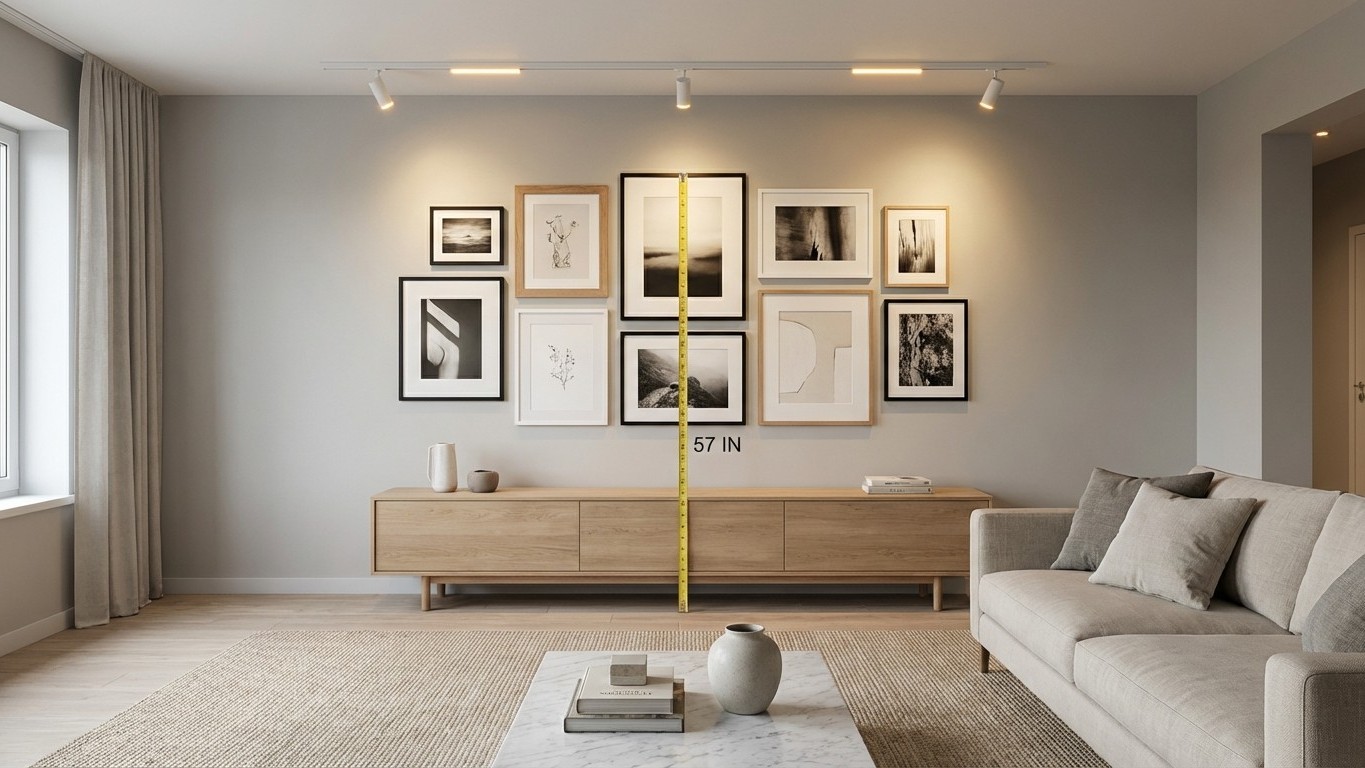
Walking into my living room used to make me cringe. Despite having beautiful artwork and meaningful photographs, something felt fundamentally off about my walls. Frames hung at seemingly random heights, creating a chaotic patchwork that made the entire space feel unbalanced and amateur. It wasn’t until a professional interior decorator visited for a consultation that I discovered the simple mathematical principle that would revolutionize how I approach wall art forever.
The revelation came when she walked straight to my gallery wall, pulled out a measuring tape, and shook her head with a knowing smile. “You’re hanging everything based on the frame height,” she explained, “when you should be focusing on the center point.” What she taught me next was so elegantly simple that I couldn’t believe I’d been struggling with frame placement for years without knowing this fundamental rule.
The 57-Inch Rule That Changes Everything
The decorator’s secret weapon was what professionals call the 57-inch rule, though she admitted that wasn’t the complete picture. “Museum curators discovered long ago that the average human eye level sits at 57 inches from the floor,” she explained while demonstrating on my wall. “But here’s what most people get wrong – you measure 57 inches to the center of your artwork, not to the hanging hardware or the bottom of the frame.”
This distinction is crucial because it accounts for the natural way our eyes scan and process visual information. When artwork centers align at this consistent height, our brains perceive the display as harmonious and professionally curated, even when the frames themselves are different sizes. The mathematical precision creates an invisible horizontal line that anchors the entire composition.
She demonstrated by repositioning my largest piece – a landscape photograph that had been hanging too high above my sofa. By measuring 57 inches from the floor to the artwork’s center point, then calculating where the hanging hardware needed to be positioned, the difference was immediately apparent. The piece no longer floated awkwardly near the ceiling but instead created a visual dialogue with the furniture below.
Adapting the Rule for Real-World Spaces
While the 57-inch rule provides an excellent foundation, the decorator emphasized that context matters enormously. In rooms where family members are consistently shorter or taller than average, she adjusts the measurement by a few inches to accommodate the primary viewers. Similarly, in spaces with unusually high or low ceilings, slight modifications ensure the artwork maintains proper proportion with the room’s architecture.
For gallery walls or arrangements with multiple pieces, she taught me to identify the largest or most visually significant artwork as the anchor piece, centering it at 57 inches, then arranging smaller pieces around it while maintaining consistent spacing. The key insight was treating the entire grouping as a single unit rather than individual frames competing for attention.
She also addressed the common mistake of hanging artwork too high above furniture. “If there’s a sofa, console table, or headboard below your art, the gap should typically be 6 to 8 inches,” she noted. “Any larger, and the pieces feel disconnected. Any smaller, and the furniture appears to be pushing against the artwork.” This furniture relationship often takes precedence over the strict 57-inch rule, particularly in dining rooms or bedrooms where the visual connection between elements is paramount.
The Psychology Behind Perfect Placement
What fascinated me most was learning about the psychological impact of proper frame placement. The decorator explained that when artwork hangs at inconsistent heights, our subconscious mind registers the space as unfinished or chaotic, even if we can’t articulate why. This creates subtle stress that affects how comfortable we feel in the room.
Conversely, when frames follow consistent proportional relationships, the space feels intentional and sophisticated. Our brains interpret this visual order as a sign of careful curation, which elevates our perception of both the artwork and the room itself. This principle extends beyond residential spaces – restaurants, offices, and retail environments all leverage these same psychological responses to create specific atmospheres.
The decorator also shared how lighting interacts with frame placement. Artwork positioned at eye level catches both natural and artificial light more effectively, reducing glare while maximizing visibility. This technical consideration reinforces why the 57-inch rule has persisted across different design eras and cultural contexts.
Transforming Your Space With Confidence
Armed with this knowledge, I spent the following weekend repositioning every frame in my home. The transformation was remarkable – rooms that had felt haphazard suddenly appeared sophisticated and intentional. Guests began commenting on my “good eye” for design, not realizing that mathematical precision, rather than artistic intuition, was behind the improvement.
The beauty of this approach lies in its simplicity and universality. Whether you’re hanging a single statement piece or creating an elaborate gallery wall, the 57-inch rule provides a reliable foundation that eliminates guesswork. You’ll find yourself approaching frame placement with newfound confidence, knowing that this time-tested principle will guide you toward professional-looking results every time. The random, hesitant approach that once characterized my wall displays has been replaced by the quiet assurance that comes from understanding the fundamental mathematics of visual harmony.