
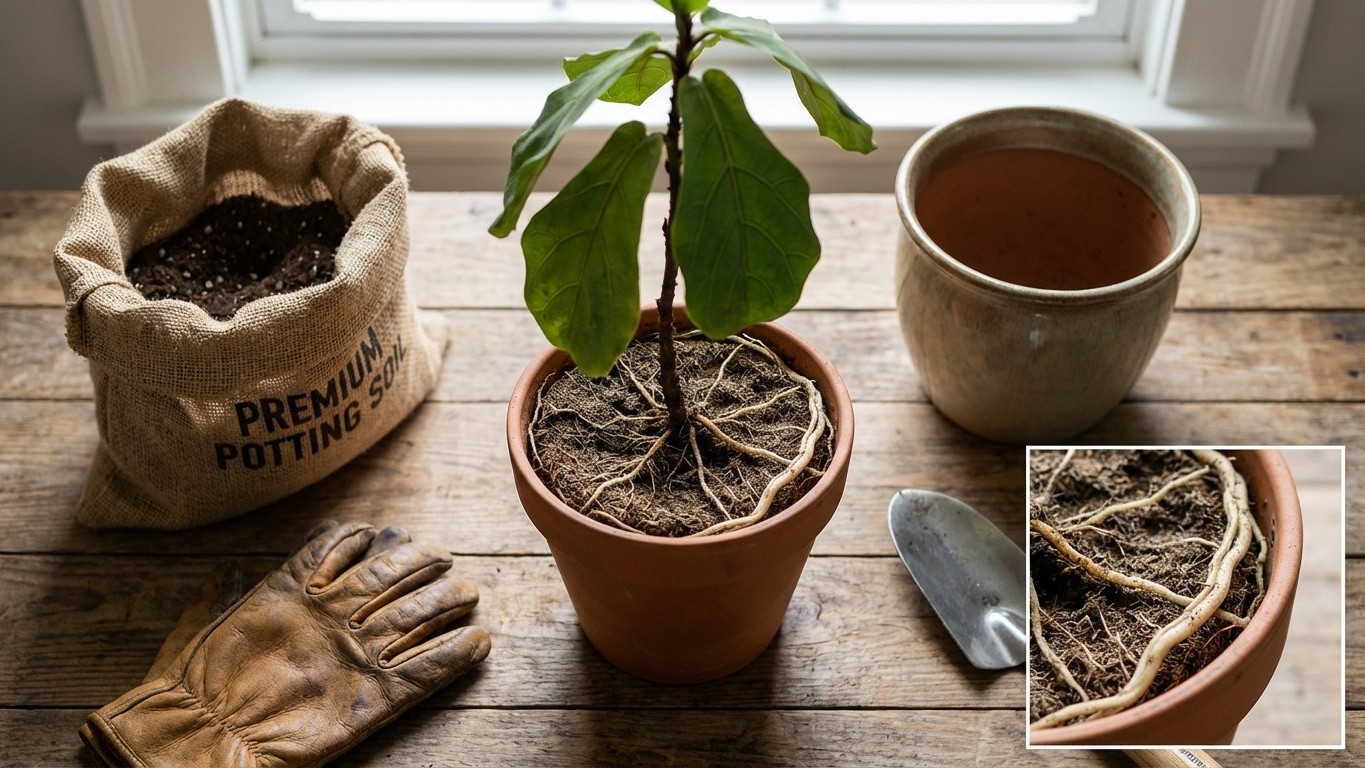
Your fiddle-leaf fig drops a leaf. Your pothos stops growing. Your ZZ plant starts leaning toward the windowsill like it’s trying to escape. Before you reach for a fertilizer bottle or second-guess your watering routine, consider something far more likely: the pot. Most houseplant owners spend years adjusting light, water, and humidity without ever looking down at the soil and roots that actually keep their plant alive. The signs a houseplant needs repotting are often hiding in plain sight, and learning to read them changes everything about how you care for your indoor garden.
Why repotting matters: more than just a bigger pot
A common misconception: repotting is only necessary when roots are visibly bursting through drainage holes. The reality is subtler and more interesting.
Repotting doesn’t necessarily mean changing a plant’s current planter — sometimes it just needs its soil refreshed, which means new nutrients.
Two distinct problems can call for the same solution. A plant can suffer from a container that’s too small for its root system, or from soil that has become chemically and structurally exhausted, even in a pot that otherwise looks fine.
Over time, soil becomes compacted and depleted of nutrients as they leach out during watering and the plant takes up those critical minerals into its foliage.
Think of the pot as a closed ecosystem. Unlike a garden bed, where earthworms aerate the soil, rainfall refreshes nutrients, and roots spread freely, a houseplant’s pot offers a finite amount of everything, space, oxygen, and food. Once those resources run out, no amount of fertilizer or careful watering will fully compensate.
A large meta-analysis found that when pot size is doubled, plants gain on average about 43% more biomass — that’s how much space and fresh substrate matter.
That statistic should recalibrate how seriously you take the question of whether your plant needs more room.
The six signs your houseplant is telling you it’s time
Roots pushing through drainage holes or surfacing above the soil
If your plant’s roots are starting to protrude from the soil’s surface or through the drainage holes at the bottom of the pot, this is a tell-tale sign that it has outgrown its current home — a symptom of a condition known as “bound roots,” whereby the roots begin to wrap around and encircle the inside of the pot in their effort to find more space.
This isn’t just a cosmetic issue.
This limits the plant’s ability to absorb moisture and nutrients, and while the pot size is the culprit, it can lead to further symptoms like stunted growth and yellowed leaves, which can mislead you into questioning other areas of your plant care strategy.
A detail worth knowing:
roots will usually grow down and outwards first, and only once they’ve completely run out of avenues in those directions will they attempt to go up.
By the time you see roots surfacing above the soil, the situation below has already been critical for some time. Roots at the drainage hole are a warning. Roots above the soil line are a 911 call.
Stalled or stunted growth during the active season
New growth looks stunted — if the plant should be growing and new leaves come in looking small, clefted, or do not fully open, this could be a sign a plant is rootbound. This could also be a result of lighting or water issues, so be sure to compare it with other signs before moving forward with a repot.
This is where diagnosis matters. A ficus that hasn’t grown in three months during summer is different from a ficus that slows down in December, plants have natural dormancy cycles, and conflating the two leads to unnecessary repotting.
If a plant has reached its maximum size, stagnation would be normal, but if it’s still only a foot tall after three years and you want it to keep growing, repotting is best — soil becomes less nutritious over time, and an infusion of fresh soil plus a larger pot should create another growth spurt.
The absence of growth, when everything else seems right, is its own kind of signal.
Water that drains too fast, or doesn’t drain at all
Two opposite watering behaviors can point to the same underlying problem.
If your plant typically wants water once a week but now you’re watering it every other day, this might be a sign that it is rootbound — rootbound means the roots in the pot are condensing and pushing out the soil.
With less substrate to hold moisture, water rushes straight through to the saucer. You water more. The plant stays thirsty.
The opposite scenario is equally telling.
When water pools on the soil surface and stays there, tightly wound roots are probably preventing moisture absorption.
Old potting mix compacts over time, slowing infiltration and reducing oxygen diffusion — this suffocates roots even when the surface looks wet.
In both cases, the soil and root structure have broken down. One scenario leaves roots drowning; the other leaves them perpetually parched.
Compacted, crusty, or shrinking substrate
Signs of poor soil aeration include potting soil that is visibly compacted and looks like cement or hard clay, water forming puddles on the soil surface longer than usual, the soil contracting towards the middle of the pot leaving a thin gap between the soil and the walls of the pot, and water draining too fast through that gap.
That gap between soil and pot wall is particularly telling, water runs down the sides without ever reaching the roots, making you think you’ve watered when you haven’t.
A white or gray crust on the surface is another red flag.
White deposits show a buildup of fertilizer salts and minerals from repeated top-watering, a sign the soil needs replacing.
If a salty crust is seen on the soil surface, repot and replace as much of the soil as possible.
Fertilizing a plant in salt-saturated soil doesn’t help, the minerals can’t move properly to the roots.
The plant tips, leans, or seems to push itself out of the pot
When a plant starts struggling to stay upright or begins to lean, it’s usually more than just a cosmetic issue — it usually means that the pot is too small to support the plant’s growth, and when the container is too small, it inhibits the root’s ability to provide nutrients and water to the plant. Also, prevents roots from spreading and providing a sturdy anchor.
A plant that keeps tipping over, especially a larger one, is essentially a tree trying to stand in a bucket.
Sometimes a plant will grow in a way that outpaces its roots and become top-heavy, with stems and leaves bigger than what the roots in its small pot can support long-term — a move to a larger pot will help it grow more proportionally.
Think of it as the plant’s structural integrity failing from the bottom up. If you notice your plant constantly drooping or falling sideways, check it for soil that feels loose and very dry around the roots, that combination is a clear indicator.
Yellowing leaves or leaf drop with no obvious cause
Yellowing leaves and loss of leaves, while they can be indications of many different problems, are also telltale signs that your plant may be rootbound — in both cases, there is not enough soil for the roots to support a strong, healthy plant, so the plant begins to sacrifice foliage in order to preserve energy.
This is the trickiest sign because it overlaps with overwatering, underwatering, low light, and nutrient deficiency. The key is to rule out those other causes first.
If you’ve ruled out factors like over or underwatering or disease, it could be time to consider repotting — plants that have been in the same pot for a long time may be root bound or lack the nutrients in the soil to keep them going, and they respond to these stressors by dropping their leaves in an attempt to survive.
One dropped leaf is often nothing. A pattern of leaf loss across multiple growth points, combined with any of the other signs above, is the real alarm.
How to verify before you repot: checking roots without damaging your plant
The most reliable way to confirm a repotting need is also the most direct.
To check, carefully remove your plant from its current pot (this is easiest to do when the plant is dry). Once you can see the soil hidden by the pot, check if your plant is rootbound: if the roots are smashed into the shape of the pot, growing directly against the sides, winding around in circles, or there’s far more roots than substrate, it’s rootbound.
If the roots wrap around the rootball a little bit, the plant is only slightly root bound. If the roots form a mat around the rootball, the plant is very root bound. If the roots form a solid mass with little soil to be seen, the plant is severely root bound.
These three levels matter because they guide your response. A mild case might only require a slightly larger pot; a severe case may require root pruning before transplanting.
Species-specific considerations: not every plant plays by the same rules
Here’s where nuance saves plants.
Many types of popular indoor plants prefer to have their roots restricted, especially those prone to overwatering or root rot (snake plants), so only a slight increase in pot size is needed.
Peace lilies, spider plants, and hoyas are similar, they actually bloom more freely when slightly root-bound. Repotting them unnecessarily can delay flowering by months.
Orchids are their own category entirely.
Over time, bark in the special mixes used for orchids can degrade and become compacted, so orchids benefit from repotting every few years.
Root trimming is actually an important step when repotting orchids — it promotes new growth and blooms.
Fast-growing tropicals like monsteras or pothos, on the other hand, can outgrow a pot within a single growing season.
Smaller plants need a refresh about every one to two years, though larger or slower-growing plants such as ficus trees and cactuses can sometimes go as long as three years.
What happens if you don’t repot in time
When plants are pot-bound, roots that should be growing outward from the bottom and sides of the plant are forced to grow in a circular fashion, following the shape of the container. Those roots will eventually form a tight mass that will overwhelm the pot and eventually strangle the plant. As the situation gradually worsens, the signs of ill health, leaf drop, minimal new growth, and a general failure to thrive — begin to show.
Plants grown in too-small containers suffer root restriction — their roots start circling the pot, cutting into themselves and blocking water and nutrient flow. Studies from UC Davis and the Arnold Arboretum show that once roots begin circling, those girdling patterns can persist and reduce long-term stability.
waiting too long doesn’t just slow your plant, it can cause damage that persists even after you finally repot. Early intervention is always easier on both the plant and the gardener.
Root bound houseplants can also clog their pot’s drainage holes, leading to overwatering and root rot
— a condition that is far harder to reverse than a simple repot.
In especially severe cases, bound roots can choke a plant, eventually resulting in its death, either the stress or the starvation associated with rootbinding can kill a plant.
FAQ: common questions about repotting signals
How do you know if a houseplant needs to be repotted? Look for a combination of signals: roots emerging from drainage holes or soil surface, soil drying unusually fast, stunted growth during the growing season, and/or yellowing leaves that can’t be explained by watering or light issues. The more signs present simultaneously, the more urgent the repot.
Is being rootbound dangerous for houseplants?
The tightly packed roots struggle to absorb adequate water and nutrients, leading to a cascade of problems that can manifest as wilting, yellowing leaves, stunted growth, and even plant death if left unaddressed.
Mildly rootbound plants can sometimes thrive for a period, but the condition only worsens without intervention.
How often should indoor plants be repotted?
Plants typically need to be repotted every 12 to 18 months, depending on how actively they are growing — some slow growers can call the same pot home for years but will just require a soil replenishment.
Timing matters too:
spring, before the start of the growth season, is usually the best time to repot your houseplants.
What if stress symptoms appear suddenly after repotting?
Transplant shock is a real phenomenon where the repotting process puts extra stress on the plant.
Temporary wilting, slowed growth, or leaf drop in the days after repotting are usually normal. Keep the plant out of direct sun, maintain consistent moisture, and avoid fertilizing immediately, never fertilize a newly repotted plant, as its roots may have been cut and can suffer from fertilizer burn — wait at least a month before fertilizing once the root system is better established.
When multiple signs appear: your next steps
Seeing one sign is worth monitoring. Seeing three or more simultaneously means it’s time to act. Start by gently removing the plant from its pot to inspect the roots directly, the visual evidence inside almost always clarifies what the external symptoms only suggested. If roots are circling tightly, there’s more root mass than soil visible, and the substrate feels hard and dry, you have your answer.
Before you repot, make sure you’re choosing the right-sized container (typically one to two inches wider in diameter than the current pot), the right type of substrate for your specific species, and the right moment in the growing season. For detailed guidance on choosing the best growing medium, see our guide to best soil for indoor plants. If you’re ready to move forward with the process itself, our step-by-step walkthrough on how to repot a houseplant covers every stage without the guesswork. Wondering about timing? The full seasonal breakdown is in our article on when to repot indoor plants. And if you’re still getting to know your plant’s specific needs, start with our comprehensive overview of indoor plants care varieties houseplants to understand what your species actually requires.
The deeper question isn’t just “does my plant need repotting?”, it’s how well you’ve learned to read your plant. A rootbound pothos and a rootbound peace lily can look identical from the outside, yet one will reward confinement with flowers while the other slowly deteriorates. That distinction, between a plant thriving in tight quarters versus suffering in them, is where attentive plant parenthood actually lives.