Your snake plant’s leaves are yellowing, your monstera isn’t putting out new growth, and your watering schedule feels completely unreliable. Nine times out of ten, the real culprit isn’t the light, the soil, or even your watering habits, it’s the pot. Specifically, the diameter. Getting this single variable right changes everything: how often you water, how fast your plant grows, and whether its root system stays healthy for years or quietly rots in the background.
Why Pot Size Directly Affects Root Health and Plant Behavior
The size of a planter pot isn’t just about aesthetics; it’s intrinsically tied to the health and vitality of the plant it houses.
Think of the pot as a plant’s entire world, its food pantry, its water reservoir, and its breathing space, all at once. Change the dimensions of that world, and you change how the plant functions at the most basic level.
Choosing the right pot size ensures that your houseplants have enough room for their roots to grow and access water and nutrients, promoting their overall health and growth.
This sounds obvious, until you realize how many people are unknowingly doing the opposite, either strangling their plants in undersized containers or drowning them in pots the size of a small bucket.
Root behavior is surprisingly sensitive to container size.
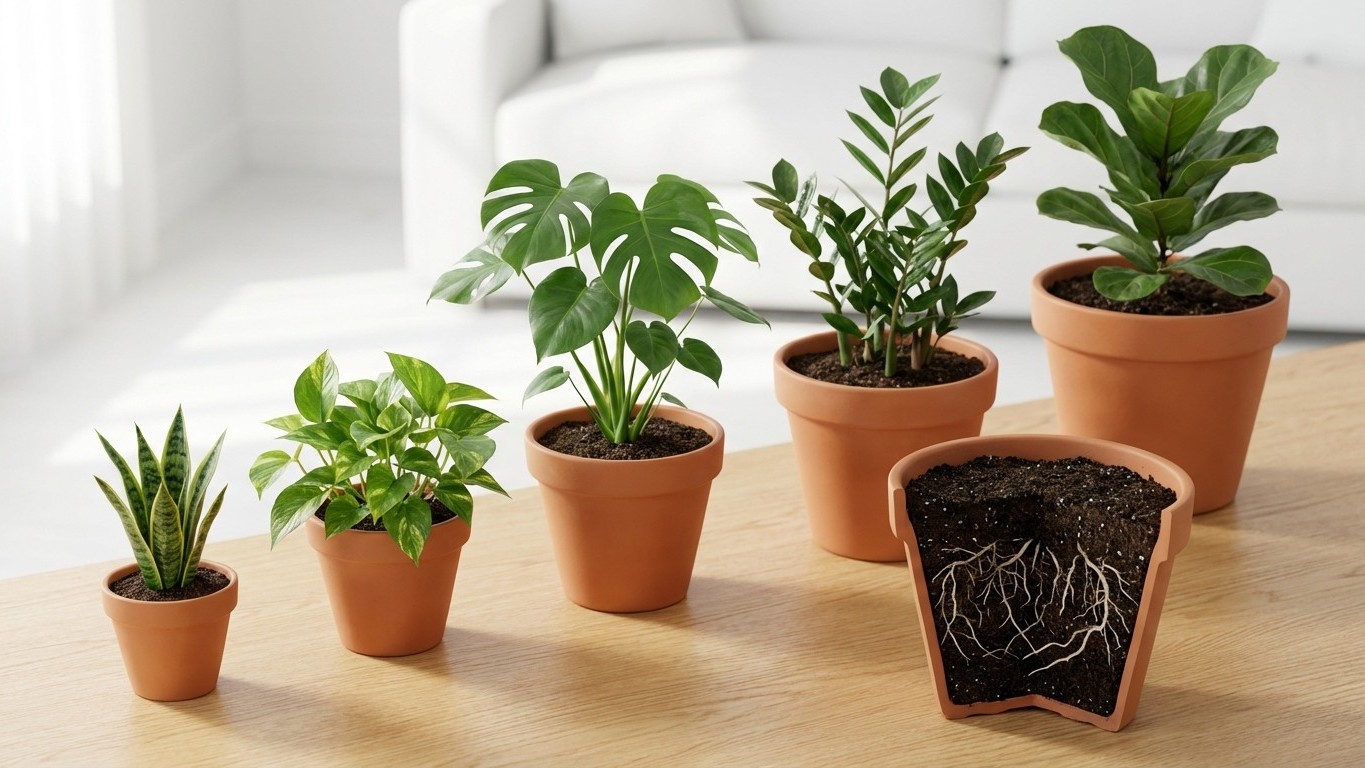
In a study published by the Society for Experimental Biology, scientists documented how a potted plant’s roots will evolve as the plant develops. Using 3-D MRI root scans, they could observe how potted plants extended their roots towards the sides of the pottery — and fairly quickly, too.
The roots are literally sensing the boundaries of their environment. Give them the right amount of room, and they’ll reward you with steady, visible growth.
What Goes Wrong With a Pot That’s Too Big
When you plant a small plant in a pot that’s too big, the potting mix stays wet for a long time. This creates a waterlogged environment that can lead to root rot, similar to overwatering a plant. So even if you water your plant properly, use a pot with a drainage hole, and let the top of the soil dry out before watering again, you could still overwater your plant by picking a pot that is too large.
That last point catches a lot of careful plant owners off guard, you’re doing everything right and the plant is still suffering, simply because of geometry.
Plant roots require oxygen from the air to reach them. When water moves down through the soil, it creates a vacuum behind it which pulls air down into the soil to the roots. If the growing medium stays too wet for too long, the roots don’t get any air in the waterlogged, anaerobic environment, and they drown, die off, turn black and eventually rot away.
Root rot is notoriously difficult to reverse once it starts. Prevention, meaning the right pot size, is always the smarter play.
Another reason to avoid oversized pots: a plant in a large pot spends most of its energy making roots
, rather than producing leaves and flowers. The visual result? Stagnant, uninspiring growth despite seemingly good conditions. Nutrient absorption is also affected:
a big pot needs too much soil, but your plant may not need that much soil. So, if the soil is too much, the plant takes much time to absorb the nutrients. Lack of nutrition can lead to stunted growth in your potted plant.
What Goes Wrong With a Pot That’s Too Small
If you use a pot that is too small, your houseplant’s roots may become root-bound, meaning they will outgrow the pot and become cramped. This can lead to stunted growth and poor absorption of water and nutrients.
A root-bound plant is also far more susceptible to drying out rapidly between waterings, since
when a pot is too small, the soil will dry out quickly, which can cause problems for plants that need consistent moistness.
The Diameter Rule: A Concrete Starting Point
So how do you actually determine the right size? The starting point is almost always the root ball, not the plant’s height, not its canopy, but the mass of roots at its base.
As a general rule of thumb, the pot should be 2-3 inches larger in diameter than the width of the plant’s root ball. For example, if the plant’s root ball measures 6 inches wide, you should choose a pot with a diameter of 8-9 inches.
This margin is the sweet spot: enough room for the roots to expand into fresh soil and new nutrients, without so much excess medium that moisture lingers dangerously long.
When repotting, the general rule is to select a pot that is 2.5-5 cm (1-2 inches) larger in diameter than the current pot for smaller plants, or 5-10 cm (2-4 inches) larger for larger plants.
The scaling matters here. A 4-inch pot graduated to a 6-inch pot is a reasonable jump. A 4-inch pot dropped into a 12-inch pot is a recipe for disaster, no matter how perfect the watering schedule.
A common mistake people often make with container gardening is thinking that plants will grow into larger pots, no matter how small they are. But if you want your plants to grow bigger, or you’ve realized that their current pots are too small, steer clear of jumping to a much bigger pot too quickly. Plants take a while to grow and adapt to new container sizes.
The gradual approach always wins.
Adapting the Rule to Different Plant Types
The 2-3 inch diameter rule works beautifully for most tropical foliage houseplants — pothos, philodendrons, peace lilies, ferns. Fast-growing species like monsteras benefit from being at the upper end of that margin; they fill new soil quickly and reward larger pots with accelerated growth.
There is evidence that doubling a pot size can encourage up to 40% increase in growth in some plants.
Succulents and cacti play by different rules entirely.
Succulents and cacti typically have shallow root systems that spread horizontally rather than deeply. However, these roots still need adequate space to grow and establish a healthy structure.
Many expert gardeners recommend using a pot that is approximately 10% larger in diameter than the plant at its widest point. For example, if your succulent is about 4 inches across at its widest point, you should look for a pot that is about 4.5-5 inches in diameter.
A margin that seems almost comically small, but it dramatically reduces waterlogging risk for species that are extremely sensitive to moisture.
Depth matters too, and it’s often overlooked.
A shallow pot is great for plants that you want to keep small or plants that don’t grow their roots very deep in the soil. These types of pots are great for bonsai trees, succulents, or cacti. A deeper pot is perfect for plants that grow large roots and thirstier plants, like a Monstera or an Alocasia.
Pot Size by Plant Category: A Quick Reference
While every plant is ultimately individual, some broad categories hold up well in practice:
- Succulents and cacti: shallow, snug pots, no more than 1-2 inches wider than the root ball; always choose shallow over deep
- Tropical foliage plants (monstera, pothos, philodendron): 2-3 inches wider than the root ball; deeper pots accommodate their extensive root systems
- Fast-growing plants:
select larger size pots for indoor plants that grow quickly, the upper end of the 2-4 inch margin is appropriate - Large specimen plants (fiddle leaf fig, bird of paradise):
24-inch pots hold 24 gallons of soil and can handle large houseplants with a somewhat extensive root system. A fiddle leaf fig tree will fit a 24-inch pot, provided the pot height is tall enough, since tree roots need room to grow downward. - Orchids:
just a bit wider than their root ball, orchids prefer specialized pots with slits or holes for airflow around the roots
How to Measure Your Plant’s Root Ball (Step by Step)
Forget guessing. Measuring takes about two minutes and eliminates the most common sizing errors.
First, gently tip the plant out of its current pot.
Use a measuring tape or ruler to determine the diameter or width of the pot’s opening.
This measurement gives you the minimum reference point. Then, look at the root ball itself.
One of the easiest ways to tell if a plant needs a bigger or smaller container is to take a look at the roots. If the roots fill the container, leaving little room for potting soil, you probably need a larger pot. The same goes if the roots are growing out of your pot’s drainage holes. But if the roots hardly fill the container and there’s a lot more soil than roots, you need a smaller pot.
Inspect the roots: check for signs of root rot, pests, or overcrowding. Healthy roots are white or light tan and firm.
Brown, mushy roots mean root rot is already present, an immediate flag to both address the rot and reassess the pot size.
Concrete example for a standard repotting scenario: your pothos is currently in an 8-inch pot, and its roots are beginning to circle the bottom.
When repotting from a container that’s ten inches in diameter or less, you’ll often need to boost pot size, diameter-wise, by an inch or two.
So you’d look for a 9-10 inch pot — nothing larger. If you have a larger plant already in a 12-inch pot,
you’ll likely need to repot in ones that are two or three inches greater, diameter-wise.
Should You Always Use a Bigger Pot When Repotting?
Not necessarily. This is one of the most persistent misconceptions in houseplant care.
Initially, repotting doesn’t always mean going up a pot size. Repotting could mean changing out old potting mix that has degraded in nutrients.
If your plant’s roots haven’t filled the current pot, or if they seem small or underdeveloped, you may not need to move to a larger pot. Instead, you can refresh the soil while keeping the same pot. Fresh soil provides new nutrients and improves drainage, both of which can encourage healthy root growth.
Although rare, there are situations where downsizing to a smaller pot is beneficial. This is typically necessary if the plant’s root system has significantly reduced, such as after root rot treatment or pest issues, or if the plant has been over-potted and struggles to absorb water effectively due to excess soil.
Downsizing feels counterintuitive, but it can be exactly what a struggling plant needs.
As a general rhythm: most houseplants need repotting every 1-2 years, moving up one size increment each time. Fast-growers like pothos or tradescantia may need annual sizing up. Slow-growers like snake plants (sansevieria) or ZZ plants might stay in the same pot for three or four years without issue, and may actually perform well slightly root-bound. Knowing when to repot indoor plants is as important as knowing what size to choose.
Does Pot Material Change the Size Equation?
Yes, and this point gets skipped far too often. The material of your pot affects how quickly moisture evaporates from the substrate, which directly influences how much “margin” you can safely give your roots.
Plastic is impermeable and retains a lot of moisture. Terracotta allows moisture to soak through and will help the soil drain more quickly. The biggest factor is how often you want to water your plants and how much moisture your plants need.
Terracotta pots let air and moisture pass through their porous material quite easily, which means that a plant’s roots benefit from a nice flow of oxygen. Like breathing helps us feel better, it’s great for root growth too. When air can flow around the roots, it prevents water from becoming waterlogged in one area.
This means that in a terracotta pot, you can actually afford a slightly larger size margin compared to the same plant in plastic, because the walls help regulate moisture actively.
Plastic and glazed ceramic pots are excellent for tropical plants, which typically like their soil to stay moist. These pots hold in moisture, which allows you to go longer between waterings.
For moisture-loving plants like ferns or calatheas in plastic or ceramic, stick to the conservative end of the diameter rule to avoid overwatering risks.
Glazed clay is a good intermediate between the two types of pots, it doesn’t hold as much moisture as plastic, yet doesn’t dry out as quickly as terracotta.
The practical takeaway: if you love terracotta for a succulent, you have a little more flexibility. If you’re putting a moisture-sensitive plant in a glazed ceramic pot without drainage, size down. Always pair your substrate choice with your pot size decision, which is why choosing the best soil for indoor plants goes hand in hand with sizing your pot correctly.
Common Sizing Mistakes (and How to Avoid Them)
The most frequent error is what professionals call “overpotting” — planting a small plant in a dramatically oversized container because it “looks better” or to avoid frequent repotting.
Overpotting is a term used to describe the negative effects on plant health when a plant is grown in a pot that is way too big for it.
Potted plants in overly large pots risk root rot because the soil around the roots stays wet for too long, causing the roots to decay. It’s best to use a pot that matches the plant’s size to avoid these issues.
The second common mistake is the opposite: keeping a plant in the same small pot for years because repotting feels like a big project.
If the planter is too small for the plant, the plant could become root-bound, and this can lead to slow or stunted growth.
Telltale signs include roots emerging from drainage holes, soil drying out within 24-48 hours of watering, and visible stunted growth despite good light and fertilizing.
A third pitfall is ignoring drainage holes altogether.
Most houseplants do not thrive in standing water, so your pot needs a drainage hole at the bottom that allows water out and air in. If you want to use a pot without drainage holes for decorative purposes, use it as a cachepot, which holds the pot the plant is growing in.
The double-pot approach is genuinely the best of both worlds for decorative setups.
Once you’ve nailed the right size pot, the next step is doing the actual move correctly, which means handling the root ball carefully and using appropriate fresh substrate. A detailed walkthrough is available in our guide on how to repot a houseplant. And if you want to understand the full picture of your plant’s long-term needs in context, the indoor plants care varieties houseplants guide covers everything from light preferences to seasonal dormancy patterns that affect how and when to resize pots.
FAQ: Pot Size Questions Answered Directly
Does pot size affect how often I need to water? Absolutely.
The right-sized pot ensures appropriate water retention and drainage. An oversized pot retains more water, increasing the risk of root rot. Conversely, a small pot diameter may not hold enough moisture, causing the plant to dry out rapidly.
Getting your pot size right is, in many ways, getting your watering schedule right by default.
How do I know if my current pot is too big?
The larger the pot, the more difficult it becomes to monitor how much water your plant actually needs. In smaller pots, it’s easy to tell when a plant needs water because the soil dries out relatively quickly. But in larger containers, moisture tends to linger longer in deeper layers of soil where you can’t see or feel it.
If you’re regularly finding wet soil a week after watering, the pot is likely too large.
Can I fix overpotting without starting over?
If your plant is in a pot that’s too large, repotting in a smaller pot or different potting mix can help prevent overwatering, especially while your plant is recovering.
Acting quickly matters, your best move is to repot right away, or soon after, because inevitably, all the wet soil surrounding the roots will start the process of root rot. And once it starts, it’s really hard to stop, and it takes a long time to get the plant back to health.
Pot size may seem like a peripheral concern compared to watering or lighting, but it’s actually the foundation everything else rests on. Get the diameter right, and you’ll find that many of the puzzling problems in your plant collection quietly resolve themselves. The question worth sitting with: how many of your current pots are actually the wrong size?