
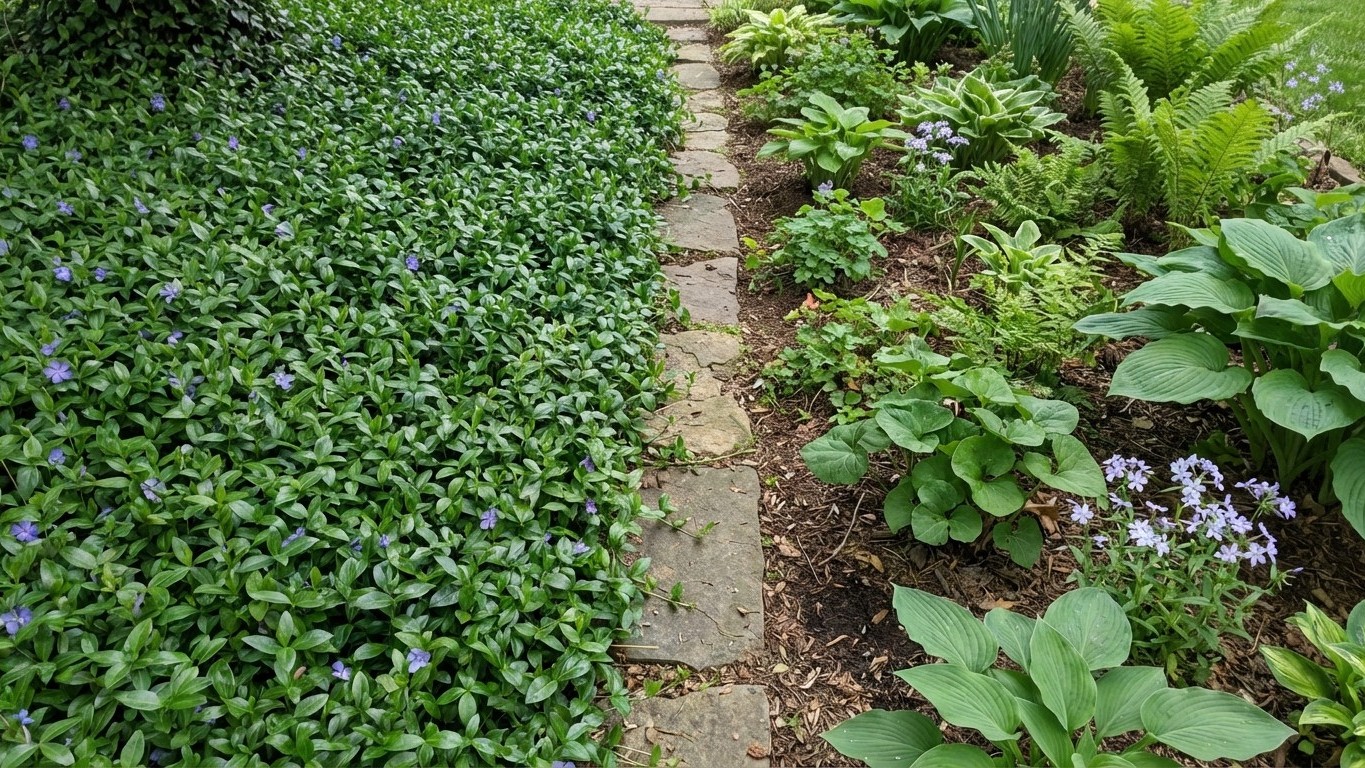
That innocent-looking little ground cover with charming blue flowers seemed like the perfect solution for my shady problem areas. Many years ago when we first moved to our house, I discovered growing here and there a vine with pretty blue flowers. It was periwinkle (Vinca minor), a European native, also called myrtle. I gathered every plant I could find around the yard to fill in a scruffy area in the back. What could go wrong with such a pretty, low-maintenance plant?
Two years later, I discovered exactly what could go wrong. Once established, Vinca minor forms a dense carpet to the exclusion of other plants. This creates a problem where it is competing with native flora. In ideal growth conditions, Vinca minor can spread with great rapidity by means of its arching stolons, which root at the tips. My charming ground cover had transformed into a botanical bully, methodically strangling every other plant in its path.
The Deceptive Appeal of Periwinkle
Periwinkle’s popularity isn’t accidental. The reasons for their invasive tendencies are the same reasons for their popularity. They’re attractive, easy to grow, and form a mat that excludes other plants, providing that green, uniform look characteristic of the turf grass they’re replacing. Garden centers continue selling it because it checks all the boxes homeowners want: shade tolerance, evergreen foliage, and virtually no maintenance requirements.
Its rapid growth rate and ability to root at the nodes enables periwinkle to form a dense mat over a wide area and become weedy and high maintenance in a short order. That “rapid growth” that initially seemed like a blessing quickly revealed itself as a curse. Within two growing seasons, my carefully planned shade garden had become a monoculture of glossy green leaves punctuated only by those deceptively innocent purple-blue flowers.
The transformation happens gradually enough that many gardeners don’t notice until it’s too late. I thought I was watching it all these years until one day I finally realized how much it was damaging my star jasmine. It’s sneaky! One day you’re admiring your attractive ground cover, and the next you’re watching it systematically eliminate your hostas, ferns, and other shade-loving perennials.
Why Periwinkle Becomes a Garden Nightmare
Understanding how periwinkle conquers territory reveals why it’s so problematic. Invasive ground covers often possess traits that give them a competitive edge—rhizomes, stolons, or aggressive root systems that allow them to spread rapidly above and below ground. These traits might sound efficient, but they don’t come with an off switch. Once established, these plants can blanket entire areas, ignoring your garden’s borders and muscling out neighboring plants.
The plant’s persistence is legendary among frustrated gardeners. Once established, it is difficult to eradicate, as its waxy leaves shed most water-based herbicide sprays. Even worse, The roots can grow up to 6 inches deep, and any small piece of the plant left behind can regrow and spread. This means that removing vinca from an area can be a time-consuming and challenging process.
What makes periwinkle particularly insidious is its ability to adapt to various conditions while maintaining its aggressive nature. Dry or cold weather may temporarily set growth back, but it quickly resprouts and regains lost ground coverage. It grows most vigorously in moist soil with only partial sun, but it can grow in the deepest shade and even in poor soil. This adaptability means there’s virtually nowhere in your garden where it won’t eventually establish itself if given the chance.
The Ecological Impact Beyond Your Garden
My personal garden nightmare pales in comparison to periwinkle’s broader environmental impact. One of the biggest dangers of vinca is its ability to displace native plant species. As it spreads, it crowds out other Plants and reduces biodiversity in the ecosystem. The Invasive Plant Atlas says it’s “invading natural areas throughout the Eastern U.S. It inhabits open to shady sites including forests and often escapes from old homesites.” The State of Indiana says: “Once established, Vinca minor forms a dense carpet to the exclusion of other plants. This creates a problem where it is competing with native flora.”
The plant doesn’t respect property boundaries. Vine stem canker (blight) can damage or kill large patches and periwinkle can spread aggressively into adjacent lawns, gardens and natural areas. It is classified as an invasive species by the NC Invasive Plant Council. What starts as a contained ground cover solution in your yard can eventually contribute to the degradation of local forest understories and woodland ecosystems.
Breaking Free: Removal and Better Alternatives
If you’re dealing with a periwinkle invasion, be prepared for a long-term commitment to removal. It can take years to completely remove vinca from your property, so it’s important to be patient and persistent. While digging and pulling up vinca by hand may be time-consuming, it is a non-toxic removal method that is highly effective. The key is persistence—any fragment left behind will regenerate into a new colony.
For those seeking better ground cover alternatives, native plants offer similar benefits without the invasive behavior. An attractive native alternative is bearberry (Arctostaphylos uva-ursi), which is hardy in zones 2-6 and is a slow-growing evergreen shrub with attractive red stems and glossy dark green leaves that turn red or purple in winter. The flowers are lantern-shaped in pink and white and will attract butterflies and hummingbirds. They are followed in the fall by red edible berries that will bring winter birds flocking.
My experience with periwinkle taught me that sometimes the most appealing garden solutions come with hidden costs. While that carpet of glossy green leaves might look perfect for the first year or two, the long-term consequences far outweigh any short-term benefits. Today, I’m much more selective about ground covers, prioritizing native alternatives that enhance rather than dominate my garden ecosystem. The lesson learned: in gardening, as in life, if something seems too good to be true, it probably is.