
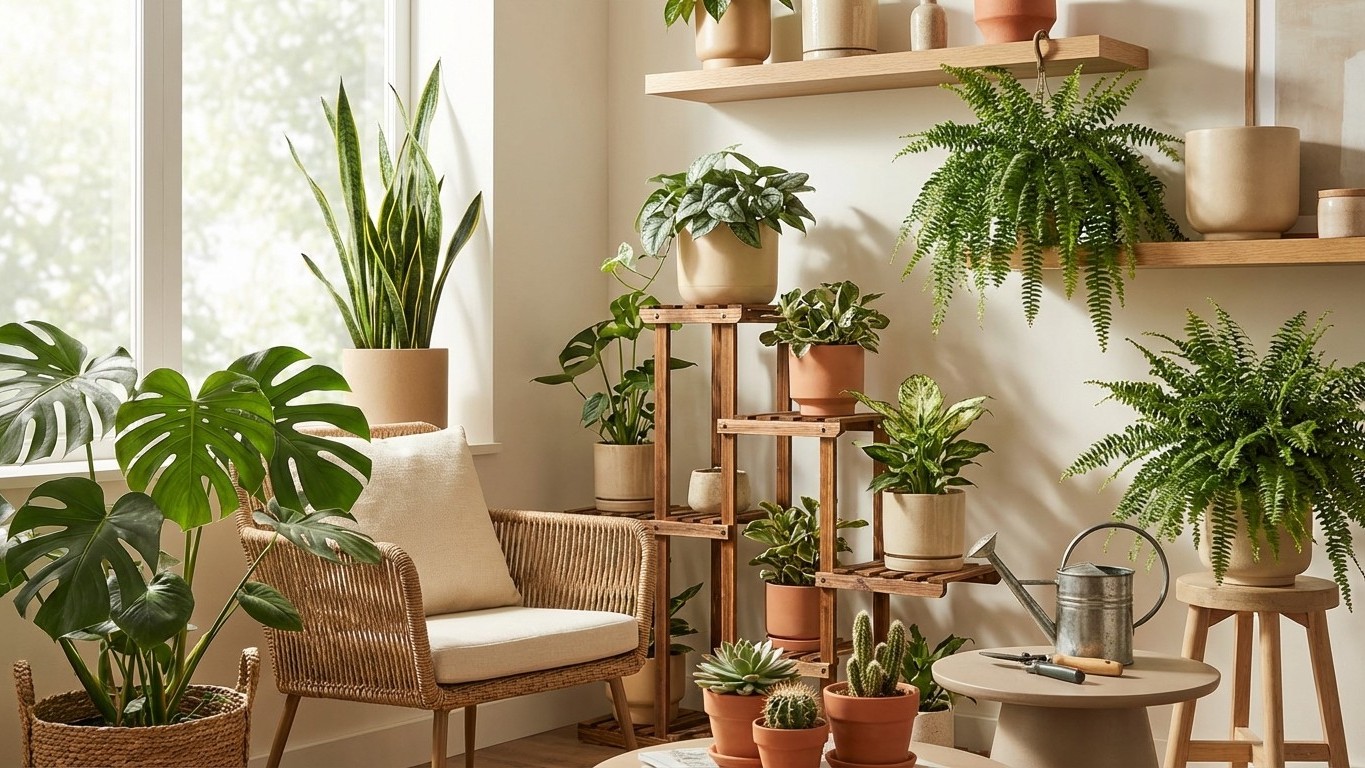
Every U.S. home holds an average of two or three houseplants. Yet roughly 30% of those plants die within the first year, not from neglect, exactly, but from a simple mismatch between what the plant needs and what the owner knows. That gap closes the moment you understand a few fundamentals: which variety fits your space, how light and water actually work together, and when to intervene before a wilting leaf turns into a dead root. This guide covers all of it, from first plant to thriving indoor jungle.
What Is a Houseplant, and Why It Matters to Draw the Line
A houseplant is any plant cultivated primarily indoors, in pots or containers, under conditions that substitute for its natural habitat.
Houseplants will perform best when grown in conditions that closely mimic their native habitat, which is why understanding where a plant comes from changes everything about how you care for it. This becomes especially important when considering seasonal variations, such as implementing proper winter care for indoor plants.
Not all “indoor plants” belong in the same category. Tropicals like Monstera deliciosa or peace lilies originate in humid rainforests. Succulents and cacti evolved in arid environments with long dry spells and intense sun.
Plants naturally filter the air through photosynthesis and transpiration, removing pollutants like formaldehyde, benzene, and trichloroethylene, but the mechanism, intensity, and even the soil they need differ dramatically between a snake plant from the African savanna and a Boston fern from a temperate woodland. This is why choosing the best soil for indoor plants specific to each variety is essential. Understanding these differences between houseplant varieties is crucial, as lumping them all together is the first mistake most plant owners make.
Then there’s the question of can you grow any plant indoors. Short answer: no. Most fruit trees, outdoor ornamentals, and large landscape plants require full sun, wind pollination, or seasonal temperature swings that simply cannot be replicated inside a typical American home. Stick to species that have been selected for indoor adaptability, the list is still vast and genuinely exciting.
The Real Benefits of Having Plants at Home (What Science Actually Says)
Air Quality: Promising, but Nuanced
NASA studied about a dozen popular varieties of ornamental plants to determine their effectiveness in removing several key pollutants associated with indoor air pollution
. The findings were positive in controlled settings.
Some of the toxins researchers found that plants remove from the air are formaldehyde, benzene, acetone, ammonia, trichloroethylene, and carbon monoxide
. Real encouragement, especially given that
people spend more than 90% of their time indoors, and indoor air pollutants can reach levels two to five times higher than outdoor pollutants, as noted by the Environmental Protection Agency
.
A word of honest calibration here:
while studies indicate that houseplants can improve air quality, many common houseplant problems can reduce their effectiveness, and houseplants do absorb common household pollutants, the effects of plant purification are probably overestimated, because the studies were conducted in laboratory settings instead of measuring the air purifying effects of houseplants in home or office spaces
. The upshot?
Healthy plants will do a better job purifying the air than those struggling to survive
. Fewer, healthier plants beat a shelf of stressed, yellowing specimens every time. And
NASA recommends one healthy plant in a 6 to 8-inch container for every 100 square feet of living space
.
Psychological Wellbeing: Where the Evidence Gets Genuinely Strong
This is where the data leans more convincingly.
A 2022 meta-analysis on the effects of indoor plants on human health, which looked at studies in both English and Chinese over a 50-year time frame, concluded that indoor plants have a positive effect on participants’ functions.
Houseplants have a calming effect and were shown to enhance cognitive functions.
Indoor plants most significantly impacted occupants’ self-reported perceptions by increasing positive emotions and reducing negative feelings, as well as reducing physical discomfort.
A 2024 editorial in Frontiers in Psychology confirms:
indoor plants positively affected occupants’ objective functions, by promoting relaxed physiology and enhanced cognition.
If you’ve ever noticed your shoulders drop when you water a plant in a quiet morning, that’s not imagination, it’s a documented neurological response to biophilic stimuli.
The act of caring itself is part of the benefit.
Having spent more hours in the last week, owning greater numbers of houseplants, and spending longer years of keeping houseplants are statistically significant and correlated with greater levels of nature relatedness, mental wellbeing, and trait mindfulness.
The Major Families of Houseplants: A Practical Taxonomy
Easy Plants for Beginners
The most important piece of advice for new plant owners is one that gets ignored constantly: match the plant to your lifestyle, not the other way around.
The easiest plant to care for is the one that fits your home’s environment and lifestyle. Instead of trying to adapt to a specific plant’s requirements, choose one that will fit your needs.
Pothos, also called Devil’s ivy, is one of the easiest and most forgiving houseplants you can grow.
Pothos stands out as the ultimate beginner-friendly houseplant, featuring distinctive heart-shaped leaves in green, golden, or cream variegations. This fast-growing trailing vine is virtually indestructible and adapts to almost any indoor environment, making it perfect for new plant parents.
The snake plant earns its reputation too:
since they’re used to receiving little water in their native dry desert habitats, Snake Plants make ideal starter plants due to their “pot it and forget it” style of care.
The ZZ plant is another standout:
the ZZ Plant grows wild in the dry soils of East Africa. Its desert pedigree makes it an incredibly durable and hardy houseplant for beginners. Although the ZZ Plant is a bit of a slow and steady grower, it can thrive in almost any condition.
For those who want flowers without fuss,
the peace lily is a top choice among indoor flowering plants that bloom all year. Its elegant, sail-shaped white flowers and glossy foliage make it a standout addition to any room, while also serving as a natural air purifier that helps neutralize toxins. This low-maintenance plant is perfect for busy individuals. It thrives with minimal care and even signals when it needs water by drooping.
Decorative Foliage and Flowering Varieties
Rubber plants, Monsteras, philodendrons, and fiddle-leaf figs anchor the decorative category.
Despite their impressive size potential, Rubber Plants are remarkably adaptable and forgiving. Their substantial presence provides immediate visual impact while being easier to care for than many smaller houseplants.
Monstera deliciosa, with its iconic split leaves, has become a design staple — and deserves its reputation for ease.
Resilient potted plants like the ZZ Plant or Swiss Cheese Monstera are known for their ability to withstand occasional neglect.
Pet-Safe Varieties: Non-Negotiable if You Have Animals
This category trips up a surprising number of people. Many of the most popular houseplants, pothos, snake plant, philodendron, fiddle-leaf fig, are toxic to cats and dogs.
Popular houseplants that are also pet-safe include spider plants, money plants, and Boston ferns.
The ASPCA maintains a complete database:
the spider plant, also known as the airplane plant, spider ivy, and ribbon plant, is a popular houseplant that’s both pet-safe and great for hanging up high so animals aren’t as tempted by it. Spider plants are great for new plant parents because they are low maintenance, propagate easily, and are non-toxic to both cats and dogs.
Parlor palms are another excellent option.
The ASPCA classifies the Parlor Palm as a pet-friendly plant (non-toxic to dogs and cats).
African violets too:
African violets are non-toxic to both cats and dogs, making them a safe and pet-friendly option for indoor plant enthusiasts. These plants are known for their vibrant blooms in shades of purple, pink, and white, adding a pop of color to any space.
The rule of thumb:
when in doubt, it’s always a good idea to search the ASPCA database to find the right plant for you and your pets to enjoy safely.
One thing to keep in mind even with non-toxic plants:
be cautious of fertilizers and plant food, as they can absolutely be harmful to pets if ingested.
Plants for Small Spaces
Urban apartments, studios, micro-units, demand compact growers.
Haworthia is the smallest on many lists. If you’re looking for a plant that stays small and can be tucked in almost anywhere, this is it.
Succulents in general are ideal:
succulents are the ideal plants for beginners and the easiest to care for — they can go with infrequent watering and can handle some neglect.
Hanging pothos or trailing string-of-pearls allow vertical space to work for you rather than against you, turning a 400-square-foot apartment into a genuinely lush environment.
How to Choose Your Plants: A Decision Framework
Start with light. It’s the single variable that most overrides everything else.
The quickest way to set yourself up for plant success is to choose a plant whose light needs match the spot you’ll keep it in. A sun-lover will never be happy in a dark corner, no matter how much you water or fuss over it.
North-facing rooms stay dim all day. South-facing windows offer the most intense light. East means gentle morning sun; west means hotter afternoon exposure.
Next, assess your actual schedule.
Selecting the perfect easy plants involves thoughtful consideration, aligning the lush greenery with your lifestyle, commuting routines, and even travel plans.
If you travel for work, succulents and ZZ plants are your allies. If you’re home daily and enjoy rituals, calatheas, ferns, and anthuriums reward consistent attention. There’s no wrong choice, only mismatches.
Then factor in occupants. Kids and pets change the equation entirely.
For households with pets or young children, verifying that any plants introduced are non-toxic and safe in case of accidental ingestion is essential.
Allergies matter too:
some plants and flowers can release pollen, spores, or fragrances that can cause allergic reactions. Certain plants including ferns, weeping figs, yuccas, and orchids may make allergies worse. Generally, plants with big leaves and no flowers are better options.
For a deep dive into matching varieties to your exact conditions, the dedicated guide on houseplant varieties covers light, space, experience level, and pet safety in exhaustive detail.
The Complete Indoor Plant Care Guide
Light: What “Bright Indirect” Actually Means in Your Home
Most indoor plants do best in bright indirect light, considered medium or moderate exposure.
In practice, this means a few feet from a south or west window, where the sun hits the wall but not the leaves directly.
Light levels vary with the seasons, so you might have to move your plants closer to a light source in the cooler, darker winter months.
A plant that thrived by a summer window may start struggling by November, that’s not failure, it’s physics.
Too much light and your plant burns. Too little and it wilts.
The farther your plant is from a window, the less light it receives.
Even a “low light” plant needs to be in a room with at least one window. True darkness, a windowless bathroom or interior hallway, is not low light, it’s no light, and virtually nothing thrives there long-term.
Watering: The Finger Test and Everything Else
Overwatering plants is one of the top ways plants die, especially in the care of new plant parents.
The core concept:
often people will think overwatering refers to the amount of water you give in one session, but that’s not the case. Overwatering refers to the frequency with which you water a plant.
The gold-standard test:
the simplest way to gauge your plant’s watering needs is by feeling the soil. The old trick of sticking your finger into the soil up to the knuckle has merit. If it’s soggy or has standing water, you’re overwatering. If it’s dry an inch below the surface, it’s time to water.
Some plants, like peace lilies, telegraph their needs dramatically.
Some plants droop slightly before needing water, making it easy to time watering perfectly. Others, like the Peace Lily, are quite dramatic about their water needs and will droop the second they require attention.
Seasonal adjustment is non-negotiable.
Plants typically need more water during the growing season (spring and summer) and less during the dormant season (fall and winter). This includes houseplants, too.
During winter, plants don’t need as much water because they’re naturally slowing their growth rate.
Watering a dormant snake plant every week in January is a fast track to root rot.
Drainage matters as much as frequency.
Always purchase a pot with drainage holes. One of the main reasons a plant becomes overwatered is because the pot does not have the proper drainage. A hole in the bottom of your plant pot allows the soil to be thoroughly watered and any excess water to seep out.
For comprehensive guidance on soil types, drainage, and pot selection, the guide on best soil for indoor plants is the definitive resource.
Humidity and Temperature
Plants can increase humidity in a dry environment, which can be beneficial for respiratory health.
The flip side: dry indoor air, especially during winter when heating systems run constantly, stresses tropical plants that expect 50–70% relative humidity.
Lots of houseplants are native to humid, jungle conditions and appreciate a little moisture in the air. Grouping plants together adds humidity, as do trays of pebbles and water (be sure the plants are not sitting in the water), and humidifiers.
Temperature swings are a lesser-known threat. Most houseplants prefer consistent warmth between 60°F and 85°F. Cold drafts from windows in winter, or air conditioning vents in summer blasting directly on leaves, cause stress that shows up days later as yellowing or leaf drop. Avoid placing plants directly next to exterior doors, radiators, or AC units.
Fertilizing: Less is More
Houseplants are not heavy feeders and do not require a lot of fertilizer for maintenance. However, they are grown in artificial potting mixes that have almost no nutrients. So if you expect to see them continue to grow, they must receive occasional fertilization.
A balanced liquid fertilizer diluted to half strength, applied once a month from March through September, covers most tropicals adequately. In winter: nothing.
Poor growth can be caused by a number of factors, low light, wrong temperature, wrong watering regime, and adding extra fertilizer in an attempt to force the plant to grow will be completely ineffective if the cause of poor growth is not a lack of nutrition.
A complete routine covering light, water, humidity, and seasonal adjustments is laid out in detail in the guide on indoor plant care.
Common Problems: Diagnosis Before Treatment
Yellow leaves. The universal alarm bell that sends plant owners to the internet.
One of the most common signs of overwatering is leaves turning yellow. While older leaves will naturally yellow as they age, widespread yellowing, especially in younger leaves, indicates excess water.
But it’s not always overwatering. Under-light, root-bound conditions, and nutrient deficiency produce similar symptoms.
In either of these situations, overwatering or underwatering, one of the first signs is often droopy, wilting leaves, so it’s critical to always check the soil moisture before adding more water.
The fastest diagnostic: touch the soil. Soggy, dark, and smelling earthy-sour? Overwatered. Bone dry, pulling away from the pot edges? Underwatered.
If a plant is overwatered, it will likely develop yellow or brown limp, droopy leaves as opposed to dry, crispy leaves (which are a sign of too little water).
Pests are the other major issue.
Newly purchased houseplants or plants that have been outside can sometimes have pests like aphids, spider mites, and mealybugs.
Fungus gnats are typically a sign of waterlogged soil:
fungus gnats are usually one of the first signs of overwatering. They stay close to the soil and lay eggs inside organic matter. They feast on plant roots and any decaying materials, and need soil moisture to thrive in their larvae stage.
First response:
use non-chemical control options first, handpick pests, remove the infested part of the plant and spray pests off with water. If those don’t work, use low-chemical options like insecticidal soaps and oils or botanical insecticides like neem oil.
For a full diagnostic guide, leaf yellowing, fungal issues, pest identification, and treatment protocols — the dedicated resource on houseplant problems walks through every scenario with solutions.
Advanced Care: Repotting, Propagation, and Seasonal Routines
Repotting: Timing and Technique
The best time to repot a plant is in the spring when it naturally and actively begins its seasonal growth. The roots will grow into the new potting mix, and the plant will produce new foliage.
Signs it’s time:
for most tropical houseplants, it’s time to repot when roots begin peeking out of the drain holes at the bottom of the container. Or you may notice that when you water, most of the water pours out of the drain holes immediately without stopping to soak in. Both clues indicate that the plant’s roots have filled the pot and have nowhere else to grow.
Repot every 2-3 years, to give your plant’s roots more space and fresh soil, and only size up to a pot about one or two inches bigger.
Jumping to a much larger pot is a trap:
oversized pots can lead to soil mass that stays wet for too long, and eventually that could lead to root rot.
Using garden soil in indoor containers could lead to disease and pest problems. Instead, choose a good-quality soilless potting mix created specifically for potted plants.
Seasonal Care and Propagation
Winter is when most plant losses occur. Shorter days mean less light, cooler temperatures near windows, and drier air from heating. The strategy: reduce watering frequency, move plants closer to windows, skip fertilizer, and hold off on repotting or pruning until spring.
You can easily overwater a houseplant in the cooler, darker months.
Propagation, growing new plants from cuttings, is one of the most satisfying skills to develop. Pothos are the ideal starting point:
many growers successfully propagate cuttings in just water, making it an excellent plant for learning propagation techniques.
Spider plants self-propagate by producing “spiderettes” that hang on long runners and can be potted independently. Even beginner-level success with propagation deepens your understanding of plant biology in a way no guide fully can.
For detailed seasonal routines including winter dormancy care, pruning schedules, and step-by-step propagation methods, the guide on winter care for indoor plants covers the full year cycle.
10 Popular Houseplants: Quick-Reference Cards
Here’s a focused overview of ten houseplants that consistently perform well across different U.S. home environments:
- Pothos (Epipremnum aureum) — Beginner-proof. Tolerates low light and irregular watering. Trails beautifully from shelves. Toxic to pets.
- Snake Plant (Sansevieria) —
Snake Plants are an excellent choice for busy individuals or people who travel, as they love to be ignored.
Toxic to cats and dogs. - ZZ Plant (Zamioculcas zamiifolia) — Drought-tolerant.
ZZ plant is drought-tolerant and accepts low-light conditions without fuss.
Toxic to pets if ingested. - Spider Plant (Chlorophytum comosum) —
Spider plants are great for new plant parents because they are low maintenance, propagate easily, and are non-toxic to both cats and dogs. - Peace Lily (Spathiphyllum) — Air-purifying, blooms indoors, droops dramatically when thirsty (an easy watering cue). Toxic to pets.
- Monstera deliciosa — Statement foliage. Needs bright indirect light. Fast grower. Toxic to pets.
- Rubber Plant (Ficus elastica) —
Can reach up to 10 feet tall indoors but responds well to pruning. The upright growth habit makes it perfect for filling vertical spaces and empty corners. - Parlor Palm (Chamaedorea elegans) —
The ASPCA classifies the Parlor Palm as a pet-friendly plant. These elegant plants are slow-growing and can handle lower light conditions, making them perfect for tricky spots in the home. - African Violet (Streptocarpus ionanthus) —
African violets are the ideal marriage of a green houseplant and a bouquet of flowers.
Pet-safe. Compact size suits windowsills perfectly. - Aloe Vera — Drought-tolerant succulent. Practical (gel soothes burns). Thrives in sunny windows. Toxic to cats and dogs.
FAQ: Answering the Questions Everyone Searches
What are the best easy-care indoor plants?
The Pothos or Snake Plant are the best plants to start with. They are widely available, inexpensive, and incredibly forgiving of beginner mistakes like under- or over-watering.
ZZ plants, spider plants, and succulents round out the top tier.
How do I know if my plant needs water or light? Soil moisture tells you about water:
it’s important to test the soil moisture before watering to ensure that the plant truly needs water. Consider how much of the soil volume has dried out, not just the top surface.
For light: a plant reaching or leaning toward its light source, producing small pale leaves, or showing etiolated (stretched-out) stems is telling you it wants more. Move it before the problem compounds.
Which houseplants are safe for homes with cats and dogs? Spider plants, Boston ferns, parlor palms, money trees, haworthia succulents, African violets, and prayer plants all clear the ASPCA’s non-toxic list.
Even if a plant is pet-friendly, insecticides used to keep it pest-free may still be toxic.
What’s the right care routine for most houseplants? A practical baseline: check soil moisture weekly (not a calendar schedule), water deeply when dry, ensure drainage, fertilize monthly in spring and summer, move plants closer to windows in fall, and reduce watering in winter.
Simple practices such as mindful watering, observing growth and development, and taking moments to appreciate the beauty of nature can foster a deeper connection with plants and promote a sense of wellbeing.
Can I grow any plant indoors?
Houseplants will perform best when grown in conditions that closely mimic their native habitat. Some varieties are more forgiving than others, making them more suitable for beginners.
Plants that require cold dormancy, outdoor pollination, or high humidity exceed what most homes offer. Stick with species specifically selected for indoor cultivation and you have hundreds of options.
Your Green Home Starts Here
The jump from one nervous succulent to a genuinely lush indoor environment is shorter than most people think. It comes down to matching the right plant to the right spot, learning to read what the leaves and soil are telling you, and building a care rhythm that fits your actual life rather than an idealized one. The resources within this guide cover every layer: from the indoor plant care fundamentals and the deep-dive houseplant varieties selector, to troubleshooting with the houseplant problems diagnostic and the long-game approach in the winter care for indoor plants guide.
Pick one plant this week. Put it somewhere you’ll see it every day. The habit forms faster than you’d expect, and somewhere around the third new leaf, a plant stops feeling like a task and starts feeling like a small, living part of your home.