
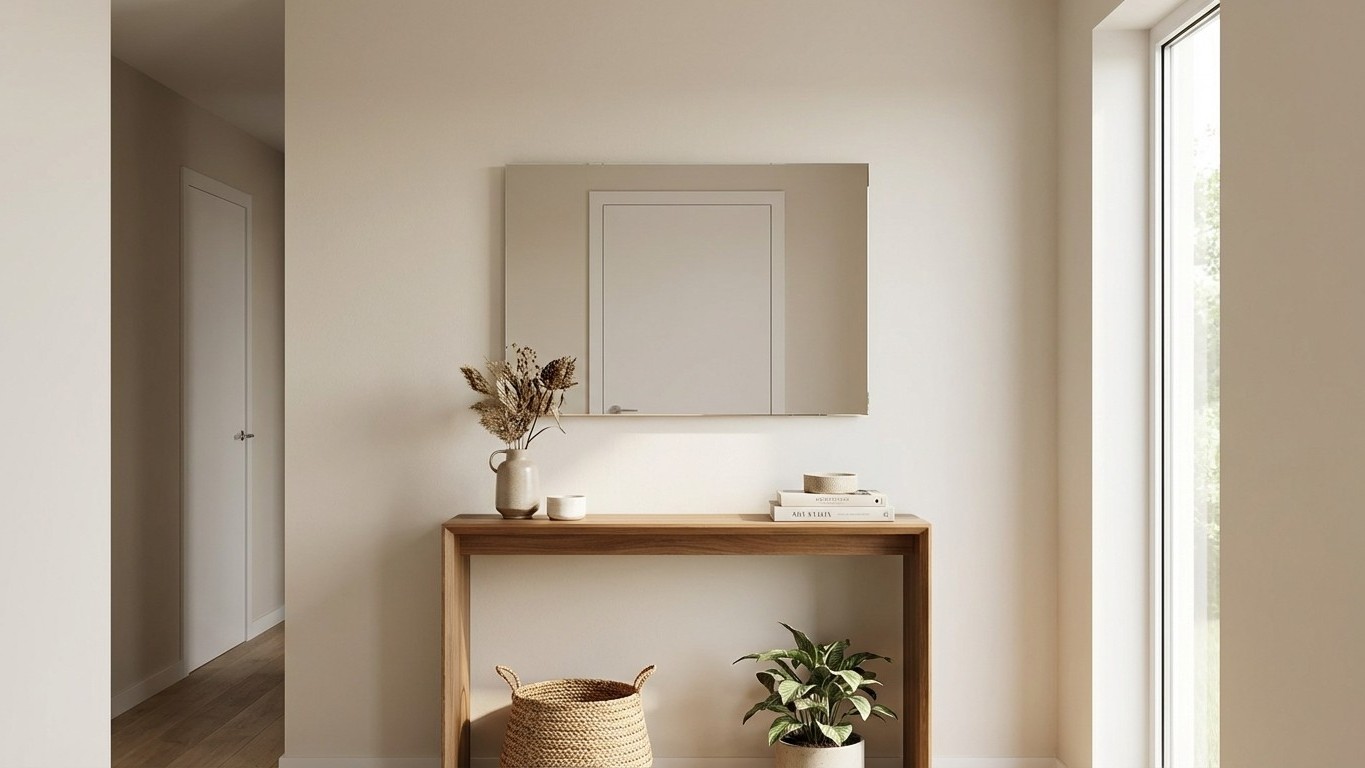
Standing in my cramped entryway, staring at yet another mirror that looked oddly out of place, I finally admitted defeat. Despite trying three different sizes and styles, nothing seemed right. The small circular mirror disappeared against the wall, while the oversized rectangular one dominated the narrow space like an awkward giant. It wasn’t until an interior designer friend visited and casually mentioned a simple ratio rule that everything clicked into place.
The Two-Thirds Rule That Changes Everything
The revelation was surprisingly straightforward: your entryway mirror should occupy approximately two-thirds the width of the furniture piece below it, or two-thirds the width of the wall section if hung alone. This isn’t just an arbitrary number pulled from thin air – it’s based on fundamental principles of visual balance that professional designers have relied on for decades.
When a mirror is too small, it creates an awkward floating effect that makes both the mirror and the surrounding space feel disconnected. Conversely, an oversized mirror can overwhelm the area and make your entryway feel cramped rather than expanded. The two-thirds ratio strikes that perfect middle ground where the mirror feels intentional and harmonious with its surroundings.
This principle works whether you’re placing a mirror above a console table, a bench, or mounting it directly on the wall. For a standard 36-inch console table, you’d want a mirror roughly 24 inches wide. If you’re working with a 48-inch wall section in a narrow hallway, a 32-inch mirror would create that ideal proportional relationship.
Beyond Width: Height and Placement Considerations
While the two-thirds width rule forms the foundation, proper mirror placement involves additional considerations that can make or break the overall effect. Height placement is equally crucial – the center of your mirror should typically sit at eye level, approximately 57 to 65 inches from the floor, depending on your household’s average height.
The relationship between mirror height and ceiling height also matters significantly. In spaces with standard 8-foot ceilings, leaving 6 to 12 inches between the top of the mirror and the ceiling prevents the space from feeling cramped. Higher ceilings offer more flexibility, but maintaining some breathing room above the mirror keeps the proportions feeling natural rather than stretched.
For entryways with architectural features like wainscoting or chair rails, these elements create natural reference points for mirror placement. Aligning the bottom edge of your mirror with the top of wainscoting, or ensuring it doesn’t awkwardly intersect with a chair rail, creates a more cohesive and professionally designed appearance.
Working with Challenging Spaces
Not every entryway fits neat proportional rules, and that’s where creative adaptation becomes essential. Narrow hallways might benefit from vertical mirrors that draw the eye upward, creating an illusion of height even if they don’t follow the traditional width ratios. In these cases, maintaining the two-thirds rule in relation to available wall space, rather than furniture, becomes the guiding principle.
Unusually wide entryways present their own challenges. A single mirror following the two-thirds rule might look lost on an expansive wall. Here, designers often recommend either grouping multiple smaller mirrors that collectively achieve the desired proportional relationship, or selecting a mirror with substantial visual weight through frame design or interesting shapes.
Corner entryways require special consideration since the mirror needs to work with the angular space rather than against it. Positioning the mirror on the wall that faces the main traffic flow ensures it serves its functional purpose while maintaining visual balance within the triangular space constraints.
Making the Rule Work for Your Style
The beauty of the two-thirds ratio lies in its versatility across different design styles and mirror types. Whether you prefer minimalist frameless mirrors, ornate vintage pieces, or contemporary geometric shapes, the proportional principle remains constant while allowing personal style to shine through.
Round mirrors require slight adjustment to the rule – focus on the diameter creating that two-thirds relationship rather than trying to match rectangular proportions exactly. The circular shape naturally softens the mathematical precision while still maintaining visual balance.
For those working with existing mirrors that don’t quite fit the ratio, creative solutions can save the day. Adding visual weight through lighting, artwork, or architectural details can help rebalance proportions without requiring a new mirror purchase.
Understanding this simple ratio transformed my approach to entryway design entirely. What once felt like guesswork now follows a clear, logical framework that consistently produces pleasing results. The mirror I ultimately chose – a 30-inch piece for my 45-inch console – finally made my entryway feel complete and intentionally designed rather than accidentally assembled. Sometimes the most profound design improvements come from the simplest rules, and this two-thirds principle proves that professional-looking results are accessible to anyone willing to measure twice and hang once.