
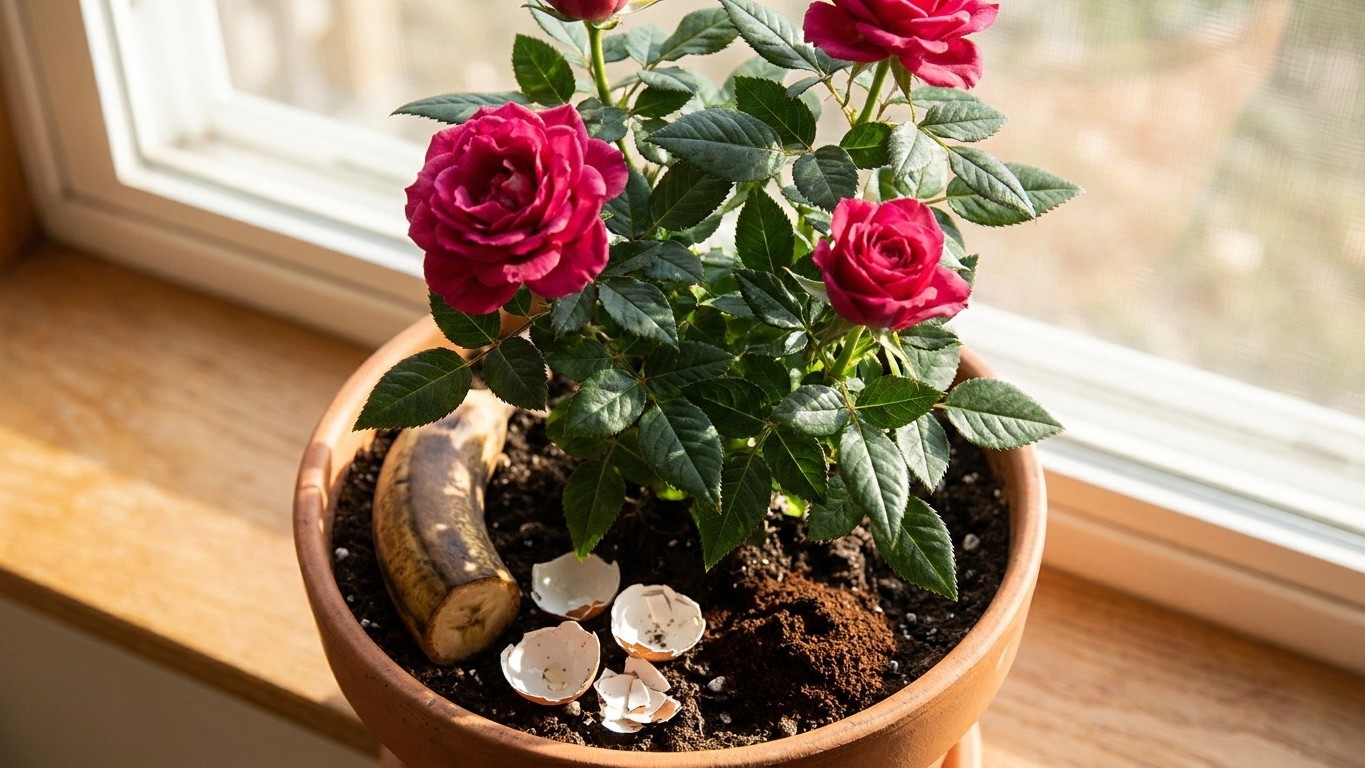
Every week, the banana peel goes straight into the trash. So do the eggshells, the coffee grounds, the mushroom stems. For years, most indoor rose growers do exactly that, never realizing those scraps contain a near-perfect cocktail of what roses crave most during their spring bloom push. Bury them in May, a few inches from the roots of your potted roses, and the chemistry underground shifts in ways a bottle of synthetic Fertilizer simply cannot replicate.
Key takeaways
- A common kitchen scrap contains the exact nutrient formula roses crave most during spring bloom season
- Burying organic matter in May triggers underground chemistry that synthetic fertilizers simply cannot replicate
- The real power isn’t just nutrients—it’s feeding the living microbial community that works on your plant’s behalf 24/7
The Scrap That Changes Everything Underground
The item most rose growers throw away without a second thought? The banana peel. Banana peels are potassium-rich and contain calcium and phosphorus, a trio that maps almost exactly onto what a rose needs to build flower buds. The banana peel adds phosphorus and potassium to the soil, with potassium specifically responsible for the formation of new flower buds. For indoor roses hitting their May growing window, that’s not a small thing. It’s the difference between a plant that leafs out and one that actually blooms.
But the nutrient payload alone doesn’t explain the full effect. When organic matter decomposes in the soil around your roses, it does something far more interesting: it feeds the microbial community that already lives there. Plant roots aid the growth and functions of several kinds of microorganisms, including plant growth-promoting rhizobacteria, mycorrhizal fungi, and endophytic bacteria — in a distinct zone known as the rhizosphere. Add a decomposing banana peel, and you’re not just dumping nutrients into the pot. You’re fueling a living ecosystem that works on the plant’s behalf around the clock.
Mushroom scraps take this even further. As they decompose, mushroom scraps encourage beneficial fungal growth that forms symbiotic relationships with rose roots, a mycorrhizal network that helps plants access nutrients and water more efficiently. This is the part nobody talks about in the fertilizer aisle. A bag of 10-10-10 can feed your plant. Only organic matter can feed the community of organisms that makes feeding possible in the first place.
Why May Is the Right Moment
We can start feeding roses in mid-spring, once they’ve started to leaf out and have about 8-10 inches of new growth. That’s May for most indoor growers in the US. Roses are actively pulling resources from the soil at this point, root activity is high, and the soil temperature in a pot near a window is warm enough for microbial decomposition to actually happen at pace. Bury scraps in January and they’ll just sit there, slowly freezing the biology around them. May is when the timing clicks.
Each nutrient has a purpose: nitrogen helps the plant create new growth, phosphorus supports root growth, and potassium keeps the entire rose healthy when stressed by heat, drought, or insect and disease attacks. A mixed burial of kitchen scraps can address all three at once. Coffee grounds supply nitrogen. Banana peels handle potassium and phosphorus. Eggshells, crushed fine, deliver calcium. Calcium helps strengthen the cell walls of your plants, making them more resilient. That’s essentially a complete slow-release fertilizer assembled from breakfast.
The slow-release aspect matters a lot for container roses. Because nutrients leach out more quickly due to more frequent watering, container roses may need fertilizing more often than those planted in the ground. Buried organic scraps don’t leach, they decompose in place, feeding the roots steadily over weeks rather than delivering a single flush that washes away at the next watering.
How to Actually Do It (Without Attracting Pests)
Preparation is the step most people skip, and it’s the one that determines whether this works or creates a mess. Raw eggshells, tossed in whole, won’t break down for a year or more. The trick is to grind up the eggshells, according to Christopher Enroth, Horticulture Extension Educator at the University of Illinois Urbana-Champaign, noting that the eggshell’s calcium carbonate is good for spreading around and adding to soil. A coffee grinder handles this in ten seconds. Before using eggshells, sterilize them, on low heat in the oven for a few minutes or in a microwave on high power for at least 10 seconds.
Coffee grounds deserve their own caution. There are components of spent coffee grounds that may be toxic to soil microorganisms and plants in certain conditions, meaning everything points to using spent coffee grounds sparingly if used fresh, or composting them fully before use. A thin layer mixed into the burial, not a clump pressed against the stem, is all you need. Coffee grounds are something most people throw away daily, but they can be very useful for composting, particularly in areas with acid-loving plants like roses, blueberries, and hydrangeas — and they naturally deter slugs and snails while attracting earthworms.
For banana peels, chopping them small before burial speeds decomposition dramatically. To avoid attracting pests, don’t bury whole peels or large pieces in the soil, chop them up or compost them first before adding them around your rose bushes. The banana smell also naturally repels aphids, making this a dual-purpose treatment. Bury the mix two to three inches deep, a few inches from the main stem, and cover it back with soil. No smell, no mess, no drama.
What Changes After a Few Weeks
The shift isn’t immediate. Organic soil amendments don’t work like a shot of espresso. When used correctly, these simple leftovers can improve soil structure, support beneficial microbes, and provide slow-release fertilizer all season long. Give it three to four weeks, and you start to see the results in the foliage first, leaves deepen in color, new growth becomes more vigorous, before the blooms follow.
Beneficial rhizosphere microbes form a protective barrier covering the root surfaces, where they can prevent root infections by reducing access and providing nutrients, including nitrogen, phosphorus, and micronutrients, to the plants. In practical terms for your indoor rose: a healthier rhizosphere means a plant that’s not just better fed, but better defended. Healthy roses not only bloom better, they are better able to withstand insect and disease problems. A synthetic fertilizer can produce the first result. Only organic matter consistently delivers both.
One detail that doesn’t make it into most gardening content: a 2024 study published in Macromolecular Symposia evaluated the effect of coffee grounds, eggshells, and banana peels as fertilizers, preparing both a dry mixture and a wet mixture obtained by boiling the dry mixture in water, and found the wet fertilizer mixture was more effective in promoting plant growth than the dry mixture. Translation: if you soak your chopped kitchen scraps in water overnight before burying them, the nutrients become more immediately bioavailable to both the roots and the microbes around them. A small step that can meaningfully accelerate the results.
Sources : almanac.com | positivebloom.com