
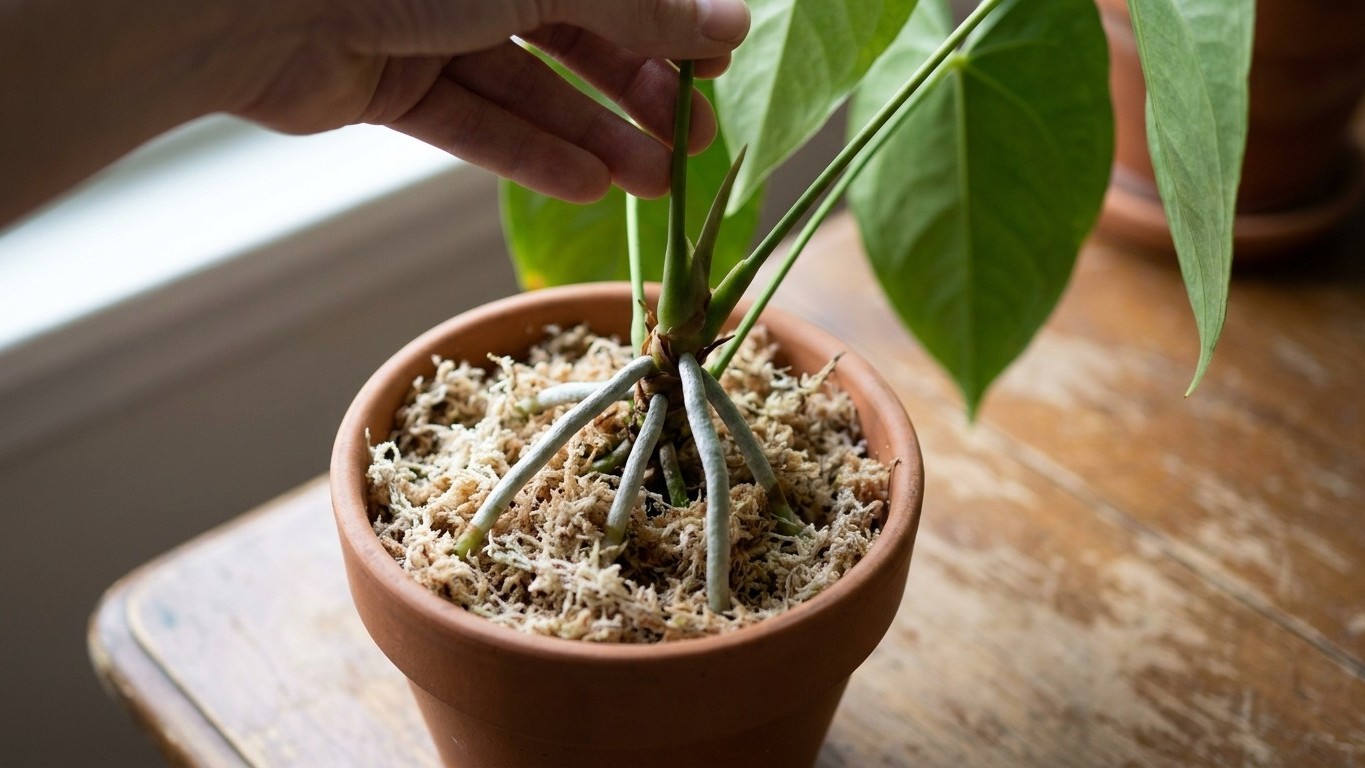
Aerial roots dangling from an anthurium look chaotic. Most people either snip them off or tuck them back into the soil to tidy things up. That’s exactly what I did last May, nudged four thick, grayish roots back into the pot and packed fresh moss around them. Two weeks later, when I gently lifted the plant’s crown to check on a yellowing leaf at the base, I found something that stopped me cold: a dense tangle of new white root tips spreading in every direction, plus the beginnings of two offset shoots I hadn’t even known were forming. Tucking those aerial roots in hadn’t just tidied the plant. It had triggered a burst of subterranean activity that changed how I think about anthurium care entirely.
Key takeaways
- Aerial roots aren’t dead weight—they’re dormant circuits waiting for the right signal to reactivate
- One intervention in May produced two entirely new plants by late summer
- The timing, technique, and humidity window matter far more than most growers realize
What aerial roots actually are (and why they reach outward)
Anthuriums are epiphytes in the wild. Native to the rainforests of Central and South America, they typically grow anchored to tree trunks or rocky ledges, never with their roots buried deep in soil. Those aerial roots aren’t cosmetic anomalies, they’re the plant’s primary system for gathering moisture from humid air and latching onto surfaces for structural support. In a standard home environment, with relative humidity often sitting between 30 and 50 percent, those same roots dry out and hang limply, doing very little.
Here’s where the biology gets interesting. An aerial root doesn’t lose its capacity to absorb nutrients and water just because it’s been dangling in dry air. The root tip stays dormant rather than dead. When it contacts a moist substrate, sphagnum moss, chunky aroid mix, even damp bark, it reactivates. The root begins pulling in moisture almost immediately, and the plant responds to that new input by ramping up growth elsewhere. Think of it like plugging a lamp that’s been unplugged for months: the circuit was complete the whole time, it just needed a connection.
The May timing wasn’t accidental
May is when northern hemisphere indoor plant growers tend to see the biggest shift in ambient light and temperature. Day length increases, window light intensifies, and most tropical houseplants move out of their winter slowdown. For anthuriums specifically, the window between May and early August represents their most active growth period, the time when energy investment in new roots and leaves pays off fastest.
Tucking aerial roots into the substrate during this window gives the plant something to work with right when it’s primed to respond. Doing the same thing in November, when light levels drop and the plant’s metabolism slows, tends to produce much weaker results: the roots may sit in the moss for weeks without showing meaningful growth. The lesson from experienced anthurium growers, a lesson I learned the slow way, is that timing the intervention to match the plant’s active phase multiplies the payoff significantly.
The two-week gap between the tuck and the visual results is also telling. Root extension in anthuriums under good conditions can move at roughly 1 to 2 centimeters per week in active growth. So after 14 days, finding a network of new white tips spreading 2 to 3 centimeters out from the original root insertion points is precisely what the math would predict. The surprising part wasn’t the speed, it was the scale. All four roots had activated, not just one or two.
The offset discovery: what buried roots communicate to the plant
The two offset shoots hiding beneath the crown were the bigger revelation. Anthurium offsets, sometimes called pups, form when the mother plant has enough root capacity and energy reserves to divert resources into a secondary growth point. They typically emerge from the base of the main stem, just below or at soil level. The trigger is often root volume, once the root system hits a certain density relative to pot size, the plant seems to “decide” it can afford to reproduce vegetatively.
By reactivating four aerial roots simultaneously, I had effectively increased the plant’s functional root mass in one move. The plant registered that expanded capacity and, within the same two-week window, began channeling energy toward offset development. This isn’t unique to anthuriums: Monstera, Philodendron, and several Hoya species show similar responses when aerial roots are encouraged into substrate contact. The common thread is that root-to-soil contact signals abundance to the plant, more anchor, more moisture pathways, more reason to grow.
Those offsets, now several months on, have developed their own root systems and can be separated cleanly. Each one already carries two or three leaves. A single tidying gesture in May produced two new plants by late summer.
How to replicate this without damaging the roots
The practical steps are simple, but the details matter. First, don’t force stiff or brittle aerial roots, roots that have dried and hardened can snap under pressure. Rehydrate them by wrapping them loosely in damp sphagnum moss for 24 to 48 hours before attempting to redirect them. Once they’ve softened, they bend without resistance.
When tucking roots into the pot, aim for the outer edge of the existing root ball rather than pushing them straight down into the center. The center of a well-established anthurium pot tends to be dense and compacted; the outer zone has more oxygen and loose substrate for new root tips to navigate. Burying them too deep also risks rot if drainage is imperfect, about 3 to 5 centimeters of depth is enough to establish contact with the moisture layer without smothering the root tip.
One detail that often gets skipped: after tucking, maintain higher humidity around the pot for the first week. A humidity tray, a nearby humidifier, or even daily misting of the soil surface helps the reactivated roots stay moist long enough to establish. Drop the humidity too quickly and the roots may desiccate before they’ve made a proper connection. Anthurium growers who use open terracotta pots report faster aerial root activation than those using glazed ceramic, likely because terracotta wicks moisture outward, keeping the root zone consistently damp without waterlogging the core.