
Every winter, the same ritual: a beloved ficus drops half its foliage, a peace lily sulks, and someone’s prized monstera develops brown edges that no amount of misting can fix. The culprit isn’t always the cold itself, it’s the drafts. That invisible river of freezing air sneaking under the front door, rushing in every time someone grabs the mail, or pooling near a leaky patio slider. Most houseplant advice says “keep away from drafts.” Fine. But what if you can’t? What if the only windowsill with decent light is three feet from a drafty door?
The answer isn’t to give up on plants near entryways. The answer is to stop putting the wrong ones there.
Key takeaways
- Most houseplants fail near drafty doors, but some plants evolved specifically for temperature swings
- Cast iron plants and snake plants shrug off cold air that would devastate a tropical ficus
- Strategic placement and terracotta pot tricks make the difference between survival and thriving
Why drafts kill plants (and why some don’t care)
Cold drafts do two things to sensitive plants. First, they cause rapid temperature fluctuations, a tropical plant sitting near a door might experience a 20-degree temperature swing every time someone walks in from a January afternoon. Second, they accelerate water loss from leaves while simultaneously chilling the roots, creating a kind of confused drought stress where the plant can’t drink fast enough to compensate for what it’s losing through its foliage. Leaf drop follows almost inevitably.
But not every plant evolved in a stable tropical greenhouse. Some come from climates that swing dramatically, coastal zones, high-altitude forests, seasonally arid regions — and their biology is built for fluctuation. These are the plants that shrug at your drafty entryway and just keep growing.
The plants that genuinely hold up near drafty doors
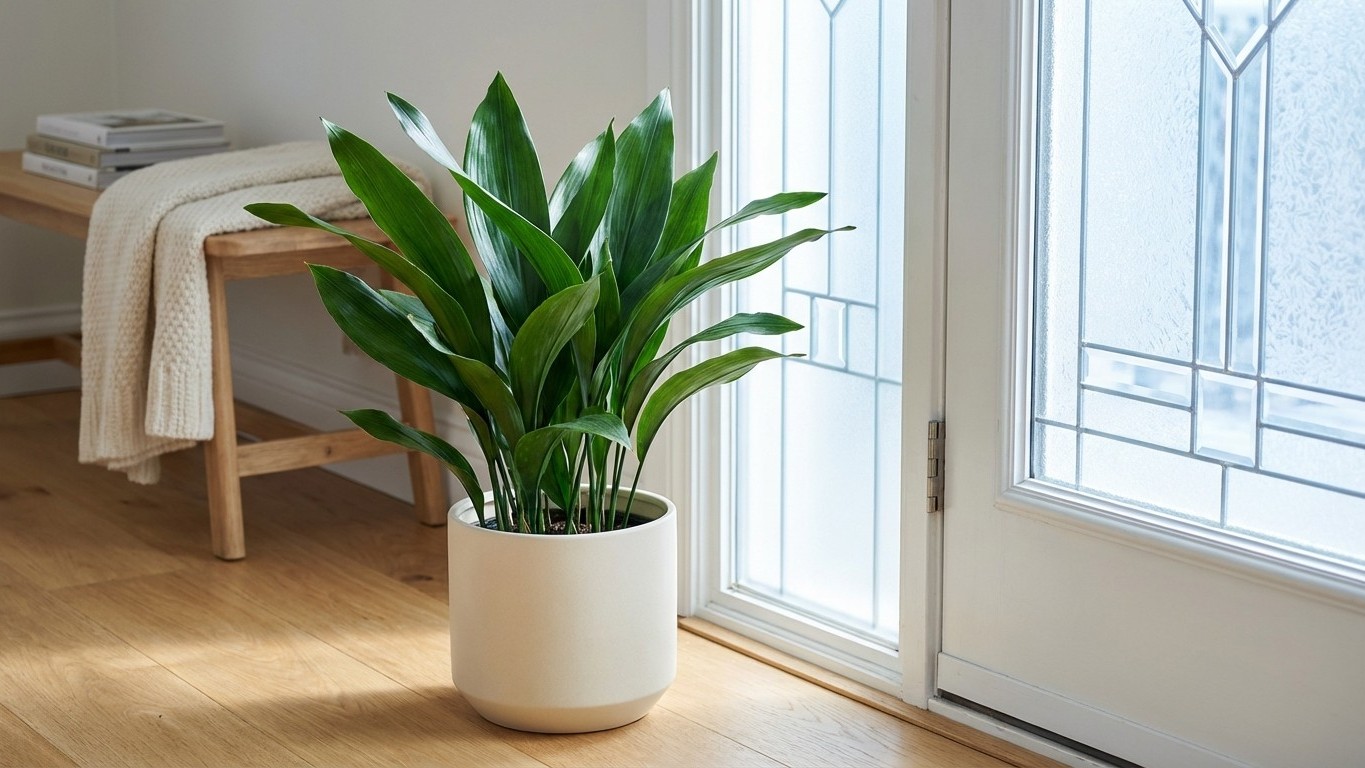
Cast iron plants (Aspidistra elatior) earned their name honestly. Native to the forest floors of China and Japan, they were developed as Victorian parlor plants precisely because Victorian parlors were cold, drafty, and poorly lit. A cast iron plant near a drafty front door is about as close to its natural habitat as you can get in a modern home. It won’t reward you with flashy blooms, but it will stay green, upright, and alive through conditions that would flatten most houseplants.
Snake plants (Dracaena trifasciata, still sold everywhere under the old name Sansevieria) are another strong choice, and probably the most practical one for most households. Their thick, waxy leaves lose water slowly, making them resilient against the drying effect of cold air. They tolerate temperature dips into the low 50s Fahrenheit without complaint, which covers most indoor draft scenarios short of leaving the door wide open in February. One thing to watch: if temperatures are regularly hitting the 40s near your door, even snake plants will start to protest.
ZZ plants (Zamioculcas zamiifolia) store water in their rhizomes underground, which means surface conditions matter far less to them than to most plants. A draft might stress the leaves slightly, but the plant’s reserves keep it stable. Think of it as the camel of houseplants, it’s built for adversity in a way that makes your drafty hallway look like a minor inconvenience.
Pothos varieties, especially golden pothos, tolerate temperature swings better than their vining, tropical appearance suggests. They do prefer warmth, but they bounce back from brief cold exposure more readily than most comparable plants. Keep them in a hanging planter near a drafty door and they’ll often trail right through winter without losing a single leaf, as long as freezing air isn’t directly hitting them for hours at a time.
For something with more visual presence, consider a Fatsia japonica. This plant is technically hardy enough to grow outdoors in USDA zones 8 and above, which means indoor drafts are essentially a non-event for it. Its large, deeply lobed leaves make a genuine statement in an entryway, and it actively prefers cooler conditions, a well-heated house can actually stress it more than a slightly chilly hallway.
What actually matters more than the plant choice
Choosing the right plant is half the equation. The other half is placement and pot management, and most people overlook this completely. A draft-tolerant plant placed directly in the path of airflow from a door gap will still struggle, the goal is proximity, not martyrdom. Positioning a plant a few feet to the side of a door, rather than directly in front of it, reduces direct exposure significantly while still letting you use that corner of the entryway.
Pot choice matters more in drafty spots than anywhere else in the house. Terracotta pots, while breathable and generally excellent, lose heat from the soil faster than plastic or ceramic containers. In a drafty Entryway, that accelerates root chill. A simple workaround: place the terracotta pot inside a slightly larger ceramic or glazed pot with no drainage hole, the air gap between them acts as insulation. It’s a trick that costs nothing and makes a measurable difference in winter.
Watering frequency also needs adjustment. Plants near drafty doors lose leaf moisture faster, but cold soil slows root activity. Watering as you normally would can lead to soggy, cold roots while the leaves are simultaneously dehydrated. The fix is to water less frequently but check the leaves more often, a light misting on the foliage during particularly dry, drafty weeks helps bridge the gap.
Rethinking the entryway entirely
There’s a tendency to treat entryways as afterthoughts in home decor, places where you dump shoes and coats rather than cultivate living things. But the entryway is often the most-visited space in a home, every arrival, every departure passes through it. A thriving cast iron plant or a dramatic fatsia near the front door creates an impression that no coat rack ever could.
The plants that survive your worst conditions, the drafts and the cold and the neglect of a busy hallway, are often the ones that end up meaning the most. There’s something satisfying about a plant that asks almost nothing and gives you green life in return all winter long. The question worth asking is whether your entryway is Actually inhospitable, or whether you’ve just been putting the wrong tenants in it.