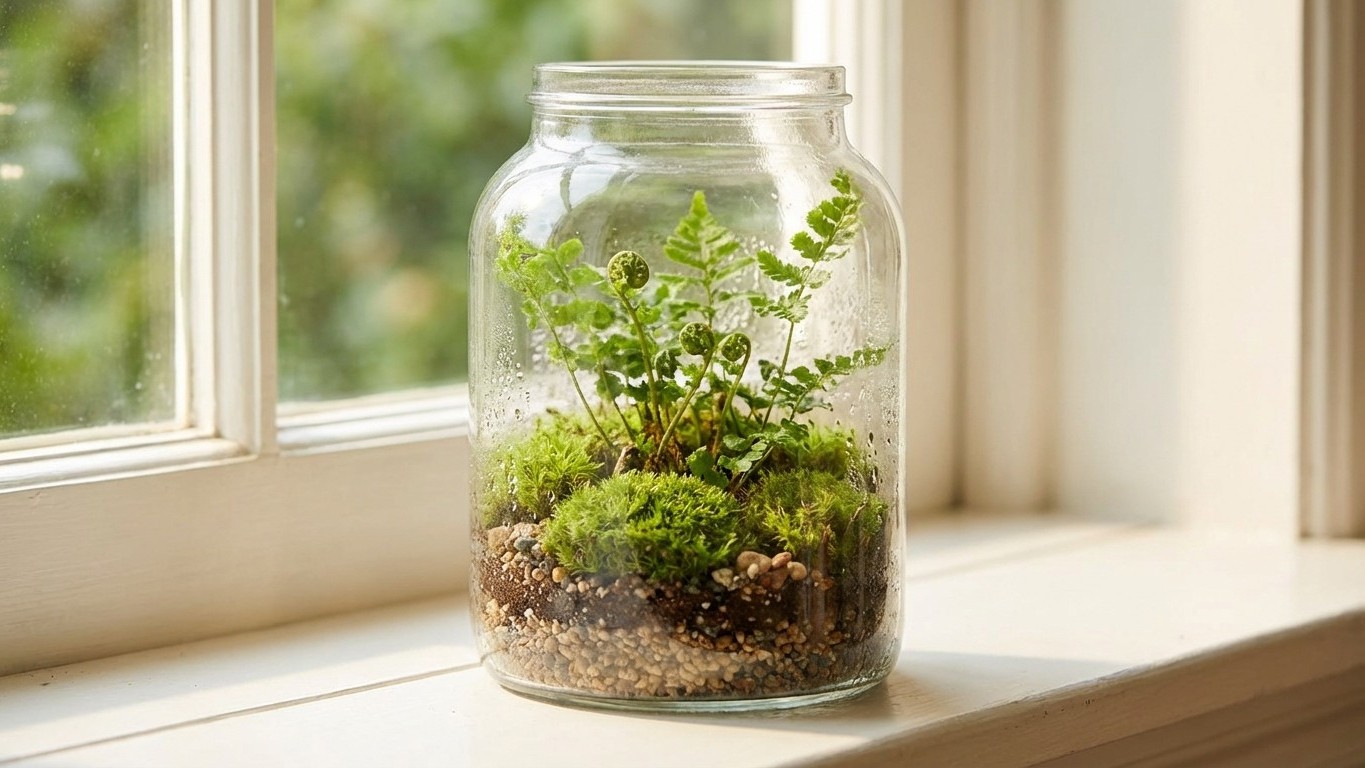
Six months. That’s how long my closed terrarium has been sitting on the windowsill without a single drop of added water. The moss is green, the ferns are pushing out new fronds, and the whole thing looks like a miniature rainforest trapped in glass. The jar cost me Nothing, it was a wide-mouth pickle jar I almost tossed into the recycling bin. If you’ve ever wanted a houseplant that genuinely takes care of itself, this might be the project that Changes how you think about indoor gardening.
Key takeaways
- A closed terrarium creates its own water cycle—transpiration, condensation, and absorption repeat endlessly without your help
- The layering system (gravel, charcoal, moss, soil) is non-negotiable, but the jar itself just needs a snug lid and clear glass
- After setup, the terrarium self-regulates and self-corrects, making it the ultimate low-maintenance houseplant
The Science Behind the Self-Watering Magic
A closed terrarium works because it creates its own water cycle inside a sealed container. Plants release moisture through their leaves in a process called transpiration, that moisture condenses on the glass walls, trickles back down to the soil, and gets absorbed by the roots again. The same water loops through the system indefinitely. Think of it as a miniature version of what Happens between the ocean, clouds, and rainfall, just compressed into a jar you can hold in both hands.
The soil plays a critical role in keeping this cycle stable. Terrarium systems depend on layering, and skipping any layer is the fastest way to end up with a rotting mess instead of a living ecosystem. The bottom layer of gravel or pebbles (about an inch deep) acts as a reservoir, keeping excess water away from plant roots. A thin layer of activated charcoal on top of the gravel keeps the environment from turning sour, neutralizing gases and preventing bacterial buildup. Then comes a layer of horticultural moss to act as a barrier, topped by several inches of good potting mix or a blend specifically formulated for terrariums.
What makes the closed system so forgiving is that mistakes tend to self-correct over time. Add a little too much water at the start? The system will regulate. Miss a week of “maintenance”? There is no maintenance to miss. The jar does the work.
Building the Thing: What Actually Works
The jar matters more than most tutorials admit. A wide opening makes planting much easier, especially when you’re trying to position small ferns with your fingers or a pair of chopsticks pressed into service as makeshift tweezers. Clear glass is better than tinted for light transmission. My pickle jar had a two-inch neck, narrow enough that I spent twenty minutes cursing while placing a clump of moss, but wide enough that it eventually worked. A large mason jar, a glass cookie jar with a tight-fitting lid, or even a repurposed apothecary bottle all work well. The seal doesn’t have to be airtight to the point of vacuum-level perfection — a snug lid that rests flush is enough.
For plants, you want species that thrive in high humidity and low to moderate light. Mosses are essentially foolproof and often free, scoop some from a shaded patch in your yard or a wooded area, check that it’s not from a protected zone, and it will almost certainly adapt. Fittonia (nerve plant), miniature ferns, baby’s tears, and small selaginella varieties all do well inside sealed glass. The one rule worth following religiously: avoid succulents, cacti, or anything that prefers dry conditions. They will rot. Slowly, expensively, and with a certain inevitability that no amount of hope will prevent.
Planting order matters. Start with your layered base, dampen the soil slightly before adding plants (this is the one moment where you control moisture going in), and tuck everything in firmly so roots make good contact with the mix. Leave a little breathing room between plants, they will grow. Once everything is placed, close the lid and set the jar somewhere with bright indirect light. Direct sun turns a terrarium into a tiny greenhouse oven within hours.
Reading the Signs After You Seal It
The first week is the most nerve-racking, mostly because the glass will fog up dramatically. This is normal, borderline exciting, actually. Heavy condensation means the system is active and finding its equilibrium. If you can barely see through the glass at all, crack the lid for a few hours to let some moisture escape, then seal it again. You’re aiming for light condensation on one side of the glass in the morning, clearing by afternoon. That pattern signals a balanced system.
Yellowing leaves usually point to one of two problems: too much water in the initial setup, or too little light. Brown, crispy edges on fern fronds are almost always a light issue, move the jar slightly closer to a window. If you see black or gray mold growing on the soil surface, remove the affected area with a spoon and leave the lid off for 24 to 48 hours before resealing.
One thing nobody mentions in beginner guides: the terrarium will change. Moss spreads. A fern that seemed tiny will unfurl new leaves and press against the glass within a few months. Some plants that seemed compatible will outcompete others. This isn’t failure, it’s succession, the same ecological process that turns a meadow into a forest over decades, just playing out on a windowsill over a few seasons. You can trim or remove plants through the opening when things get crowded. Or you can let it go feral and see what wins.
The Deeper Satisfaction of Doing Less
There’s something quietly subversive about a plant that asks nothing of you. In a culture that rewards constant optimization and daily input, a closed terrarium operates on completely different logic: the less you interfere, the better it does. Most of us were taught that caring for something means tending to it constantly. The terrarium suggests that setting up the right conditions and then stepping back is its own form of expertise.
My pickle jar is still going. The moss has crept up one side of the glass. A fern I didn’t deliberately plant, probably a spore that hitched a ride on the moss, appeared two months in and now dominates one corner. I have done absolutely nothing except watch. Which raises a question worth sitting with: how many other things in the garden, or in life, would do better with the same approach?